



Phenelzine sulfate
Based on 6 publication(s) in Google Scholar
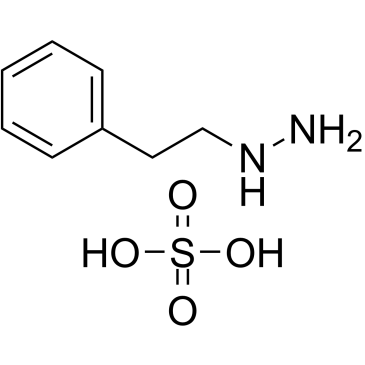
Phenelzine sulfate, an antidepressant agent, is an irreversible and orally active monoamine oxidase (MAO-A and MAO-B) inhibitor. Phenelzine sulfate inhibits GABA transaminase and primary amine oxidase (PrAO), and sequester reactive aldehydes. Phenelzine sulfate also inhibits LSD1 (Ki: 5.6 μM) and suppresses oxidative stress and lipogenesis. Phenelzine sulfate elevates neurotransmitters (serotonin, norepinephrine, dopamine). Phenelzine sulfate is studied in neurological, metabolic and cancer diseases for depression and anxiety disorders, stroke, spinal cord injury, traumatic brain injury, multiple sclerosis, Parkinson’s disease, Alzheimer’s disease, inflammatory pain, obesity and prostate cancer.
For research use only. We do not sell to patients.
- Purity : 99.95%
- CAS No.: 156-51-4
- Formula: C8H14N2O4S
- Molecular Weight:234.27
-
Storage:
4°C, sealed storage, away from moisture
* In solvent : -80°C, 6 months; -20°C, 1 month (sealed storage, away from moisture)

To place orders, for customer services and technical support, please contact: MedChemExpress USA
Tel: 609-228-6898 E-mail: [email protected] [email protected]


-
 Biological Activity
-
Chemical Information
-
Solvent & Solubility
- Purity & Documentation
- References
-
 Help & FAQs


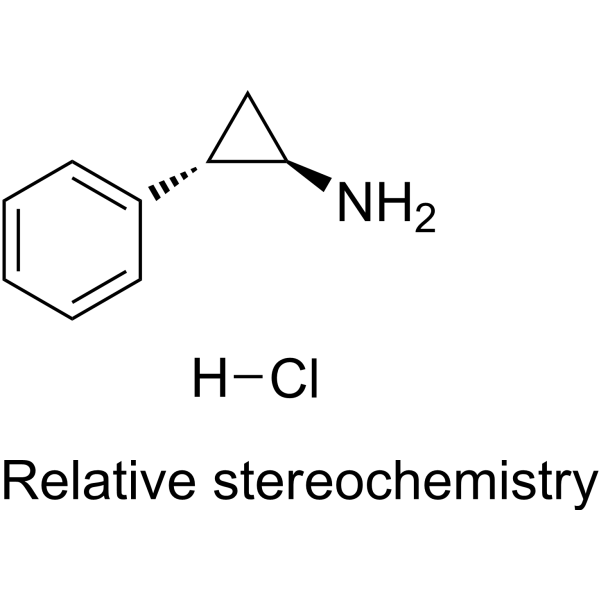
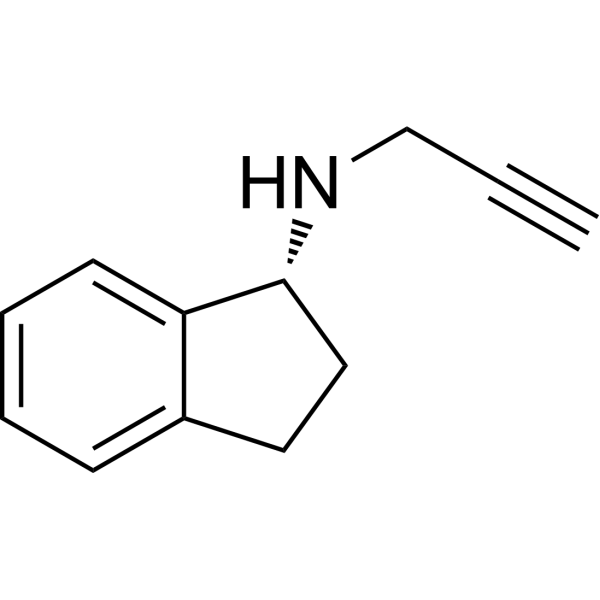
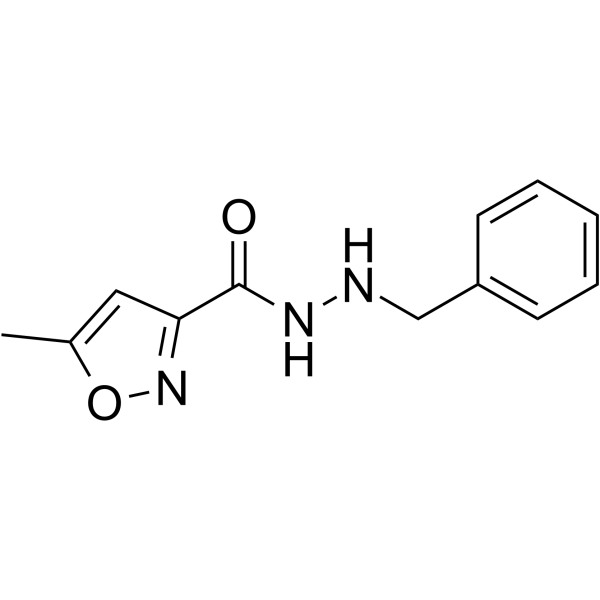
Publications Citing Use of MedChemExpress (MCE) Phenelzine sulfate
More- Nat Commun. 2024 May 7;15(1):3834. [Abstract]
- J Immunother Cancer. 2025 Sep 10;13(9):e011831. [Abstract]
- J Immunother Cancer. 2025 Mar 22;13(3):e010555. [Abstract]
- Neurosci Bull. 2021 Aug;37(8):1160-1175. [Abstract]
- ACS Pharmacol Transl Sci. 2021 Nov 12;4(6):1818-1834. [Abstract]
- Front Neurosci. 2020 May 28:14:458. [Abstract]


Biological Activity
Description
In Vitro
Phenelzine sulfate inhibits recombinant mouse MAOA/MAOB, PIPOX, PCYOX1, ALDH2 and SCRN3 proteins[2].
Phenelzine (80 μM; 48 h; H460) sulfate reduces H460 cell proliferation by less than 50% in a [3H]thymidine incorporation assay[3].
Phenelzine (10-100 μM; 24 h; rat retinal ganglion cells) sulfate reduces 3-Aminopropanal-induced toxicity[1].
Phenelzine (150-300 nmol; 30 min; phosphate-buffered saline) sulfate reduces acrolein levels in vitro[1].
MedChemExpress (MCE) has not independently confirmed the accuracy of these methods. They are for reference only.
-
Cell Line:Rat retinal ganglion cells
-
Concentration:10 μM, 20 μM, 30 μM, 40 μM, 50 μM, 100 μM
-
Incubation Time:24 h
-
Result:LDH release was measured 24 hours after cotreatment with 3-Aminopropanal, showing reduced toxicity.
-
Cell Line:LNCaP
-
Concentration:3 μM, 10 μM, 20 μM, 40 μM
-
Incubation Time:48 h
-
Result:No significant changes in H3K4Me2 or total H3 levels were observed.
-
Cell Line:H460
-
Concentration:80 μM
-
Incubation Time:48 h
-
Result:Less than 50% reduction in 3H-thymidine incorporation.
In Vivo
Phenelzine (15 mg/kg; IP, 15 minutes post-injury) sulfate reduces acrolein and 4-HNE levels and improves recovery in a rat spinal cord injury (SCI) model[1].
Phenelzine (aquarium water) sulfate mitigates paraquat-induced neurotoxicity in zebrafish by reducing oxidative stress and preserving dopamine levels and promotes axonal regrowth and remyelination in a zebrafish SCI model[1].
MedChemExpress (MCE) has not independently confirmed the accuracy of these methods. They are for reference only.
-
Animal Model:Female C57BL/6 micEAE was induced in female C57/BL mice with MOG35-55 (HY-P1240)(subcutaneous injection).[5]
-
Dosage:15 mg/kg
-
Administration:IP; daily, for 28 days
-
Result:Reduced disease severity in the chronic phase and was associated with substantial improvements in exploratory behavior.
Showed a normalization of 5-HT levels in the ventral horn of the spinal cord that might account for the improvements in behavioral outcomes.
-
Animal Model:Rats; traumatic brain injury (TBI) model, induced by controlled cortical impact (CCI-TBI)[1]
-
Dosage:15 mg/kg
-
Administration:IP; once; 15 minutes post-injury
-
Result:Prevented the decrease in respiratory control ratio, increased cortical tissue sparing from 86 to 97%, and reduced 4-HNE levels in mitochondria.
-
Animal Model:Gerbils (male, 8 weeks); global ischemia model, induced by carotid ligation for 5 minutes followed by reperfusion[1]
-
Dosage:15 mg/kg, 30 mg/kg
-
Administration:IP; once daily; 6 days
-
Result:Significantly attenuated neuronal loss in the hippocampal CA1 region compared to ischemia-vehicle gerbils.
-
Animal Model:C57BL/6 mice (male, 9 weeks); no disease model[4]
-
Dosage:31.6 mg/kg
-
Administration:Drinking water; once daily; 12 weeks
-
Result:Exhibited lower body fat content, subcutaneous WAT mass and lipid content in skeletal muscles than control, without decreased body weight gain or food consumption. Phenelzine impaired the lipogenic but not the antilipolytic actions of insulin in WAT.
Lowered MAO activity and hydrogen peroxide release in WAT.
Decreased phosphoenolpyruvate carboxykinase (PEPCK) expression in subcutaneous WAT.
-
Animal Model:C57BL/6 mice (male, 9 weeks); no disease model[4]
-
Dosage:31.6 mg/kg
-
Administration:Drinking water; once daily; 12 weeks
-
Result:Lowered non-fasting blood glucose levels.
Clinical Trial
| NCT Number | Sponsor | Condition | Start Date |
Phase

|
|---|---|---|---|---|
| NCT01329991 | Plexxikon| | 2011-05 | PHASE1 |


Chemical Information
-
CAS No. 156-51-4
-
Appearance Solid
-
Molecular Weight 234.27
-
Formula C8H14N2O4S
-
Color White to off-white
-
SMILES
NNCCC1=CC=CC=C1.O=S(O)(O)=O
-
Shipping
Room temperature in continental US; may vary elsewhere.
-
Storage
4°C, sealed storage, away from moisture
* In solvent : -80°C, 6 months; -20°C, 1 month (sealed storage, away from moisture)


Publications (6)
-
Journal Impact Factor
-
Most Recent
-
Nat Commun
Sleep fragmentation exacerbates myocardial ischemia‒reperfusion injury by promoting copper overload in cardiomyocytes. [Abstract]2024 May 7;15(1):3834. PMID: 38714741 -
J Immunother Cancer
Enhancing immunotherapy efficacy in NSCLC through the combined use of phenelzine and Akkermansia muciniphila to regulate gut microbial metabolite 5-HIAA. [Abstract]2025 Sep 10;13(9):e011831. PMID: 40930748 -
J Immunother Cancer
Inhibition of stromal MAOA leading activation of WNT5A enhance prostate cancer immunotherapy by involving the transition of cancer-associated fibroblasts. [Abstract]2025 Mar 22;13(3):e010555. PMID: 40121032 -
Neurosci Bull
Acrolein Induces Systemic Coagulopathy via Autophagy-dependent Secretion of von Willebrand Factor in Mice after Traumatic Brain Injury. [Abstract]2021 Aug;37(8):1160-1175. PMID: 33939120 -
ACS Pharmacol Transl Sci
Comprehensive in Vitro Characterization of the LSD1 Small Molecule Inhibitor Class in Oncology. [Abstract]2021 Nov 12;4(6):1818-1834. PMID: 34927013 -
Front Neurosci
Adhesion Molecule L1 Agonist Mimetics Protect Against the Pesticide Paraquat-Induced Locomotor Deficits and Biochemical Alterations in Zebrafish. [Abstract]2020 May 28:14:458. PMID: 32547358


Solvent & Solubility
In Vitro:
DMSO : ≥ 100 mg/mL (426.86 mM; Hygroscopic DMSO has a significant impact on the solubility of product, please use newly opened DMSO)
* "≥" means soluble, but saturation unknown.
Please refer to the solubility information to select the appropriate solvent. Once prepared, please aliquot and store the solution to prevent product inactivation from repeated freeze-thaw cycles.
Storage method and period of stock solution: -80°C, 6 months; -20°C, 1 month (sealed storage, away from moisture). When stored at -80°C, please use it within 6 months. When stored at -20°C, please use it within 1 month.
Please refer to the solubility information to select the appropriate solvent. Once prepared, please aliquot and store the solution to prevent product inactivation from repeated freeze-thaw cycles.
Storage method and period of stock solution: -80°C, 6 months; -20°C, 1 month (sealed storage, away from moisture). When stored at -80°C, please use it within 6 months. When stored at -20°C, please use it within 1 month.
Concentration (start) × Volume (start) = Concentration (final) × Volume (final)
In Vivo:
Select the appropriate dissolution method based on your experimental animal and administration route.
- For the following dissolution methods, please ensure to first prepare a clear stock solution using an In Vitro approach and then sequentially add co-solvents:
- To ensure reliable experimental results, the clarified stock solution can be appropriately stored based on storage conditions. As for the working solution for In Vivo experiments, it is recommended to prepare freshly and use it on the same day.
- The percentages shown for the solvents indicate their volumetric ratio in the final prepared solution. If precipitation or phase separation occurs during preparation, heat and/or sonication can be used to aid dissolution.
Add each solvent one by one: 10% DMSO 40% PEG300 5% Tween-80 45% Saline
Solubility: ≥ 2.08 mg/mL (8.88 mM); Clear solution
This protocol yields a clear solution of ≥ 2.08 mg/mL (saturation unknown).
Taking 1 mL working solution as an example, add 100 μL DMSO stock solution (20.8 mg/mL) to 400 μL PEG300, and mix evenly; then add 50 μL Tween-80 and mix evenly; then add 450 μL Saline to adjust the volume to 1 mL.
Preparation of Saline: Dissolve 0.9 g sodium chloride in ddH₂O and dilute to 100 mL to obtain a clear Saline solution.
Add each solvent one by one: 10% DMSO 90% (20% SBE-β-CD in Saline)
Solubility: ≥ 2.08 mg/mL (8.88 mM); Clear solution
This protocol yields a clear solution of ≥ 2.08 mg/mL (saturation unknown).
Taking 1 mL working solution as an example, add 100 μL DMSO stock solution (20.8 mg/mL) to 900 μL 20% SBE-β-CD in Saline, and mix evenly.
Preparation of 20% SBE-β-CD in Saline (4°C, storage for one week): 2 g SBE-β-CD powder is dissolved in 10 mL Saline, completely dissolve until clear.
In Vivo Dissolution Calculator
Please enter the basic information of animal experiments:
-
-
-
-
Recommended: Prepare an additional quantity of animals to account for potential losses during experiments.
Please enter your animal formula composition:
-
%DMSO +
Recommended: Keep the proportion of DMSO in working solution below 2% if your animal is weak.
-
%+
-
+%Tween-80 + +
-
%Saline +
The co-solvents required include: DMSO, . All of co-solvents are available by MedChemExpress (MCE). , Tween 80. All of co-solvents are available by MedChemExpress (MCE).
Working solution concentration: 0.22 mg/mL
Method for preparing stock solution: mg drug dissolved in μL DMSO. Stock solution concentration: mg/mL. * In solvent : -80°C, 6 months; -20°C, 1 month (sealed storage, away from moisture)
1. Take μL DMSO stock solution;
2. Add μL .
μL , mix evenly;
3. Then add μL Tween 80, mix evenly;
4. Then add μL
Please ensure that the stock solution in the first step is dissolved to a clear state, and add co-solvents in sequence. You can use ultrasonic heating (ultrasonic cleaner, recommended frequency 20-40 kHz), vortexing, etc. to assist dissolution.


Purity & Documentation
-
Data Sheet (286 KB)
-
SDS (480 KB)
- English - EN (480 KB)
- Français - FR (480 KB)
- Deutsch - DE (480 KB)
- Norwegian - NO (480 KB)
- Español - ES (480 KB)
- Swedish - SV (480 KB)
- Italian - IT (480 KB)
- Korean - KR (480 KB)
- Portuguese - PT (480 KB)
-
Handling Instructions (2659 KB)
References
[1]. Matveychuk D, et al. Overview of the Neuroprotective Effects of the MAO-Inhibiting Antidepressant Phenelzine. Cell Mol Neurobiol. 2022;42(1):225-242. [Content Brief]
[2]. Bustin KA, et al. Phenelzine-based probes reveal Secernin-3 is involved in thermal nociception. Mol Cell Neurosci. 2023;125:103842. [Content Brief]
[3]. Prusevich P, et al. A selective phenelzine analogue inhibitor of histone demethylase LSD1. ACS Chem Biol. 2014;9(6):1284-1293. [Content Brief]
[4]. Carpéné C, et al. Body fat reduction without cardiovascular changes in mice after oral treatment with the MAO inhibitor phenelzine. Br J Pharmacol. 2018;175(12):2428-2440. [Content Brief]
[5]. Musgrave T, et al. The MAO inhibitor phenelzine improves functional outcomes in mice with experimental autoimmune encephalomyelitis (EAE). Brain Behav Immun. 2011 Nov;25(8):1677-88. [Content Brief]


Complete Stock Solution Preparation Table
Please refer to the solubility information to select the appropriate solvent. Once prepared, please aliquot and store the solution to prevent product inactivation from repeated freeze-thaw cycles.
Storage method and period of stock solution: -80°C, 6 months; -20°C, 1 month (sealed storage, away from moisture). When stored at -80°C, please use it within 6 months. When stored at -20°C, please use it within 1 month.
| Optional Solvent | Concentration Solvent Mass | 1 mg | 5 mg | 10 mg | 25 mg |
|---|---|---|---|---|---|
| DMSO | 1 mM | 4.2686 mL | 21.3429 mL | 42.6858 mL | 106.7145 mL |
| 5 mM | 0.8537 mL | 4.2686 mL | 8.5372 mL | 21.3429 mL | |
| 10 mM | 0.4269 mL | 2.1343 mL | 4.2686 mL | 10.6714 mL | |
| 15 mM | 0.2846 mL | 1.4229 mL | 2.8457 mL | 7.1143 mL | |
| 20 mM | 0.2134 mL | 1.0671 mL | 2.1343 mL | 5.3357 mL | |
| 25 mM | 0.1707 mL | 0.8537 mL | 1.7074 mL | 4.2686 mL | |
| 30 mM | 0.1423 mL | 0.7114 mL | 1.4229 mL | 3.5571 mL | |
| 40 mM | 0.1067 mL | 0.5336 mL | 1.0671 mL | 2.6679 mL | |
| 50 mM | 0.0854 mL | 0.4269 mL | 0.8537 mL | 2.1343 mL | |
| 60 mM | 0.0711 mL | 0.3557 mL | 0.7114 mL | 1.7786 mL | |
| 80 mM | 0.0534 mL | 0.2668 mL | 0.5336 mL | 1.3339 mL | |
| 100 mM | 0.0427 mL | 0.2134 mL | 0.4269 mL | 1.0671 mL |


Phenelzine sulfate Related Classifications
HY-B1018A Related Classifications
 Powered by Bioz
Keywords
- Phenelzine
- 156-51-4
- Monoamine Oxidase
- GABA Receptor
- Histone Demethylase
- lipid content
- monoamine oxidase
- ChIP-seq
- catecholamines
- neurotransmitter amines
- ABPP
- 5-hydroxytryptamine
- stereochemistry
- lipid levels
- cardiac oxidative stress
- tranylcypromine
- cancer cells
- triacylglycerol turnover
- Target discovery
- cardiovascular dysfunction
- enzymes
- Reactive aldehydes
- in vitro
- metabolism
- glucose
- β-Phenylethylidenehydrazine
- body composition
- NMR
- histone methylation
- heart rate variability
- neurodegenerative disease
- hydrogen peroxide
- γ-Aminobutyric acid
- insulin
- obesity-associated complications
- non-selective monoamine oxidase inhibitors
- trace amines
- monoamine oxidase inhibitors
- cardiac sympathovagal balance
- Chemical proteomics
- adipocytes
- antilipogenic
- lipogenic
- antilipolytic
- non-fasting blood glucose
- oxidative stress
- antiadipogenic
- amino acids
- body fat
- MAO activity
- white adipose tissue
- SCRN3
- phosphoenolpyruvate carboxykinase
- Neuroprotection
- receptors
- LSD1 inhibitor
- MAO inhibitor
- HDAC inhibitors
- Monoamine oxidase
- Phenelzine analogue
- subcutaneous WAT
- Inhibitor
- inhibitor
- inhibit