



Ramifenazone

Based on 1 Customer Validation
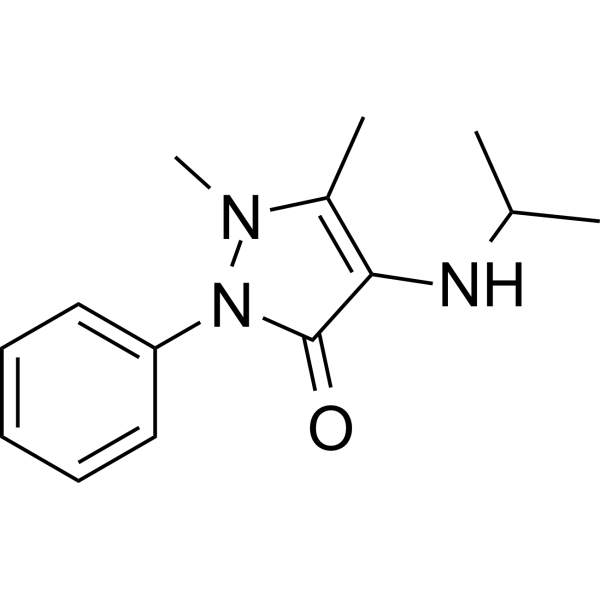
Ramifenazone (Isopropylaminoantipyrine) is a pyrazolone non-steroidal anti-inflammatory agent (NSAID) and a potent COX-2 inhibitor. Ramifenazone exhibits analgesic, antipyretic, anti-inflammatory, and antibacterial activities. Ramifenazone can be used for research on inflammation.
연구목적의 판매만을 진행합니다. 환자를 대상으로 한 판매는 하지 않습니다.
- Purity : 98.99%
- CAS No.: 3615-24-5
- 화학식: C14H19N3O
- 분자량:245.32
-
보관:
4°C, protect from light
* The compound is unstable in solutions, freshly prepared is recommended.

To place orders, for customer services and technical support, please contact: MedChemExpress USA
Tel: 609-228-6898 E-mail: [email protected] [email protected]


-
 Biological Activity
-
Chemical Information
- Protocol
- 순도&문서
- References
-
 Help & FAQs




Biological Activity
제품 설명
IC50 & Target
[3]|
COX-2 |
In Vitro
Ramifenazone is detected and quantified in bovine milk by an LC-MS/MS multi-residue method, with a decision limit of 25 μg/kg and a detection capability of 31 μg/kg, and RMZ in milk exhibits the highest measurement uncertainty (47%), indicating reduced method ruggedness for this compound[4].
MedChemExpress (MCE) has not independently confirmed the accuracy of these methods. They are for reference only.


Chemical Information
-
CAS No. 3615-24-5
-
Appearance Solid
-
분자량 245.32
-
화학식 C14H19N3O
-
Color White to off-white
-
SMILES
O=C1N(C2=CC=CC=C2)N(C)C(C)=C1NC(C)C
-
Synonyms
Isopropylaminoantipyrine
-
선적
Room temperature in continental US; may vary elsewhere.
-
보관
4°C, protect from light
* The compound is unstable in solutions, freshly prepared is recommended.


순도&문서
-
Data Sheet (284 KB)
-
SDS (252 KB)
- English - EN (252 KB)
- Français - FR (252 KB)
- Deutsch - DE (252 KB)
- Norwegian - NO (252 KB)
- Español - ES (252 KB)
- Swedish - SV (252 KB)
- Italian - IT (252 KB)
- Korean - KR (252 KB)
- Portuguese - PT (252 KB)
-
Handling Instructions (2659 KB)
References
[2]. Surendra Kumar R, et al. Anti-inflammatory and antimicrobial activities of novel pyrazole analogues. Saudi journal of biological sciences. 2016 Sep;23(5):614-20. [Content Brief]
[3]. Nehra B, et al. Recent advancements in the development of bioactive pyrazoline derivatives. European journal of medicinal chemistry. 2020 Nov 01;205:112666. [Content Brief]

Calculators
Concentration (start) × Volume (start) = Concentration (final) × Volume (final)


Ramifenazone Related Classifications
HY-B1137 Related Classifications
 Powered by Bioz