



Amyloid-β Ligand
- 1
-
rTRD01
 0 Images
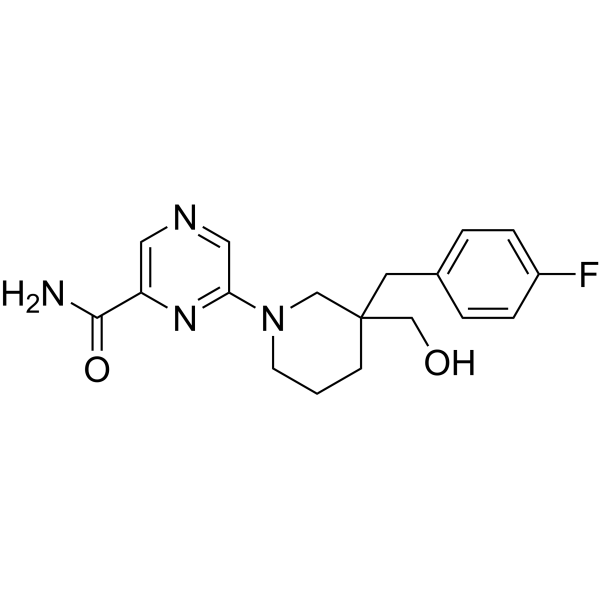
rTRD01 is an orally active, specific TDP-43 binder that targets the RRM1 and RRM2 domains of TDP-43. rTRD01 partially disrupts the interaction between TDP-43 and c9orf72 repeat RNA, but does not affect the binding of TDP-43 to canonical binding sequences. rTRD01 exhibits significant neuroprotective effects in zebrafish models, improves motor function and protects against paraquat (a widely used herbicide)-induced neurodegeneration, with no teratogenicity at high concentrations. rTRD01 is not a general antioxidant and cannot counteract Rotenone (HY-B1756)-induced neuronal death. rTRD01 can be used to study amyotrophic lateral sclerosis and other TDP-43 proteinopathies.
-
Pittsburgh Compound B
 0 ImagesSynonyms: PiB; 6-OH-BTA-1
Pittsburgh Compound B (PiB) is a blood-brain barrier-permeable, specific Aβ deposition PET tracer that binds to Aβ(1-40) fibrils with a Ki value of 678.4 nM. Through click chemical modification (a clickable Pittsburgh Compound B derivative is prepared by introducing a PEG3 linker and an alkynyl group at the 6-hydroxy site of Pittsburgh Compound B, followed by covalent conjugation with azide-labeled fluorescent dyes or affinity tags via copper-catalyzed azide-alkyne cycloaddition (CuAAC)), Pittsburgh Compound B and its conjugates can be used for fluorescence imaging, ultrastructural studies, and enrichment and characterization of Aβ complexes. Pittsburgh Compound B is applicable to Alzheimer's disease research.
-
ACI-19626
 0 ImagesSynonyms: TDP-43-IN-2
ACI-19626 (TDP-43-IN-2) is a TDP-43 aggregation inhibitor that can be used in the research of neurodegenerative diseases.
-
q-FTAA
 0 ImagesCat. No.: HY-148547CAS No.: 1352477-22-5
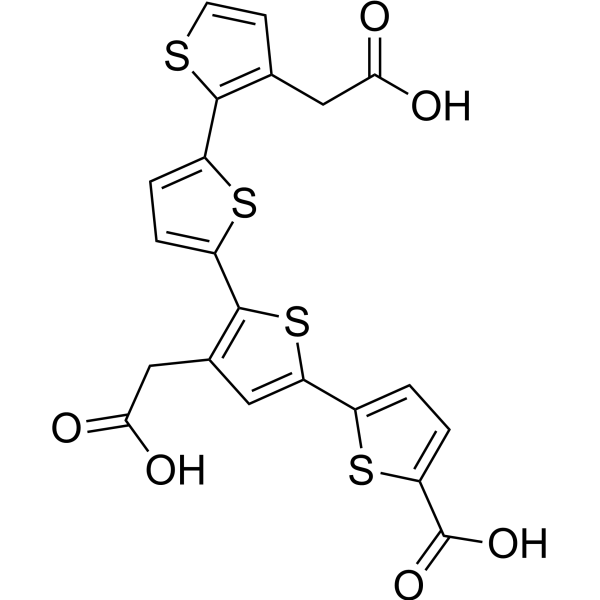
q-FTAA is an oligothiophene. q-FTAA competes for binding to the X-34 binding site on Aβ fibrils. q-FTAA is applicable to research related to Alzheimer's disease.
-
Dalidnetug
 0 ImagesCat. No.: HY-P991130CAS No.: 2991369-43-6
Dalidnetug is a humanized monoclonal antibody targeting human amyloid-beta precursor protein (APP). Dalidnetug specifically binds to APP to reduce the production of amyloid-beta (Aβ), thus exerting the activity of clearing amyloid-beta. Dalidnetug is promising for research of Alzheimer's disease.
-
4-Sulfocalix[4]arene
![4-Sulfocalix[4]arene](https://file.medchemexpress.com/product_pic/hy-w440555.gif "Click to View 4-Sulfocalix[4]arene Product Detail") 0 ImagesCat. No.: HY-W440555CAS No.: 112269-92-8Synonyms: para-Sulfonatocalix[n]arene
0 ImagesCat. No.: HY-W440555CAS No.: 112269-92-8Synonyms: para-Sulfonatocalix[n]arene4-Sulfocalix[4]arene (para-Sulfonatocalix[n]arene) is a amyloid-beta 42 binder with a Kd of 5.39 M. 4-Sulfocalix[4]arene can inhibit amyloid β-peptide fibrillation and reduce amyloid cytotoxicity.
-
AZD-2184
 0 ImagesCat. No.: HY-165470CAS No.: 945400-24-8
AZD-2184 is a β-amyloid (Aβ(1-40)) fibril binder with blood-brain barrier permeability, exhibiting a Kd of 8.4 nM for hAβ(1-40). AZD-2184 binds to the same site as CPIB, shows low levels of non-specific binding to brain tissue, rapidly enters and clears from the brain tissue of normal rats, and binds reversibly to plaques in vivo. The radiolabeled form of AZD-2184 can serve as a PET ligand for the visualization of Aβ deposits. AZD-2184 is applicable to research related to Alzheimer's disease.
-
CDy11
 0 ImagesCat. No.: HY-D3192CAS No.: 2028316-07-4
CDy11 is a fluorescent probe and amyloid-binding dye (λex=590 nm; λem=612 nm), with a Ka of 29 μM for Pseudomonas aeruginosa Fap. CDy11 specifically recognizes amyloid fibrils in bacterial biofilms and exhibits significantly enhanced fluorescence upon binding to the target. CDy11 shows no staining effect on amyloid-deficient mutant strains, planktonic cells or protein monomers. CDy11 supports in vivo imaging of Pseudomonas aeruginosa biofilms in mouse implant and corneal infection models. CDy11 is widely used in studies of Staphylococcus aureus biofilm infections, dental caries, and Pseudomonas aeruginosa-associated implant and corneal infections.
-
PTO-41
 0 ImagesCat. No.: HY-D3220CAS No.: 2408913-88-0
PTO-41 is a blood-brain barrier-permeable near-infrared fluorescent probe that targets β-amyloid oligomers (Aβ Oligomers, AβOs) with a Kd of 349 nM. PTO-41 exhibits low cytotoxicity, high sensitivity to β-amyloid oligomers in in vitro phantom imaging, and can be rapidly cleared from the brain. PTO-41 is applicable to the research of Alzheimer's disease (Ex/Em = 538 nM/680 nM).
-
Shiga-Y51
 0 ImagesCat. No.: HY-D3429CAS No.: 2700202-84-0
Shiga-Y51 is a molecular probe that can cross the blood-brain barrier and selectively bind Aβ oligomers. Shiga-Y51 can be imaged based on fluorine-19 nuclear magnetic resonance imaging (19F-MRI) technology. Shiga-Y51 exhibits extremely strong binding affinity for early to intermediate Aβ oligomers, while having almost no affinity for mature Aβ fibrils. Shiga-Y51 is a derivative of Curcumin (HY-N0005) and can inhibit the binding of Curcumin to Aβ oligomers with an IC50 of 34.61 µM. Shiga-Y51 can be used in research related to Alzheimer's disease.
-
Caprospinol
 0 Images
Caprospinol (SP-233) is a steroid compound candidate based on the structure of 22R-hydroxycholesterol. It has multiple mechanisms of neuroprotection, including binding to β-amyloid protein (Aβ(42)), interacting with the mitochondrial respiratory chain, clearing Aβ(42) monomers, and acting as a σ-1 receptor ligand. It can cross the blood-brain barrier in vivo and restore cognitive impairment, and has the potential to inhibit Alzheimer's disease.
-
Anti-APP/Amyloid beta Antibody (3D6)
 0 ImagesCat. No.: HY-P992157Synonyms: murine version of Bapineuzumab
Anti-APP/Amyloid beta Antibody (3D6) (murine version of Bapineuzumab) is an antibody targeting β-amyloid protein (Aβ) with free Asp1. Anti-APP/Amyloid beta Antibody (3D6) recognizes and binds to the amino acid epitope at positions 1-5 of β-amyloid protein carrying the free Asp1 residue. Anti-APP/Amyloid beta Antibody (3D6) can be used in research related to Alzheimer's disease.
-
BF-158
 0 ImagesCat. No.: HY-167189CAS No.: 682763-67-3
BF-158 is a quinoline-based Tau Protein fluorescent imaging probe that produces specific staining by recognizing the β-sheet structure of paired helical filaments (PHF)/neurofibrillary tangles (NFT) in tau aggregates, with EC50 values of 399 nM and 659 nM for tau fibrils and Aβ1-42 fibrils, respectively. BF-158 preferentially labels NFTs, neuropil threads, and PHF-type neurites. BF-158 is useful for the study and imaging of tau pathology in Alzheimer's disease.
- 1



