



CDK
Cyclin dependent kinase
CDKs (Cyclin-dependent kinases) are serine-threonine kinases first discovered for their role in regulating the cell cycle. They are also involved in regulating transcription, mRNA processing, and the differentiation of nerve cells. CDKs are relatively small proteins, with molecular weights ranging from 34 to 40 kDa, and contain little more than the kinase domain. In fact, yeast cells can proliferate normally when their CDK gene has been replaced with the homologous human gene. By definition, a CDK binds a regulatory protein called a cyclin. Without cyclin, CDK has little kinase activity; only the cyclin-CDK complex is an active kinase.
There are around 20 Cyclin-dependent kinases (CDK1-20) known till date. CDK1, 4 and 5 are involved in cell cycle, and CDK 7, 8, 9 and 11 are associated with transcription.
CDK levels remain relatively constant throughout the cell cycle and most regulation is post-translational. Most knowledge of CDK structure and function is based on CDKs of S. pombe (Cdc2), S. cerevisia (CDC28), and vertebrates (CDC2 and CDK2). The four major mechanisms of CDK regulation are cyclin binding, CAK phosphorylation, regulatory inhibitory phosphorylation, and binding of CDK inhibitory subunits (CKIs).
CDK Isoform Specific Products
-
CDK
(479)
View all products
-
CDK1
(179)
View all products
-
CDK2
(294)
View all products
-
CDK3
(21)
View all products
-
CDK4
(222)
View all products
-
CDK5
(95)
View all products
-
CDK6
(168)
View all products
-
CDK7
(114)
View all products
-
CDK8
(54)
View all products
-
CDK9
(198)
View all products
-
CDK11
(7)
View all products
-
CDK12
(49)
View all products
-
CDK13
(25)
View all products
-
CDK14
(6)
View all products
-
CDK16
(8)
View all products
-
CDK19
(24)
View all products
-
CDC
(21)
View all products
-
CLK
(31)
View all products
-
Pho85
(1)
View all products
-
CDK10
(1)
View all products
-
CDK15
(1)
View all products
-
CDK17
(2)
View all products
-
CDK18
(1)
View all products
-
CDK20
(1)
View all products
-
PITSLRE
(1)
View all products
All Product Categories
-
CDK Inhibitors
(1045)
View all products
-
CDK Agonists
(3)
View all products
-
CDK Antagonists
(2)
View all products
-
CDK Activators
(15)
View all products
-
CDK Modulators
(14)
View all products
-
CDK Degraders
(83)
View all products
-
CDK Controls
(4)
View all products
-
CDK Substrate
(1)
View all products
-
CDK Ligands
(15)
View all products
-
Cyclin-Dependent Kinases (CDKs) Proteins
(81)
View all products
-
Cyclin Dependent Kinase 1 (CDK1) Proteins
(9)
View all products
-
Cyclin-Dependent Kinase 2 (CDK2) Proteins
(11)
View all products
-
Cyclin-Dependent Kinase 3 (CDK3) Proteins
(6)
View all products
-
Cyclin-Dependent Kinase 4 (CDK4) Proteins
(5)
View all products
-
Cyclin-Dependent Kinase 5 (CDK5) Proteins
(5)
View all products
-
Cyclin-Dependent Kinase 6 (CDK6) Proteins
(6)
View all products
-
Cyclin-Dependent Kinase 7 (CDK7) Proteins
(4)
View all products
-
CDK Related Products (1293)
Related Products (1293)

-
Recombinant Proteins (82)
-
Antibodies (42)
-
CDK Isoform Comparison
-
CDK2-IN-28
 0 ImagesCat. No.: HY-161463CAS No.: 3025006-64-5
-
CDK9-IN-26
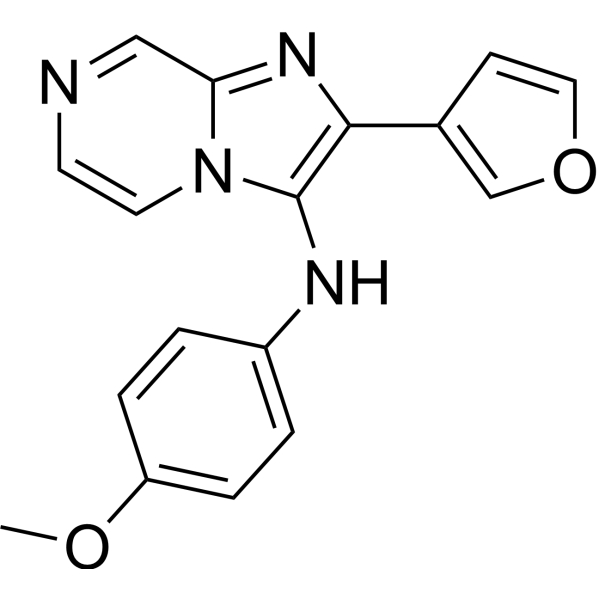 0 ImagesCat. No.: HY-155844CDK9-IN-26 (compound 1is a CDK9 inhibitor (IC50=0.18 μM). .

-
JHK-02-108-2
 0 ImagesCat. No.: HY-184910JHK-02-108-2 is a PROTAC degrader targeting CDK6, with an EC50 of 0.22 μM and a Kd of 1.9 μM. JHK-02-108-2 selectively promotes CRBN-dependent ubiquitination and proteasomal degradation of CDK6. JHK-02-108-2 induces sustained cell cycle arrest at the G1 phase. JHK-02-108-2 reduces the phosphorylation level of retinoblastoma protein. JHK-02-108-2 can be used in research related to acute myeloid leukemia and glioblastoma.


-
WEE1/PKMYT1-IN-4
 0 ImagesCat. No.: HY-183547CAS No.: 3055032-68-0WEE1/PKMYT1-IN-4 is a selective WEE1/PKMYT1 inhibitor, with IC50 values of 0.185 μM and 2.2 nM for human WEE1 and PKMYT1, respectively. WEE1/PKMYT1-IN-4 inhibits phosphorylation of CDK1 at T14 and Y15, disrupting the G2/M cell cycle checkpoint. WEE1/PKMYT1-IN-4 can be used for the research of colorectal cancer and amplified breast cancer.
-
ALK/PI3K/AKT-IN-1
 0 ImagesCat. No.: HY-173007CAS No.: 3050831-84-7ALK/PI3K/AKT-IN-1 (Compound 45) inhibits the proliferation of cancer cell A549, H1975 and PC9 with an IC50 of 0.44, 0.83 and 1.51 μM. ALK/PI3K/AKT-IN-1 increases the expression of p21 and p27, inhibits the activity of CDK2 and p-Rb, arrests the cell cycle at G1 phase. ALK/PI3K/AKT-IN-1 inhibits the ALK/PI3K/AKT signaling pathway, promotes the depolarization of mitochondrial membrane potential, and inducing apoptosis in A549 cell. ALK/PI3K/AKT-IN-1 inhibits the formation and growth of A549 cell spheroids.


-
KW-2478 hydrochloride
 0 ImagesCat. No.: HY-13468ACAS No.: 819812-18-5KW-2478 hydrochloride is an HSP90 inhibitor (IC50 = 3.8 nM). KW-2478 hydrochloride inhibits the growth and induces apoptosis in chronic myeloid leukemia (CML) cells and liver cancer cells. KW-2478 hydrochloride weakens the BCR/ABL and MAPK signaling pathways, leading to increased p27 and p21 expression and decreased cyclin B1 expression. KW-2478 hydrochloride downregulates STAT3 expression. KW-2478 hydrochloride may be used in research on cancers such as CML and liver cancer.
-
NUAK1-IN-2
 0 ImagesCat. No.: HY-172128NUAK1-IN-2 (Compound 24) is a NUAK1 (IC50 of 3.162 nM) and CDK2/4/6 inhibitor. NUAK1-IN-2 can be used in cancer, neurodevelopmental disorders and Alzheimer's disease research.
-
CDK12-Cyclin K Ligand-Linker Conjugates 1
 0 ImagesCat. No.: HY-176791CDK12-Cyclin K Ligand-Linker Conjugates 1 is an Target Protein Ligand-Linker Conjugate that incorporates a ligand for CDK12-Cyclin K (HY-176790) and a PROTAC linker (HY-W244922), which recruits E3 ligases. CDK12-Cyclin K Ligand-Linker Conjugates 1 can be used for synthesis of PROTAC PP-C8 (HY-144691).
-
CDK9-IN-44
 0 ImagesCat. No.: HY-178499CDK9-IN-44 (Compound 7) is a selective CDK9 inhibitor (IC50=7.6 μM). CDK9-IN-44 inhibits CDK9/cyclin T1 kinase activity, blocking transcriptional elongation, reducing the expression of pro-cancer proteins (such as MCL1, c-MYC), and inducing tumor cell apoptosis. CDK9-IN-44 is promising for research of glioblastoma (GBM) and central nervous system (CNS) disorders.
-
CDK2-IN-51
 0 ImagesCDK2-IN-51 is a pyrazolopyridine derivative, a CDK2 inhibitor with an IC50 of 23.47 nM. CDK2-IN-51 does not have a pro-apoptotic effect and had no significant effect on CDK2 protein expression. CDK2-IN-51 reduces expression of DNA replication factors (Polα, MCM7, ORC2, and ORC4) and pre-G1 cell cycle arrest. CDK2-IN-51 can be used for the research of colorectal cancer.
-
CLK1/2-IN-2
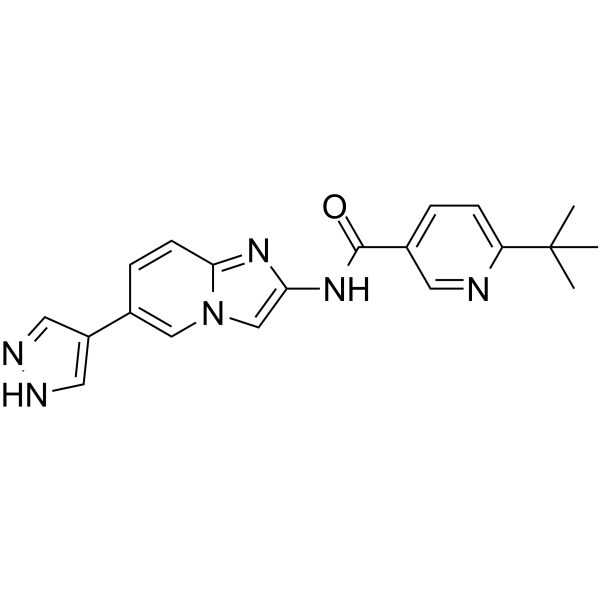 0 ImagesCLK1/2-IN-2 is CLK1 and CLK2 inhibitor with IC50 values of 1.1 nM and 2.4 nM, respectively. CLK1/2-IN-2 exhibits potent anti-cancer activities[1].

-
Carbonic anhydrase-IN-35
 0 ImagesCat. No.: HY-175638Carbonic anhydrase-IN-35 is a selective carbonic anhydrase (CA) inhibitor. Carbonic anhydrase-IN-35 potently inhibits tumor-associated hCA IX (Ki = 0.6 nM) and hCA XII (Ki = 2.2 nM). Carbonic anhydrase-IN-35 induces apoptosis in MCF-7 cells by elevating Bax, reducing Bcl-2, and downregulating CDK4/6. Carbonic anhydrase-IN-35 exhibits potent cytotoxicity against MCF-7 (IC50 = 0.3975 μM normoxic/0.6575 μM hypoxic), MCF-7-ADR (IC50> = 0.3975 μM normoxic/4.488 μM hypoxic), MDA-MB-231, and 4T1 breast cancer cells. Carbonic anhydrase-IN-35 can be used for the study of breast cancer.
-
CDK10/CycQ Recombinant Human Active Protein Kinase
 0 ImagesCat. No.: HY-E70657CDK10/CycQ Recombinant Human Active Protein Kinase is a cyclin-dependent kinase, which is important for neural development and can act as a tumour suppressor.
-
CDK-IN-16
 0 ImagesCat. No.: HY-170507CDK-IN-16 (Compound 5g) is a CDK2/cyclin A2 inhibitor with an IC50 of 1.67 μM. CDK-IN-16 exhibits anticancer activity. The IC50 of CDK-IN-16 against the AGS cell line is 3.5 μM.




