



MAP3K
MAP kinase kinase kinase, MEKK, MAPKKK
MAP3Ks (Mitogen-activated protein kinase kinase kinases), the top components of MAPK cascades, provide specificity for stimulus-dependent activation of MAP2K-MAPK pathways through unique protein-protein interactions and phosphorylation of signaling effectors. The MAP3Ks are highly divergent in gene numbers and structure, including TAK1, ASK1, A-Raf and C-Raf.
MAPK system is a three-step sequential phosphorylation cascade which is composed of MAPK, MAP2K, and MAP3K. ERK, p38 MAPK, and JNK, which are known to be activated by mechanical stimuli, belong to the MAPK family. MAP3Ks function as “platforms to integrate MAPK signaling, and activation of multiple MAP3Ks provides the spatiotemporal regulation of the MAPK pathways, which induces a wide range of physiological responses required for determining cell fate, such as cytokine production, survival, differentiation and apoptosis”.
MAP3K Isoform Specific Products
-
MAP3K
(37)
View all products
-
MAP3K7/
TAK1 (11)View all products
-
MAP3K8/
COT/ (4)Tpl2 View all products
-
MAP3K6/
ASK2 (1)View all products
-
MAP3K5/
ASK1 (15)View all products
-
MAP3K12/
DLK/ (2)Pref-1 View all products
-
MAP3K13/
LZK (3)View all products
-
MAP3K1
(1)
View all products
-
NIK/
MAP3K14 (1)View all products
All Product Categories
-
MAP3K Related Products (87)
Related Products (87)

-
Antibodies (11)
-
MAP3K Isoform Comparison
-
DLK-IN-2
 0 ImagesCat. No.: HY-181662CAS No.: 883012-32-6DLK-IN-2 is a selective inhibitor of DLK and neuroprotective agent. DLK-IN-2 shows no significant inhibition against CYPs 3A4, 2D6 and 2C9. DLK-IN-2 inhibits acute axonal palmitoylation of DLK, blocks DLK-dependent pro-degenerative axon-to-soma retrograde signaling and suppresses c-Jun phosphorylation. DLK-IN-2 can be used for the mechanistic study of neurodegenerative diseases.
-
Anti-inflammatory agent 102
 0 ImagesCat. No.: HY-172871CAS No.: 3053104-47-2Anti-inflammatory agent 102 (Compound 11a) is an orally active anti-inflammatory agent. Anti-inflammatory agent 102 exerts its anti-inflammatory effect by blocking the activation of the ASK1/p38 MAPKs/NF-κB signaling pathway. Anti-inflammatory agent 102 has significant anti-inflammatory activity and can inhibit the release of NO, ROS, and inflammatory factors (such as IL-6, TNF-α, IL-1β). Anti-inflammatory agent 102 can be used in the study of inflammatory diseases such as ulcerative colitis (UC).
-
KAI-11101
 0 ImagesCat. No.: HY-170484KAI-11101 is the inhibitor for dual leucine zipper kinase (DLK, MAP3K12) with a Ki of 0.7 nM. KAI-11101 inhibits Paclitaxel (HY-B0015)-induced cJun phosphorylation (IC50=95 nM) and thus inhibits the activation of MAPK pathway. KAI-11101 is blood brain barrier penetrable and can be further investigated for its neuroprotective property.
-
Selonsertib hydrochloride
 0 ImagesCat. No.: HY-18938ACAS No.: 1448428-05-4Synonyms: GS-4997 hydrochlorideSelonsertib hydrochloride (GS-4997 hydrochloride) is an orally bioavailable enzyme inhibitor with potential anti-inflammatory, anti-tumor and anti-fibrotic activities. Selonsertib hydrochloride blocks ASK1 phosphorylation and activation by binding to the catalytic kinase domain. Selonsertib hydrochloride prevents the production of inflammatory cytokines and reduces the expression of genes associated with fibrosis. Selonsertib hydrochloride inhibits excessive apoptosis and limits cell proliferation.
-
Cot inhibitor-3
 0 ImagesCat. No.: HY-169153CAS No.: 1984784-12-4Cot inhibitor-3 (Compound 33) is a potent and selective cancer osaka thyroid (COT) kinase inhibitor, with an IC50 of 4 nM. Cot inhibitor-3 can be used to prevent inflammation-driven lameness.
-
N-Acetylgalactosaminyltransferase 4
 0 ImagesCat. No.: HY-E70291Synonyms: GALNT4N-Acetylgalactosaminyltransferase 4 (GALNT4) is a glycosyltransferase capable of inhibiting the activation of ASK1. By directly binding to ASK1, N-Acetylgalactosaminyltransferase 4 suppresses its N-terminal dimerization and subsequent phosphorylation, leading to robust inactivation of downstream JNK/p38 and NF-κB signals, and thereby improving the prognosis of liver surgery.
-
Cot-IN-5
 0 ImagesCat. No.: HY-159074CAS No.: 1798303-75-9Cot-IN-5 (compound 1) is a potent ATP-competitive inhibitor of cancer osaka thyroid (COT). Cot-IN-5 can block COT kinase autophosphorylation.
-
Tpl2 Kinase Inhibitor 1 hydrochloride
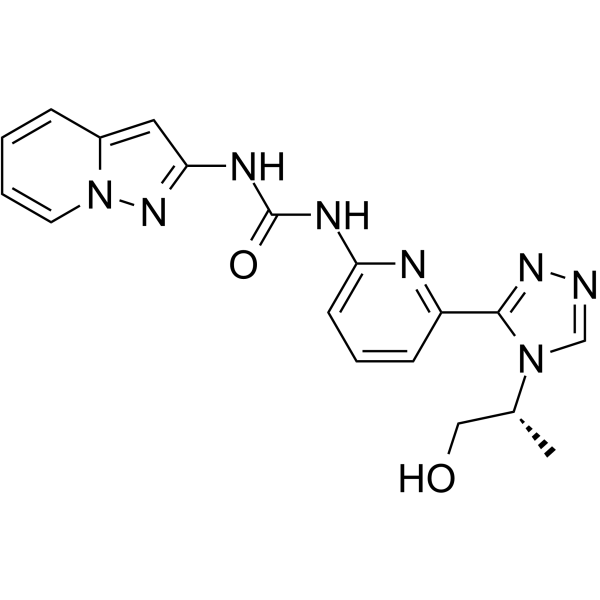
 0 ImagesCat. No.: HY-12358ACAS No.: 2934185-09-6Tpl2 Kinase Inhibitor 1 hydrochloride is a 3-pyridylmethylamino analog, and is a selective Tpl2 inhibitor (IC50=50 nM). Tpl2 consists of COT kinase and MAP3K8. Tpl2 Kinase Inhibitor 1 hydrochloride plays an important role in the regulation of the inflammatory response and the progression of some cancers.
-
MAP3K1-IN-1
 0 ImagesCat. No.: HY-208723CAS No.: 2345648-39-5MAP3K1-IN-1 is an orally active and selective MAP3K1 kinase inhibitor. MAP3K1-IN-1 blocks TNFα-induced phosphorylation of IKKβ and activation of NF-κB. MAP3K1-IN-1 inhibits the growth of cancer cells. MAP3K1-IN-1 induces a decrease in phosphorylation sites of NPM1. MAP3K1-IN-1 can be used in pancreatic cancer-related research.
-
MSC 2032964A
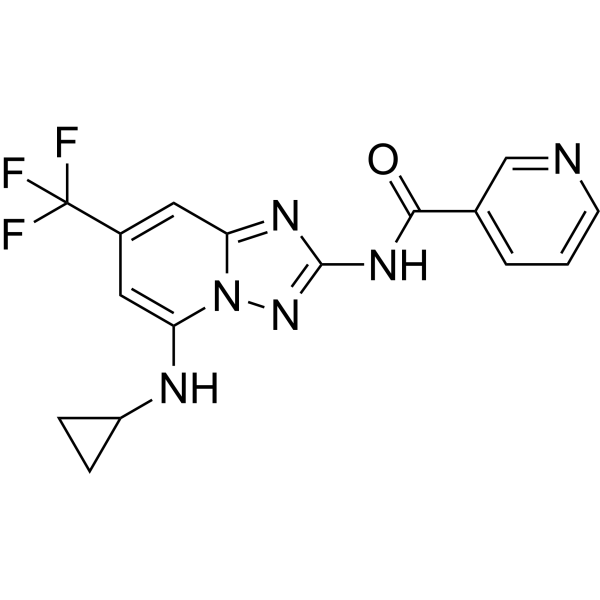 0 ImagesCat. No.: HY-110262CAS No.: 1124381-43-6
-
TAO Kinase-IN-3
 0 ImagesTAO Kinase-IN-3 is a potent pan-TAOK (Thousand-And-One Kinase) inhibitor that specifically binds to and inhibits the kinase activities of TAOK1, TAOK2 and TAOK3 with Kd values of <0.17 nM, 0.34 nM, and 0.17 nM, respectively. TAO Kinase-IN-3 can be used to study Alzheimer's disease, primary tauopathies and related syndromes. In addition, TAO Kinase-IN-3 is also widely used in research on the mechanisms of cancer cachexia and the muscle atrophy it induces.
-
Higenamine-d4-1 hydrochloride
 0 ImagesCat. No.: HY-N2037AS1Synonyms: Norcoclaurine-d4-1 hydrochloride; Demethyl-Coclaurine-d4-1 hydrochlorideHigenamine-d4-1 (Norcoclaurine-d4-1) hydrochloride is deuterium labeled Higenamine (hydrochloride). Higenamine hydrochloride is a selective LSD1 inhibitor (IC50=1.47 μM) that can be isolated from aconite. Higenamine hydrochloride has anti-inflammatory and antibacterial activity. Higenamine (Norcoclaurine) can attenuate IL-1β-induced Apoptosis through ROS-mediated PI3K/Akt signaling pathway. Higenamine hydrochloride protects brain cells from oxygen deprivation. Higenamine can promote bone formation in osteoporosis through the SMAD2/3 pathway. Higenamine hydrochloride can be used to study cancer, inflammation, cardiorenal syndrome and other diseases.
-
TC ASK 10 (Standard)
 0 ImagesCat. No.: HY-103258RCAS No.: 1005775-56-3TC ASK 10 (Standard) is the analytical standard of TC ASK 10 (HY-103258). This product is intended for research and analytical applications. TC ASK 10 (Compound 10) is a potent, selective and orally active apoptosis signal-regulating kinase 1 (ASK1) inhibitor with an IC50 of 14 nM. The inhibitory activities of TC ASK 10 towards other representative panel of kinases are less than 50%, except for ASK2 (IC50 of 0.51 μM).
-
NG25 (Standard)
 0 ImagesCat. No.: HY-15434RCAS No.: 1315355-93-1NG25 (Standard) is the analytical standard of NG25. This product is intended for research and analytical applications. NG25 is a potent dual TAK1 and MAP4K2 inhibitor, with IC50s of 149 nM and 21.7 nM, respectively.

-
Phosphocreatine disodium (Standard)
 0 ImagesCat. No.: HY-D0885BRCAS No.: 922-32-7Synonyms: Disodium creatine phosphate (Standard)Phosphocreatine (disodium) (Standard) is the analytical standard of Phosphocreatine (disodium). This product is intended for research and analytical applications. Phosphocreatine (disodium) is an organic compound found in vertebrate skeletal muscles. Phosphocreatine (disodium) enhances antioxidant activity, and activates the TAK1 pathway to protect the heart. Phosphocreatine (disodium) normalizing mitochondrial function and reducing oxidative stress via Akt mediated Nrf2/HO-1 pathway. Phosphocreatine (disodium) provides renal protection by suppressing Apoptosis and ROS (Reactive Oxygen Species) generation through ERK mediated mediated Nrf-2/HO-1 pathway..
-
Higenamine hydrochloride (Standard)
 0 ImagesSynonyms: Norcoclaurine hydrochloride (Standard)Higenamine (hydrochloride) (Standard) is the analytical standard of Higenamine (hydrochloride). This product is intended for research and analytical applications. Higenamine hydrochloride is a selective LSD1 inhibitor (IC50=1.47 μM) that can be isolated from aconite. Higenamine hydrochloride has anti-inflammatory and antibacterial activity. Higenamine (Norcoclaurine) can attenuate IL-1β-induced Apoptosis through ROS-mediated PI3K/Akt signaling pathway. Higenamine hydrochloride protects brain cells from oxygen deprivation. Higenamine can promote bone formation in osteoporosis through the SMAD2/3 pathway. Higenamine hydrochloride can be used to study cancer, inflammation, cardiorenal syndrome and other diseases.
-
GS-444217 (Standard)
 0 ImagesCat. No.: HY-100844RCAS No.: 1262041-49-5
-
ASK1-IN-5
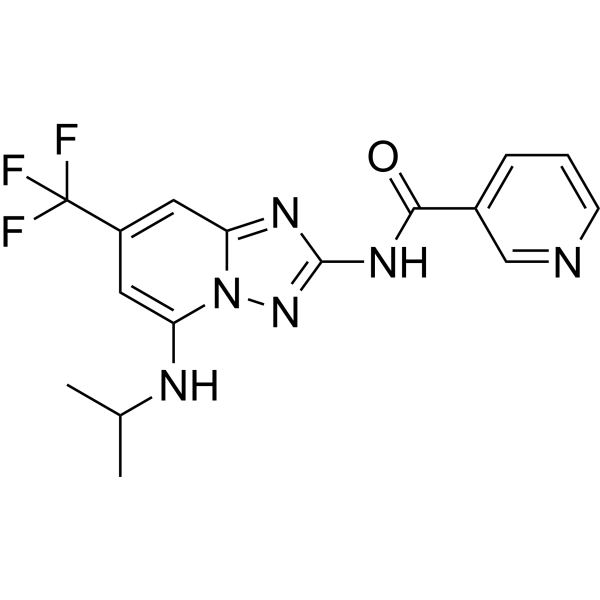 0 ImagesCat. No.: HY-18297CAS No.: 1124381-69-6




