



URAT1
Urate transporter 1; SLC22A12
URAT1, a member of the OAT (organic anion transporter) family was first cloned from the human kidney, where it is localized to the apical (brush border) membrane of renal proximal tubular cells. URAT1 mediates the reabsorption of uric acid, thereby regulating blood uric acid concentrations. Impairment in URAT1 activity, either due to polymorphisms, or drug-drug interactions, can have toxicological consequences. In the kidney, URAT1 is distributed along the renal tubular cell membrane and involved in reabsorption and excretion of uric acid, organic acids, drugs and their metabolites. Uric acid is taken up by OAT1 and OAT3 from the blood and reabsorbed into renal tubular cells via URAT1, in exchange for dicarboxylic acid. URAT1, along with OAT4 mediates uptake of uric acid from the renal tubule into renal tubular cells in exchange for organic anions such as lactic acid and nicotinic acid. This exchange is electroneutral and can be trans-stimulated by Cl- gradients and gradients of lactate transported by the sodium-monocarboxylate transporter. In the salivary glands, URAT1 is distributed along the entire surface, including the ductal and acinar cells, suggesting a role in the transport of organic acids and uric acid in the whole salivary gland.
All Product Categories
-
URAT1 Related Products (48)
Related Products (48)

-
URAT1 inhibitor 11
 0 ImagesCat. No.: HY-168740CAS No.: 2416416-13-0URAT1 inhibitor 11 (Compound 7) is a URAT1 inhibitor with an IC50 value of 0.18 μM. URAT1 inhibitor 11 exhibits potent hypouricemic effects in hyperuricemic zebrafish induced by Potassium oxonate (HY-17511) and Xanthine sodium salt (HY-W017389).
-
URAT1&XO inhibitor 3
 0 ImagesCat. No.: HY-159581CAS No.: 2089040-93-5URAT1&XO inhibitor 3 (compound 27) is an orally active anti-gout agent targeting XO (IC50: 35 nM) and URAT1 (IC50: 31 nM). URAT1&XO inhibitor 3 has good pharmacological and pharmacokinetic (PK) characteristics and in vivo safety.
-
HC-1310
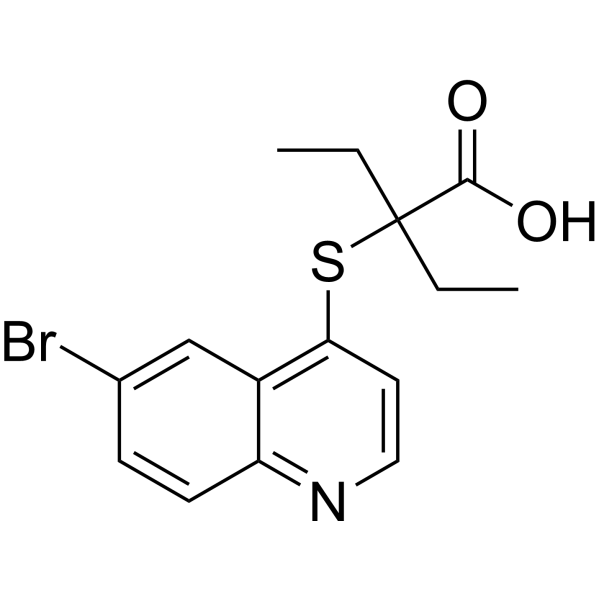 0 ImagesCat. No.: HY-157306CAS No.: 2101230-88-8HC-1310 URAT1 Inhibitor (Compound 83) is a potent URAT1 inhibitor and can be used for research on hyperuricemia and gout.
-
Epaminurad hydrochloride
 0 ImagesCat. No.: HY-111345ACAS No.: 1198153-46-6Synonyms: UR-1102 hydrochloride; URC-102 hydrochlorideEpaminurad (UR-1102) hydrochloride is an orally active, potent and selective URAT1 (urate transporter 1) inhibitor, with a Ki of 0.057 μM. Epaminurad hydrochloride quite modestly inhibits OAT1 and OAT3 (organic anion transporter). Epaminurad hydrochloride is a uricosuric agent. Epaminurad hydrochloride can be used for gout and hyperuricemia research.
-
URAT1-IN-14
 0 ImagesCat. No.: HY-175309CAS No.: 2516232-89-4URAT1-IN-14 is a potent and orally active Urate transporter 1 (URAT1) inhibitor. URAT1-IN-14 inhibits the human URAT1 in HEK293 cells with an IC50 of 0.72 μM. URAT1-IN-14 exhibits low cytotoxic in Hep-G2 cells. URAT1-IN-14 shows urate-lowering effect in hyperuricemia mouse models. URAT1-IN-14 can be used for the study of hyperuricemia and gout.
-
Verinurad (Standard)
 0 ImagesSynonyms: RDEA3170 (Standard)Verinurad (Standard) is the analytical standard of Verinurad. This product is intended for research and analytical applications. Verinurad (RDEA3170) is a highly potent and specific URAT1 inhibitor with an IC50 of 25 nM.
-
Digallic acid
 0 ImagesDigallic acid is an antioxidant, antimutagenic, antigenotoxic, and anti-hyperuricemic compound. Digallic acid is a reverse transcriptase and XOD, URAT1 (IC50: 5.34 μM) inhibitor. Digallic acid scavenges DPPH· and O2·− radicals. Digallic acid induces apoptosis. Digallic acid can be isolated from the fruits of Pistascia lentiscus.
-
Benzarone (Standard)
 0 ImagesBenzarone (Standard) is the analytical standard of Benzarone. This product is intended for research and analytical applications. Benzarone is a potent human uric acid transporter 1 (hURAT1) inhibitor, with an IC50 of 2.8 μM in oocyte. Benzarone could lower uric acid serum levels.



