



Biochemical Assay Reagents
Biochemical agents refers to the life science research related to biological material or organic compounds. Due to a wide range of life sciences, rapid development, and therefore a wide variety of such agents, complex in nature. There are electrophoresis reagents, chromatography reagents, centrifuged reagents, immunological reagent, labeled reagent, staining agents, penetration agents and carcinogens variable, insecticides, culture, buffering agents, electron microscopy reagents, protein and nucleic acid precipitating agent, condensing agent ultrafiltration membrane, clinical diagnostic reagents, dyes, antioxidants, preservatives, detergents and surfactants, standard biochemical reagents, biochemical reagents quality control materials, separation material, etc..
All Product Categories
-
Biochemical Assay Reagents Inhibitors
(10)
View all products
-
Biochemical Assay Reagents Modulator
(1)
View all products
-
Biochemical Assay Reagents Chemicals
(7)
View all products
-
Biochemical Assay Reagents Inducer
(1)
View all products
-
Biochemical Assay Reagents Controls
(59)
View all products
-
Biochemical Assay Reagents Substrates
(4)
View all products
-
Biochemical Assay Reagents Ligands
(2)
View all products
-
Biochemical Assay Reagents Related Products (16057)
Related Products (16057)

-
Antibodies (44)
-
DSG-PEG2000-R6H4
 0 ImagesCat. No.: HY-189162ASynonyms: DSG-PEG2000-Mal-Cys-RRRRRRHHHHDSG-PEG2000-R6H4 (DSG-PEG2000-Mal-Cys-RRRRRRHHHH) is a functionalized PEGylated phospholipid conjugate composed of three modular components: distearoylglycerol (DSG) as a lipid anchoring group, a polyethylene glycol (PEG) spacer arm with a molecular weight of 2000 Da, and an R6H4 peptide as a terminal targeting/functional ligand. DSG-PEG2000-R6H4 can be used in studies such as pH-responsive tumor-targeting drug delivery.
-
Biotin-PEG5000-maleimide
 0 ImagesCat. No.: HY-W1048661ABiotin-PEG5000-maleimide is a PEG derivative consisting of a linear PEG chain with biotin attached to one end and maleimide modified to the other end. Biotin-PEG5000-maleimide anchors drugs or targeting ligands to liposomes or polymer nanocarriers through the maleimide end, and the biotin end is used for in vitro purification or in vivo targeted release.
-
4-S-β-D-Glucopyranosyl-4-thio-D-glucose
 0 ImagesCat. No.: HY-W009078CAS No.: 80951-92-44-S-β-D-Glucopyranosyl-4-thio-D-glucose is a class of biochemical reagents used in glycobiology research. Glycobiology studies the structure, synthesis, biology, and evolution of sugars. It involves carbohydrate chemistry, enzymology of glycan formation and degradation, protein-glycan recognition, and the role of glycans in biological systems. This field is closely related to basic research, biomedicine, and biotechnology.
-
Phenylmethyl 2,3,6-tris-O-(phenylmethyl)-α-D-galactopyranoside
 0 ImagesCat. No.: HY-W792146CAS No.: 53929-38-7Phenylmethyl 2,3,6-tris-O-(phenylmethyl)-α-D-galactopyranoside is a class of biochemical reagents used in glycobiology research. Glycobiology studies the structure, synthesis, biology, and evolution of sugars. It involves carbohydrate chemistry, enzymology of glycan formation and degradation, protein-glycan recognition, and the role of glycans in biological systems. This field is closely related to basic research, biomedicine, and biotechnology.
-
3-(imidazol-5-yl)Lactate dehydrogenase
 0 ImagesCat. No.: HY-E716303-(Imidazol-5-yl)lactate dehydrogenase (EC 1.1.1.111) belongs to the oxidoreductase family; it is an enzyme that acts on the CH-OH group of a donor molecule, using NAD+ or NADP+ as the acceptor.
-
M6 glycan (Man6), 2-AA labelled
 0 ImagesCat. No.: HY-158511Synonyms: Mannose-6 N-linked oligosaccharide, 2-AA labelled; Oligomannose 6 glycan, 2-AA labelledM6 glycan (Man6), 2-AA labelled (Mannose-6 N-linked oligosaccharide, 2-AA labelled; Oligomannose 6 glycan, 2-AA labelled) is a N-polysaccharide protein and a multifunctional fluorescent linker. The resulting conjugates exhibit high sensitivity and specificity by mimicking the antennal elements of N-glycans.
-
Boric Acid Buffer Solution, 0.05 M, pH 8.0
 0 ImagesCat. No.: HY-182590CBoric Acid Buffer Solution, 0.05 M, pH 8.0 is a standard buffer solution, also known as borate buffer. It is mainly composed of boric acid and borax, with a pH of 8.0 and a final borate concentration of 0.05 M.
-
9-Hydroxyundecanoyl-CoA
 0 ImagesCat. No.: HY-CE01456Synonyms: 9-Hydroxyundecanoyl-coenzyme A9-Hydroxyundecanoyl-CoA (9-Hydroxyundecanoyl-coenzyme A) is a coenzyme A derivative.
-
PLLA1000-PEG5000-ALK
 0 ImagesCat. No.: HY-167404PLLA1000-PEG5000-ALK is a polylactic acid derivative that can form micelles in water. PLLA1000-PEG5000-ALK can be used in drug delivery research.

-
Thymolphthalein complexone
 0 ImagesCat. No.: HY-W110908CAS No.: 1913-93-5Thymolphthalein complexone is a biochemical reagent.
-
Tanacetin
 0 ImagesTanacetin is a sesquiterpenoid compound discovered in the whole herb of Crossostephium chinense (L.) Makino. Sesquiterpene lactones, the class to which Tanacetin belongs (e.g., constituents of plants in the Tanacetum genus), inhibit the inflammatory mediators prostaglandins and leukotrienes. Tanacetin crosses intestinal cell monolayers primarily via transcellular passive diffusion, and no significant first-pass metabolism occurs during its intestinal absorption. Tanacetin is used in research related to diabetes, migraine, and rheumatoid arthritis.

-
FA-PEG400-Cholesterol
 0 ImagesCat. No.: HY-W1052178ESynonyms: Folate-PEG400-CholesterolFA-PEG400-Cholesterol (Folate-PEG400-Cholesterol) is a multifunctional drug delivery system composed of Folic acid (HY-16637), polyethylene glycol (PEG), and Cholesterol (HY-N0322). Folic acid (FA) has a high affinity for folic acid receptors and can be used to target cell membrane receptors for drug delivery. Cholesterol can improve the circulation time of encapsulated drugs.
-
15-Keto-ETE-CoA
 0 ImagesCat. No.: HY-CE00916Synonyms: 15-Keto-ETE-coenzyme A15-Keto-ETE-CoA (15-Keto-ETE-coenzyme A) is an oxo-fatty acyl-CoA.
-
Cholesterol-PEG600-Cholesterol
 0 ImagesCat. No.: HY-W1123933ASynonyms: CLS-PEG600-CLSCholesterol-PEG600-Cholesterol (CLS-PEG600-CLS) is a cholesterol-modified PEG derivative. Cholesterol-PEG600-Cholesterol can be combined with liposomes to form nanolipid carriers for drug delivery.
-
6-Arm-PEG1000-FA
 0 ImagesCat. No.: HY-174960BSynonyms: 6-Arm-PEG1000-Folate6-Arm-PEG1000-FA (6-Arm-PEG1000-Folate) is a PEG derivative modified with Folic acid (HY-16637). Polyethylene glycol can increase solubility and stability and reduce the immunogenicity of peptides and proteins. It can also inhibit the nonspecific binding of charged molecules to modified surfaces. Folic acid (-FA) has a high affinity for folate receptors and can be used for cell membrane receptors for targeted drug delivery.
-
Sialyl lewis x-lactose
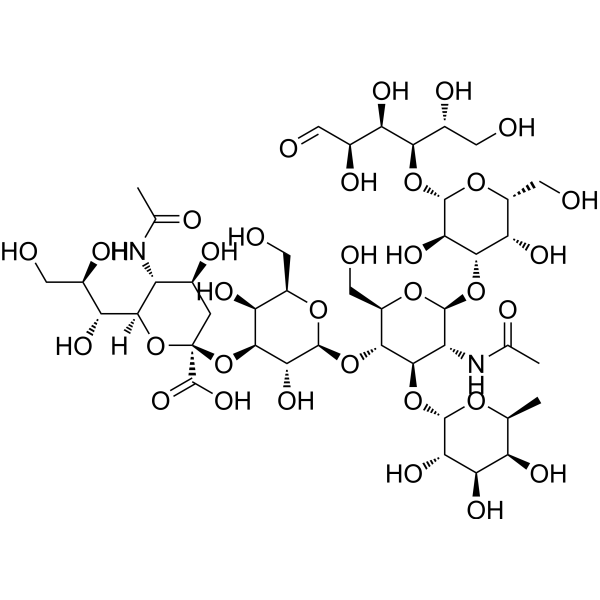 0 ImagesCat. No.: HY-W145535CAS No.: 127923-85-7Sialyl Lewis X-Lactose is a biochemical reagent that can be used as a biological material or organic compound for life science related research.
-
Bezafibroyl-CoA
 0 ImagesCat. No.: HY-CE01230CAS No.: 109881-30-3Synonyms: Bezafibroyl-coenzyme ABezafibroyl-CoA (Bezafibroyl-coenzyme A) is a coenzyme A derivative.
-
1-Alkylglycerophosphocholine O-acyltransferase
 0 ImagesCat. No.: HY-E713771-Alkylglycerophosphocholine O-acyltransferase (EC 2.3.1.63) is an acyltransferase involved in the biosynthesis of ether lipids.




