



Fluorescent Dye
Fluorescence is a phenomenon of photoluminescence in luminescence. When an atom is irradiated by light, some electrons around the nucleus jump from their original orbitals to higher energy orbitals under the influence of light energy, i.e., from the ground state to the first or second excited single-line state, etc. Due to the instability of the first or second excited singlet state, the electron returns from the excited singlet state to the ground state accompanied by released energy, resulting in fluorescence.
Fluorescent dyes can be covalently bound or physically adsorbed in the structure of the substance. The fluorescence properties allow for the characterization, localization and quantitative analysis of the labeled object. Fluorescent dyes have shown great potential for the detection of proteins, nucleic acids, cells, and immunoassays, attributed to the advantages in non-radioactive contamination, simple experimental operation and easy observation.
Fluorescent dyes have penetrated many fields such as pharmacology, physiology, environmental science, and information science, as well as functional studies of proteins and drug screening.
All Product Categories
-
Fluorescent Dye Related Products (4914)
Related Products (4914)

-
Antibodies (4)
-
1,8-Dinitroanthraquinone
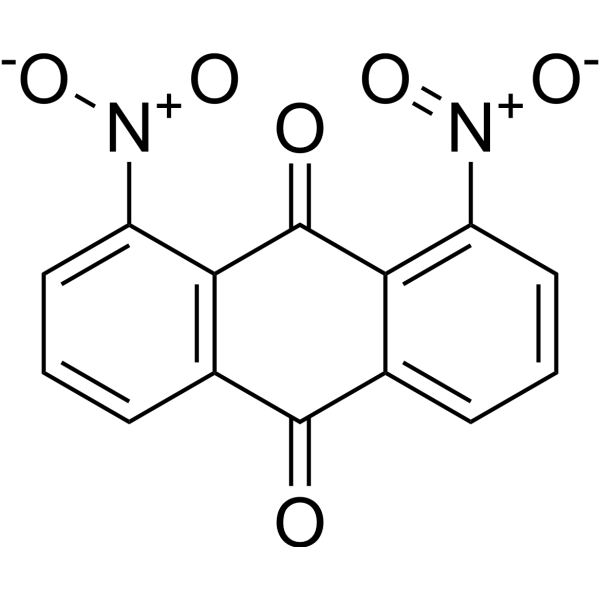 0 Images1,8-Dinitroanthraquinone is a multifunctional dye. Dyes are important tools in biological experiments. They can help researchers observe and analyze cell structures, track biomolecules, evaluate cell functions, distinguish cell types, detect biomolecules, study tissue pathology and monitor microorganisms. Their applications range from basic scientific research to clinical A wide range of diagnostics. Dyes are also widely used in traditional fields such as textile dyeing, as well as in emerging fields such as functional textile processing, food pigments and dye-sensitized solar cells.
-
Fluorescent red NIR 880
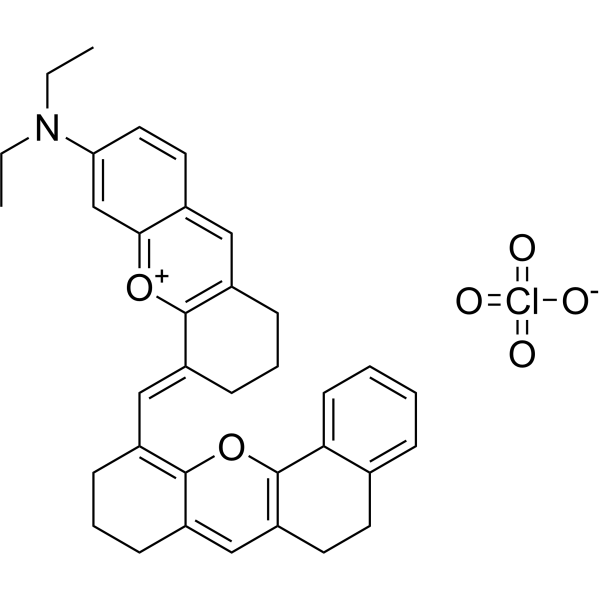 0 ImagesCat. No.: HY-D1495CAS No.: 177194-52-4Synonyms: DY 880Fluorescent red NIR 880 is a fluorescent dye.
-
AF488-PEG12-DBCO
 0 ImagesCat. No.: HY-D3575AF488-PEG12-DBCO is a derivative of Alexa Fluor 488 featuring a DBCO (dibenzocyclooctyne) group for copper-free click chemistry (SPAAC). It incorporates a PEG12 linker to enhance hydrophilicity and provide increased spacer length. AF488-PEG12-DBCO is primarily used for copper-free click chemistry (SPAAC) bioconjugation (Ex/Em = 495/519 nm).
-
Sulfo-cyanine5 dimethyl
 0 ImagesCat. No.: HY-D3324CAS No.: 1208223-69-1Sulfo-cyanine5 dimethyl is a derivative of sulfonated Cyanine5 featuring dimethylindole substituents, which enhance photostability. It can be used for fluorescent labeling and detection (Ex/Em = 650/670 nm).
-
Cyanine7.5 carboxylic acid chloride
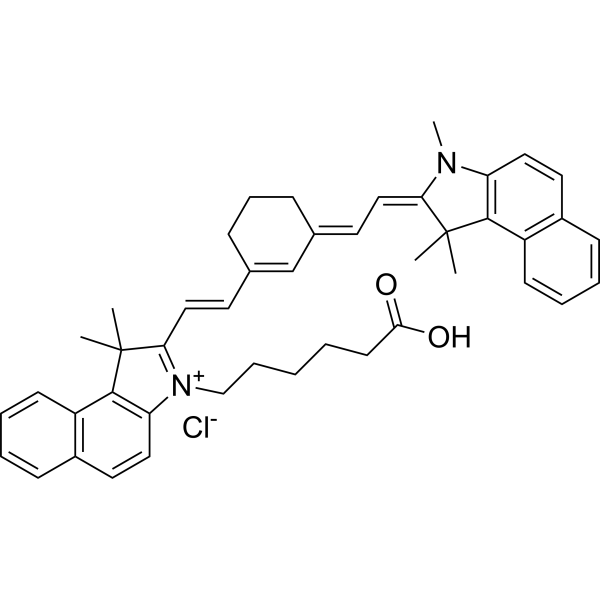 0 ImagesCat. No.: HY-D1317CAS No.: 1803099-44-6Cyanine7.5 carboxylic acid chloride is a dye derivative of Cyanine 7.5 (Cy7.5) (HY-D0926) with carboxylic acid functional groups. Cy7.5 is a near-infrared fluorescent dye commonly used in biomedical research areas such as biomarkers and cell imaging. Cyanine7.5 carboxylic acid chloride can be covalently bound to some biological molecules (especially antibodies, proteins, etc.) to track their location and dynamic changes in biological samples.

-
Ehrlich's Reagent
 0 ImagesCat. No.: HY-DY2030Ehrlich's Reagent is an indicator with p-dimethylaminobenzaldehyde (HY-Y0015) as its core component. Ehrlich's Reagent is mainly used for the identification of enterobacteria, non-fermentative bacteria, fastidious bacteria and anaerobic bacteria, as well as the detection of indole derivatives and amines. It turns pink, red or purple when a positive reaction occurs. Ehrlich's Reagent undergoes colorimetric reactions with urobilinogen, indican, phenol, allantoin, tryptophan and uric acid, and forms yellow-green products when reacting with sulfur derivatives.

-
JHIT2e aptamer sodium
 0 ImagesCat. No.: HY-160059JHIT2e aptamer sodium is a molecular probe based on the aptamer JHIT2 of human liver cancer cell line HepG2 cells. JHIT2e aptamer sodiu retains the ability to specifically bind HepG2 and can deliver fluorescent materials or radionuclides to tumors.
-
MBCB
 0 ImagesCat. No.: HY-D3117CAS No.: 2146114-18-1MBCB is a two-photon Fluorescent probe for dual-detection of mitochondrial SO₂ derivatives and viscosity. For SO₂ derivatives detection, the probe utilizes a Michael addition mechanism: nucleophilic addition of SO₂ derivatives to the C=C bond between the carbazole skeleton and 3-methylbenzothiazolium moiety destroys the strong intramolecular charge transfer (ICT) system between these groups, while enhancing the weak ICT system between the benzothiazole group and carbazole framework; this causes the red emission at 600 nm to decrease and the blue emission at 434 nm to increase, creating a ratiometric response based on the I₄₃₄ₙₘ/I₆₀₀ₙₘ intensity ratio. For viscosity detection, in low-viscosity environments, steric hindrance creates a twisted ICT (TICT) system with weak fluorescence, while in high-viscosity environments, intramolecular rotation is blocked, the TICT state is disrupted, and the strong ICT system is recovered, leading to a strong red emission at 567 nm with negligible change to the short-wavelength emission at 415 nm, creating a ratiometric response based on the I₅₆₇ₙₘ/I₄₁₅ₙₘ intensity ratio that has a logarithmic linear relationship with viscosity. The probe has excitation/emission wavelengths of Ex/Em = 351/434, 600 nm for SO₂ derivatives detection and Ex/Em = 351/567 nm for viscosity detection, with two-photon excitation at 740 nm for bioimaging; it also exhibits good mitochondrial targeting ability with a Pearson's colocalization coefficient of 0.93 when paired with Mito-Tracker Green. The probe shows high sensitivity and selectivity for SO₂ derivatives, has low cell cytotoxicity, and can be applied to detect exogenous/endogenous HSO₃⁻ in living cells and in vivo, as well as visualize mitochondrial viscosity changes induced by nystatin[1].
-
8-Bromo TNP-GTP tetrasodium
 0 ImagesCat. No.: HY-173530Synonyms: 8-Bromo TNP-Guanosine 5'-triphosphate tetrasodium8-Bromo TNP-GTP (8-Bromo TNP-Guanosine 5'-triphosphate) tetrasodium is a fluorescent TNP-GTP analogue with a TNP fluorophore and a bromo group at the 8-position. 8-Bromo TNP-GTP tetrasodium can be used to analyze the binding activity of GTP-binding proteins (such as Ras and Gα subunits).
-
Cy3 labled Rosomidnar sodium
 0 ImagesCat. No.: HY-153494ECy3 labled Rosomidnar sodium is a Cy3 labled Rosomidnar sodium.

-
ATTO 565 alkyne
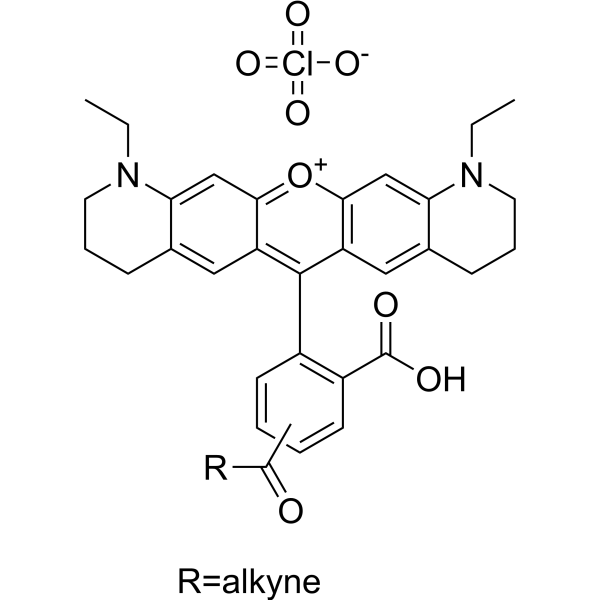 0 ImagesCat. No.: HY-D2014ATTO 565 alkyne is a new fluorescent marker based on the Rhodamine structure. It has strong absorption, high fluorescence quantum yield, high thermal stability and photochemical stability, and is suitable for single molecule detection and high-resolution microscopy. ATTO 565 alkyne is an alkyne derivative of ATTO 565 and can be used to label proteins or antibodies.
-
Cy3 labled S2.2 aptamer sodium
 0 ImagesCat. No.: HY-160062CCy3 labled S2.2 aptamer sodium is a Cy3 labled S2.2 aptamer sodium.
-
AF 568 azide
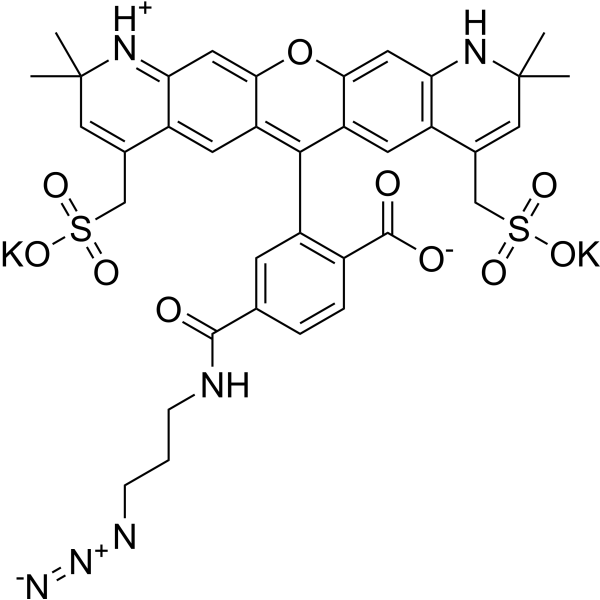 0 ImagesCat. No.: HY-D2168AF 568 azide is an azide derivative of the orange fluorescent dye AF 568. AF 568 has an absorption wavelength of 590-720 nm (FRET) and an emission wavelength of 515-720 nm. AF 568 alkyne can undergo copper-catalyzed azide-alkyne cycloaddition (CuAAc) via the Azide group and molecules containing Alkyne groups. Strain-promoted alkyne-azide cycloaddition (SPAAC) can also occur with molecules containing DBCO or BCN groups. To achieve specific coupling of dye labels and biomolecules.
-
FAM labled ISIS 14803 sodium
 0 ImagesCat. No.: HY-153837DFAM labled ISIS 14803 sodiumis a FAM labled ISIS 14803 sodium.
-
Fura PE-3 potassium
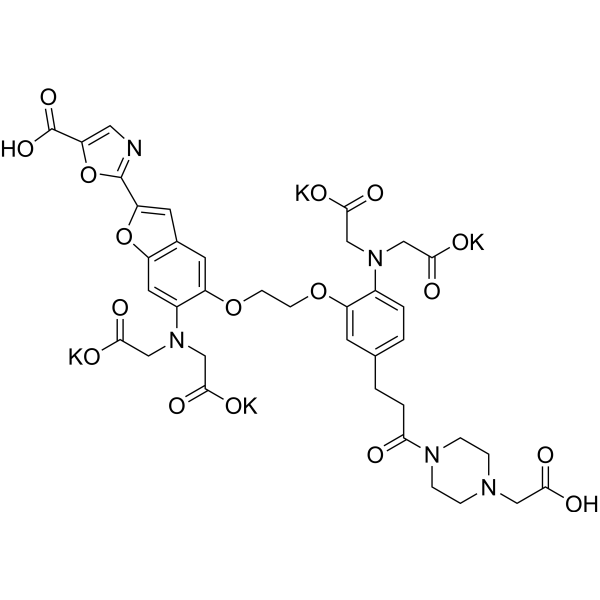 0 ImagesCat. No.: HY-D1501CAS No.: 172890-83-4Fura PE-3 potassium is a Ca2+sensitive fluorophore. Fura PE-3 potassium loads in IPA (intrapulmonary arteries) and MA (mesenteric resistance arteries) for the research of vasoconstriction.

-
DMA-SiRd
 0 ImagesCat. No.: HY-D3368DMA-SiRd is a fluorescent probe that can be used for crosstalk-free dual-channel imaging of lipid droplets and mitochondria, mapping of lipid microenvironment heterogeneity, and imaging of lipid droplet-mitochondria interactions. DMA-SiRd has two imaging channels: Ex/Em = 633/650-750 nm and Ex/Em = 546/570-620 nm, with two-photon excitation wavelengths of 1040 nm and 1200 nm for brain imaging. DMA-SiRd can be applied to the research of atherosclerosis.




