



Fluorescent Dye
Fluorescence is a phenomenon of photoluminescence in luminescence. When an atom is irradiated by light, some electrons around the nucleus jump from their original orbitals to higher energy orbitals under the influence of light energy, i.e., from the ground state to the first or second excited single-line state, etc. Due to the instability of the first or second excited singlet state, the electron returns from the excited singlet state to the ground state accompanied by released energy, resulting in fluorescence.
Fluorescent dyes can be covalently bound or physically adsorbed in the structure of the substance. The fluorescence properties allow for the characterization, localization and quantitative analysis of the labeled object. Fluorescent dyes have shown great potential for the detection of proteins, nucleic acids, cells, and immunoassays, attributed to the advantages in non-radioactive contamination, simple experimental operation and easy observation.
Fluorescent dyes have penetrated many fields such as pharmacology, physiology, environmental science, and information science, as well as functional studies of proteins and drug screening.
All Product Categories
-
Fluorescent Dye Related Products (4914)
Related Products (4914)

-
Antibodies (4)
-
Rhodamine B-Dextran chloride (MW 500000)
 0 ImagesCat. No.: HY-D3047IRhodamine B-Dextran (chloride) (MW 500000) is a Rhodamine B (HY-Y0016)-labeled dextran with a molecular weight of 500000. Rhodamine B-Dextran (chloride) (MW 500000) is a fluorescent dye used to track the diffusion of macromolecules in ex vivo human skin. Rhodamine B-Dextran (chloride) (MW 500000) is delivered to skin layers via the Nanopatch microneedle array, which physically disrupts the stratum corneum and dermal-epidermal junction barriers to deposit the dye directly into epidermal and dermal regions; fluorescence is detected via multiphoton microscopy, and fluorescence intensity is assumed to be roughly proportional to dye concentration.
-
DCM-KPV
 0 ImagesCat. No.: HY-D3210CAS No.: 2098632-04-1DCM-KPV is a fluorescent probe targeting the human intestinal oligopeptide transporter PEPT1/SLC15A1 receptor (λex=480 nm, λem=620-670 nm). DCM-KPV specifically binds to PepT1 via its KPV domain and mediates receptor-targeted internalization, thus effectively accumulating in the cytoplasm and nucleus of cells overexpressing this receptor. DCM-KPV has the advantages of long emission wavelength, high emission efficiency, low photobleaching, and negligible cytotoxicity. DCM-KPV maintains stable fluorescence intensity under continuous illumination, exhibiting extremely high live cell compatibility. DCM-KPV can specifically accumulate at colonic inflammatory sites through the intestinal mucosa, enabling direct non-invasive visual differentiation between chronic and acute ulcerative colitis groups and the normal group.
-
Fluorescein-12-dATP
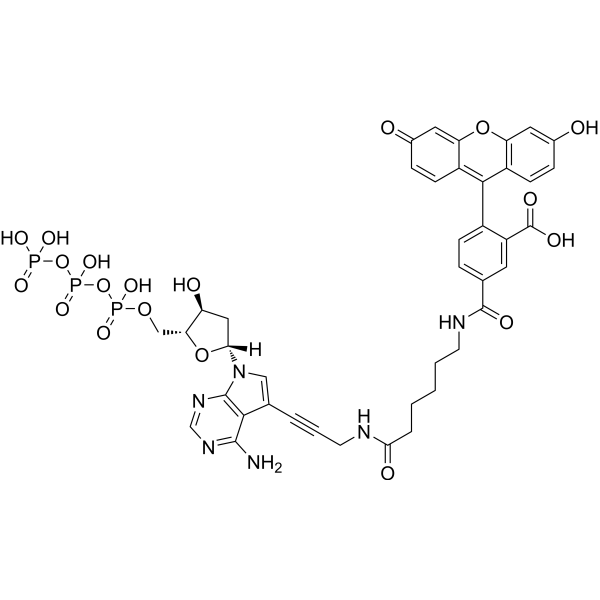 0 ImagesCat. No.: HY-D1721Fluorescein-12-dATP is a fluorescein-labeled deoxyadenosine triphosphate and signal amplifier. Fluorescein-12-dATP can be incorporated into the 3'-end of exposed thrombin-binding aptamers via terminal deoxynucleotidyl transferase to form multi-labeled nucleic acid chains, which are used for signal amplification in thrombin detection. Fluorescein-12-dATP acts as a fluorescent detection probe in chip-based aptamer sandwich biosensors for the detection of thrombin in serum. Fluorescein-12-dATP can be used in studies related to thrombin detection.
-
MCA-d3
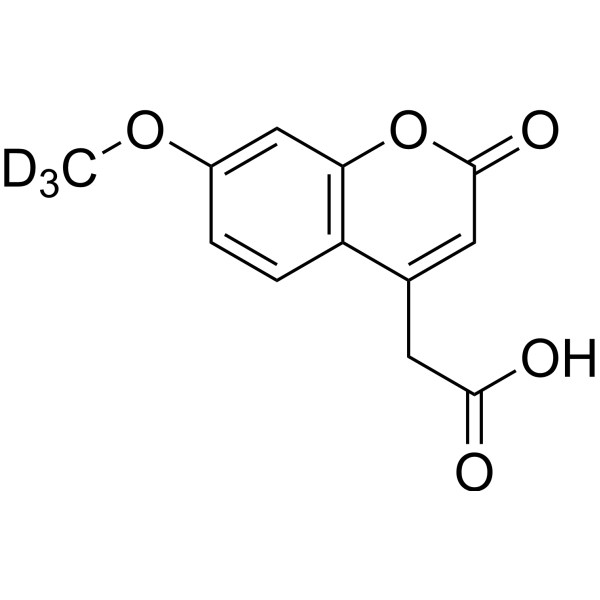 0 ImagesCat. No.: HY-W027544SSynonyms: 7-Methoxycoumarin-4-acetic acid-d3MCA-d3 (7-Methoxycoumarin-4-acetic acid3) is the deuterium labeled MCA (HY-W027544). MCA is a Coumarin (HY-N0709) derivative. MCA quantitates platelet-activating factor (PAF) by high-performance liquid chromatography with fluorescent detection. MCA can modify FRET peptide substrates for analyzing protease activities.
-
Cy3-PEG10000-NH2
 0 ImagesCat. No.: HY-D2508Cy3-PEG10000-NH2 is a polyethylene glycol derivative containing Cy3 (HY-D0822) fluorescent dye and polyethylene glycol (PEG) and an amino group. The Cy3 fluorophore is commonly used in applications such as immunolabeling, nucleic acid labeling, fluorescence microscopy, and flow cytometry. Cy3 has an emission maximum around 562-570 nm. Cy3-PEG10000-NH2 can be used for fluorescence imaging, fluorescence tracing and fluorescence labeling.



-
Cy7.5-COOH bromide (solution)
 0 ImagesCat. No.: HY-DY1121CAS No.: 2978106-25-9Cy7.5-COOH bromide (solution), a cyanine dye, is a highly fluorescent compound (Abs/Em = 781/808 nm). Cy7.5-COOH bromide (solution) can be used as a fluorescent probe in a wide-range of applications such as DNA sequencing, flow cytometry and in vivo imaging.
Solvent and concentration: DMSO: 10 mM

-
RhoVR 1
 0 ImagesCat. No.: HY-D3147CAS No.: 1965316-23-7RhoVR 1 is a voltage-sensitive probe targeted to the inner mitochondrial membrane. The detection mechanism of RhoVR 1 relies on membrane potential via the photoinduced electron transfer (PeT) mechanism. RhoVR 1 can be used for cell imaging.
-
ATTO 740 NHS ester
 0 ImagesCat. No.: HY-D2062CAS No.: 1448146-89-1ATTO 740 NHS ester is a near-infrared fluorescent dye and a multimodal fluorescence/photoacoustic contrast agent with excellent near-infrared emission properties and extremely high photostability. The photoacoustic signal of ATTO 740 NHS ester shows no significant decrease after continuous irradiation with a 750 nm laser for 30 min, making it suitable for in vivo fluorescence imaging and photoacoustic contrast imaging. When conjugated with the cystine knot peptide R01, ATTO 740 NHS ester enables precise detection of integrin αvβ6-positive cells and tumors in nude mouse xenograft models.
-
Dolichos Biflorus Agglutinin (Fluorescein)
 0 ImagesCat. No.: HY-NP098Synonyms: DBA (Fluorescein)Dolichos Biflorus Agglutinin (DBA) Fluorescein is a plant lectin that can be used as a probe to specifically bind biomolecules (such as polysaccharides, peptides, etc.).Dolichos Biflorus Agglutinin (DBA) Fluorescein is a biological material or organic compound that can be used in life science research.
-
Janus Green B Staining Solution (1:5000)
 0 ImagesCat. No.: HY-DY2046Janus Green B Staining Solution (1:5000) is an in vitro vital stain. The staining reaction of Janus Green B Staining Solution (1:5000) depends on oxygen and is reversibly inhibited by cyanide. Janus Green B Staining Solution (1:5000) can be used for vital staining of peripheral nerves in insects, rabbit lymphatic vessels, mitochondria, mast cells, etc.

-
Z-VAN-AMC
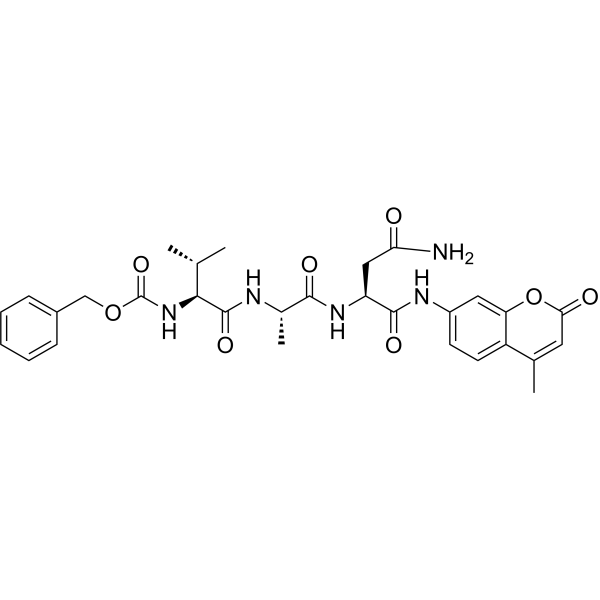 0 ImagesCat. No.: HY-P4427CAS No.: 245036-58-2Z-VAN-AMC is a fluorogenic substrate. Z-VAN-AMC can be hydrolysed by a phytophagous mite of legumain-like activity.
-
BODIPY 530/550 NHS ester
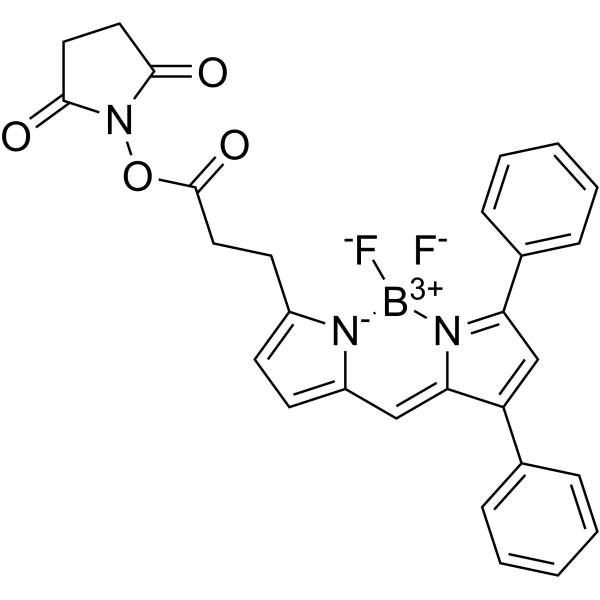 0 ImagesCat. No.: HY-D1615CAS No.: 216961-93-2BODIPY 530/550 NHS ester can be used for the stain of protein. BODIPY 530/550 NHS ester can be used for fluorescence OIM (oblique illumination microscopic) image.
-
SGC3
 0 ImagesCat. No.: HY-D3382SGC3 is a fluorescent dye with lipophilic properties. SGC3 can be used to study synaptic vesicle recycling and "kiss-and-run" exocytosis by monitoring dye efflux through nanoscale fusion pores, and its detection mechanism relies on its own lipophilic properties. SGC3 generates fluorescence when bound to lipid membranes, and a decrease in fluorescence intensity can be detected when SGC3 leaves vesicles and exists in a free state in solution.
-
PTO-41
 0 ImagesCat. No.: HY-D3220CAS No.: 2408913-88-0PTO-41 is a blood-brain barrier-permeable near-infrared fluorescent probe that targets β-amyloid oligomers (Aβ Oligomers, AβOs) with a Kd of 349 nM. PTO-41 exhibits low cytotoxicity, high sensitivity to β-amyloid oligomers in in vitro phantom imaging, and can be rapidly cleared from the brain. PTO-41 is applicable to the research of Alzheimer's disease (Ex/Em = 538 nM/680 nM).




