Fluorescent Dye
Fluorescence is a phenomenon of photoluminescence in luminescence. When an atom is irradiated by light, some electrons around the nucleus jump from their original orbitals to higher energy orbitals under the influence of light energy, i.e., from the ground state to the first or second excited single-line state, etc. Due to the instability of the first or second excited singlet state, the electron returns from the excited singlet state to the ground state accompanied by released energy, resulting in fluorescence.
Fluorescent dyes can be covalently bound or physically adsorbed in the structure of the substance. The fluorescence properties allow for the characterization, localization and quantitative analysis of the labeled object. Fluorescent dyes have shown great potential for the detection of proteins, nucleic acids, cells, and immunoassays, attributed to the advantages in non-radioactive contamination, simple experimental operation and easy observation.
Fluorescent dyes have penetrated many fields such as pharmacology, physiology, environmental science, and information science, as well as functional studies of proteins and drug screening.
All Product Categories
-
Fluorescent Dye Related Products (4914)
Related Products (4914)

-
Antibodies (4)
-
Cy3 labled Revusiran sodium
 0 ImagesCat. No.: HY-132590ECy3 labled Revusiran sodium is a Cy3 labled Revusiran sodium.
-
RB-PEG400-DSPE
 0 ImagesCat. No.: HY-D2887Synonyms: Rhodamine B-PEG400-DSPERB-PEG400-DSPE (Rhodamine B-PEG400-DSPE) is a PEG phospholipid labeled Rhodamine B (HY-Y0016). RB-PEG400-DSPE can be used to prepare liposomes or nanoparticles for nutrients delivery such as mRNA or DNA vaccine (Ex/Em=546/610 nm).
-
P-BP-SFAC
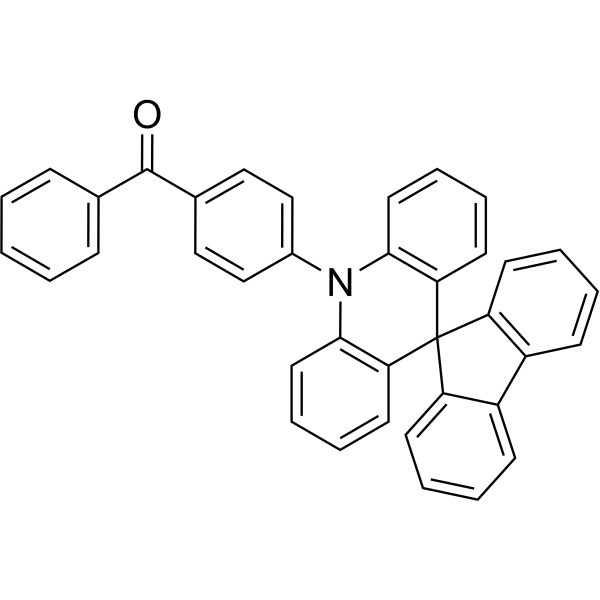 0 ImagesCat. No.: HY-D1417CAS No.: 2247391-82-6P-BP-SFAC is a fluorescence molecule. P-BP-SFAC exhibits an apparent absorption band with a peak at about 377 nm, indicative of a stronger ICT effect.
-
Pisum Sativum Agglutinin
 0 ImagesCat. No.: HY-NP078Pisum Sativum Agglutinin is a plant lectin that can be used as a probe to specifically bind biomolecules (such as polysaccharides, peptides, etc.).Pisum Sativum Agglutinin is a biological material or organic compound that can be used in life science research.
-
Human Serum Albumin-ICG
 0 ImagesCat. No.: HY-D3026Synonyms: HSA-ICGHuman Serum Albumin-ICG (HSA-ICG) is a Indocyanine green (ICG) (HY-D0711) labeled serum albumin. Human Serum Albumin-ICG plays an important role in fluorescent labeling, drug delivery research, and other fields (Ex/Em = 785/813 nm).
-
Cy-AP
 0 ImagesCat. No.: HY-D3234CAS No.: 2409037-97-2Cy-AP is a hypoxia-sensitive near-infrared Fluorescent probe (emission wavelength: 725 nm). Cy-AP exhibits no fluorescence under normoxic microenvironments, while under hypoxic microenvironments, its azo group is reduced, releasing strong near-infrared fluorescence with an emission at 725 nm. Cy-AP enables visualization of intracellular hypoxic status through multiple imaging modalities.
-
TPEQM-DMA
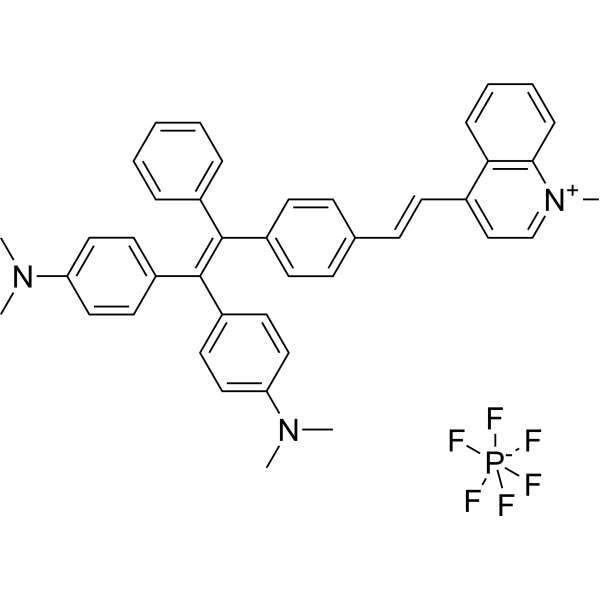 0 ImagesCat. No.: HY-155003TPEQM-DMA is a NIR-II photosensitizer. TPEQM-DMA accumulates in cancerous mitochondria, and inhibits cancer cell growth. TPEQM-DMA has potent type-I phototherapeutic efficacy to overcome the intrinsic pitfalls of PDT in combating hypoxic tumors.

-
CLIP-Biotin
 0 ImagesCat. No.: HY-D2945CAS No.: 1004524-73-5CLIP-Biotin is a Biotin-labeled CLIP tag fluorescent probe. CLIP-Biotin can be used for marking the CLIP-tag fusion proteins in cells.
-
SPY555-BG
 0 ImagesCat. No.: HY-D2994CAS No.: 2434651-49-5Synonyms: SNAP-MaP555SPY555-BG (SNAP-MaP555) is a cell-permeable fluorescent dye for SNAP-tag labeling of HIV-1 Gag, which enables visualization of HIV-1 intercellular transmission via SNAPf. SPY555-BG relies on irreversible covalent binding to the active-site cysteine of the SNAPf tag fused to HIV-1 Gag.
-
Sulfo-CY3 tetrazine potassium
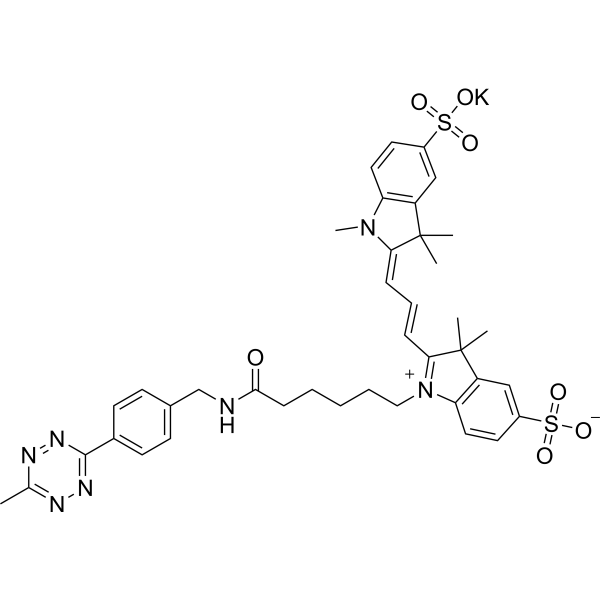 0 ImagesCat. No.: HY-D1598Sulfo-CY3 tetrazine potassium is a sulfo-Cyanine3 derivative that contains methyltetrazine moiety (Ex=548 nm, Em=563 nm). Sulfo-CY3 tetrazine potassium can be used for the labeling of metabolically engineered cell-surface glycoconjugates. Sulfo-CY3 tetrazine (potassium) is a click chemistry reagent, it contains a Tetrazine group that can undergo an inverse electron demand Diels-Alder reaction (iEDDA) with molecules containing TCO groups.
-
18:0 SquareFluor(629/648) PE ammonium
 0 ImagesCat. No.: HY-N15943CAS No.: 3077426-99-118:0 SquareFluor(629/648) PE ammonium is a fluorescent lipid that can be used to visualize cell membranes (Ex/Em = 629/648 nm).
-
Sulfo-Cy7.5 dicarboxylic acid
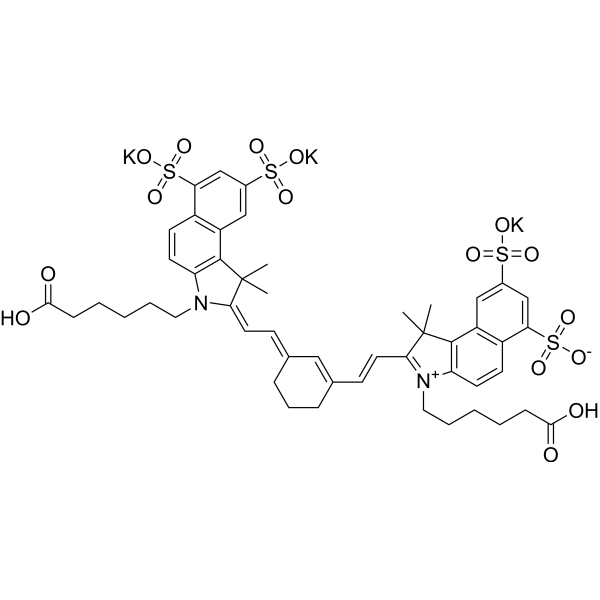 0 ImagesCat. No.: HY-D1864Sulfo-Cy7.5 dicarboxylic acid is a dye derivative of Cyanine 7.5 (Cy7.5) (HY-D0926) with carboxylic acid and sulfonate functional groups. The sulfonate ion increases the water solubility of the compound, making it suitable for use in aqueous solutions. Cy7.5 is a near-infrared fluorescent dye commonly used in biomedical research areas such as biomarkers and cell imaging. Sulfo-Cy7.5 dicarboxylic acid can be covalently bound to some biomolecules (especially antibodies, proteins, etc.) to track their location and dynamic changes in biological samples.
-
8-Azido-cADPR
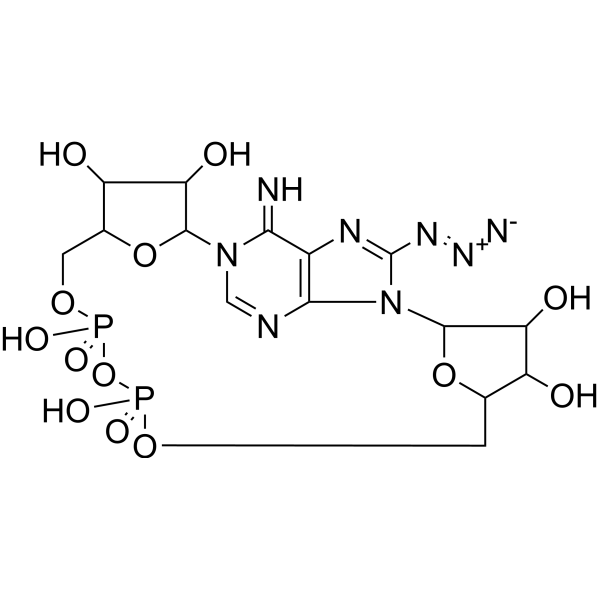 0 ImagesCat. No.: HY-147150CAS No.: 150424-94-58-Azido-cADPR, with its photoactive azido group, is a potent photoaffinity probe. 8-Azido-cADPR can be used for the identification and characterization of cADPR-binding proteins. 8-Azido-cADPR is a click chemistry reagent, it contains an Azide group and can undergo copper-catalyzed azide-alkyne cycloaddition reaction (CuAAc) with molecules containing Alkyne groups. It can also undergo strain-promoted alkyne-azide cycloaddition (SPAAC) reactions with molecules containing DBCO or BCN groups.
-
Abz-FRLKGGAPIKGV-EDDNP TFA
 0 ImagesCat. No.: HY-P2296Abz-FRLKGGAPIKGV-EDDNP TFA is a fluorogenic substrate used to measure the enzymatic activities of protease forms, such as papain-like protease 2 (PLP2) from severe acute respiratory syndrome coronavirus (SARS-CoV). Abz-FRLKGGAPIKGV-EDDNP TFA has the potential for study 2019-nCoV (COVID-19) infection.
-
Congo Red Staining Solution (1%)
 0 ImagesCat. No.: HY-DY2023Congo Red Staining Solution (1%) is an absorptive histochemical staining solution based on Congo Red (HY-D0236), which is specifically designed to detect amyloid deposits in tissue sections. When observed under a polarizing microscope, the stained amyloid complexes exhibit characteristic apple-green birefringence, making it a standard tool for the diagnosis of amyloidosis.
-
C6 Biotin phytoceramide (t18:0/6:0)
 0 ImagesCat. No.: HY-175133CAS No.: 257297-61-3Synonyms: Biotin ceramide (t18:0/6:0)C6 Biotin phytoceramide (t18:0/6:0) is an affinity probe that allows C6 phytoceramide to be detected or immobilized through interaction with the biotin ligand.
-
Chromotropic acid disodium
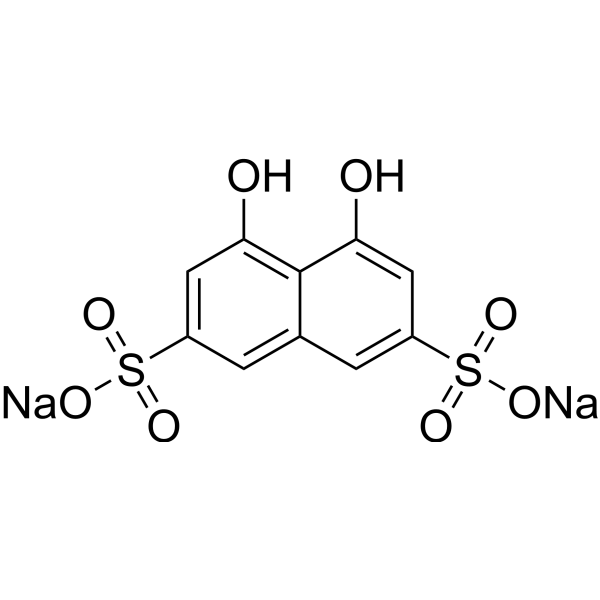 0 ImagesChromotropic acid disodium is a multifunctional dye. Dyes are important tools in biological experiments. They can help researchers observe and analyze cell structures, track biomolecules, evaluate cell functions, distinguish cell types, detect biomolecules, study tissue pathology and monitor microorganisms. Their applications range from basic scientific research to clinical A wide range of diagnostics. Dyes are also widely used in traditional fields such as textile dyeing, as well as in emerging fields such as functional textile processing, food pigments and dye-sensitized solar cells.