



Fluorescent Dye
Fluorescence is a phenomenon of photoluminescence in luminescence. When an atom is irradiated by light, some electrons around the nucleus jump from their original orbitals to higher energy orbitals under the influence of light energy, i.e., from the ground state to the first or second excited single-line state, etc. Due to the instability of the first or second excited singlet state, the electron returns from the excited singlet state to the ground state accompanied by released energy, resulting in fluorescence.
Fluorescent dyes can be covalently bound or physically adsorbed in the structure of the substance. The fluorescence properties allow for the characterization, localization and quantitative analysis of the labeled object. Fluorescent dyes have shown great potential for the detection of proteins, nucleic acids, cells, and immunoassays, attributed to the advantages in non-radioactive contamination, simple experimental operation and easy observation.
Fluorescent dyes have penetrated many fields such as pharmacology, physiology, environmental science, and information science, as well as functional studies of proteins and drug screening.
All Product Categories
-
Fluorescent Dye Related Products (4914)
Related Products (4914)

-
Antibodies (4)
-
RB-PEG600-DSPE
 0 ImagesCat. No.: HY-D2887ASynonyms: Rhodamine B-PEG600-DSPERB-PEG600-DSPE (Rhodamine B-PEG600-DSPE) is a PEG phospholipid labeled Rhodamine B (HY-Y0016). RB-PEG600-DSPE can be used to prepare liposomes or nanoparticles for nutrients delivery such as mRNA or DNA vaccine (Ex/Em=546/610 nm).
-
18:1 SquareFluor(629/648) PE ammonium
 0 ImagesCat. No.: HY-N15954CAS No.: 3077427-01-818:1 SquareFluor(629/648) PE ammonium is a fluorescent lipid that can be used to visualize cell membranes (Ex/Em = 629/648 nm).
-
Rhodamine B-Dextran chloride (MW 200000)
 0 ImagesCat. No.: HY-D3047HRhodamine B-Dextran (MW 200000) is a Rhodamine B (HY-Y0016)-labeled dextran with a molecular weight of 200,000. Rhodamine B-Chitosan (MW 200000) plays an important role in fluorescent labeling, cell imaging, vascular imaging, and drug delivery research (Ex/Em = 546/610 nm).
-
BODIPY FL-C5 NHS Ester
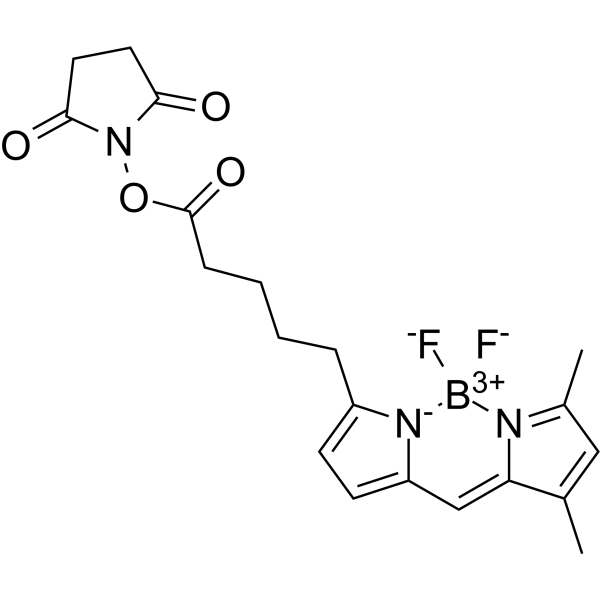 0 ImagesCat. No.: HY-D1611CAS No.: 133867-52-4BODIPY FL-C5 NHS Ester is a green-fluorescent dye that is reactive with primary amines on biomolecules such as peptides, proteins, modified nucleotides and biopolymers.
-
Vari Fluor 594 Carboxylic acid(free acid)
 0 ImagesCat. No.: HY-D1826Synonyms: VF 594 Carboxylic acid(free acid)Vari Fluor 594 Carboxylic acid (VF 594 Carboxylic acid) free acid is a carboxylic acid derivative of Vari Fluor. Vari Fluor carboxylic acid derivatives are unactivated labeled fluorescent dyes for protein, antibody, and polysaccharide labeling that require carboxylic acid activation for use.
-
RL560
 0 ImagesCat. No.: HY-D3365RL560 is a red-emitting RNA fluorescent dye used for RNA-selective labeling and live-cell RNA imaging. RL560 achieves RNA-selective fluorescence turn-on via covalent acylation between its acylimidazole reactive group and the 2′-OH of RNA ribose, as well as fluorescence signal enhancement through restriction of TICT molecular motion. RL560 is applicable for RNA imaging and multicolor RNA detection, with detection wavelengths of Ex/Em = 560/639 nm.
-
AMCA-PEG4-Mal
 0 ImagesCat. No.: HY-D3342AMCA-PEG4-Mal is a derivative of AMCA featuring a maleimide reactive group for thiol-based conjugation and labeling. It incorporates a PEG4 linker to enhance solubility and minimize steric hindrance. AMCA-PEG4-Mal is suitable for labeling thiol-containing proteins or peptides (Ex/Em = 347/444 nm).
-
Cy3 labled Nivudirsen sodium
 0 ImagesCat. No.: HY-177649DCy3 labled Nivudirsen sodium is a Cy3 labled Nivudirsen sodium.
-
FAM labled RG-101 sodium
 0 ImagesCat. No.: HY-132600DFAM labled RG-101 sodiumis a FAM labled RG-101 sodium.
-
PE-Cy5
 0 ImagesCat. No.: HY-D3274PE-Cy5 is a tandem fluorescent dye commonly used in flow cytometry, immunofluorescence, and cell biology research. It is formed by the covalent linkage of two fluorescent molecules, namely phycoerythrin and CY5. PE-Cy5 binds to human FcγRI (CD64), and this binding can be blocked by human pooled serum, anti-CD64 monoclonal antibodies targeting the ligand-binding region, or aggregated IgG. PE-Cy5 supports three-color flow cytometry analysis, and whole blood staining can partially reduce its non-specific binding (Ex/Em = 450-500 nm/665 nm).
-
Cyanine 3.18
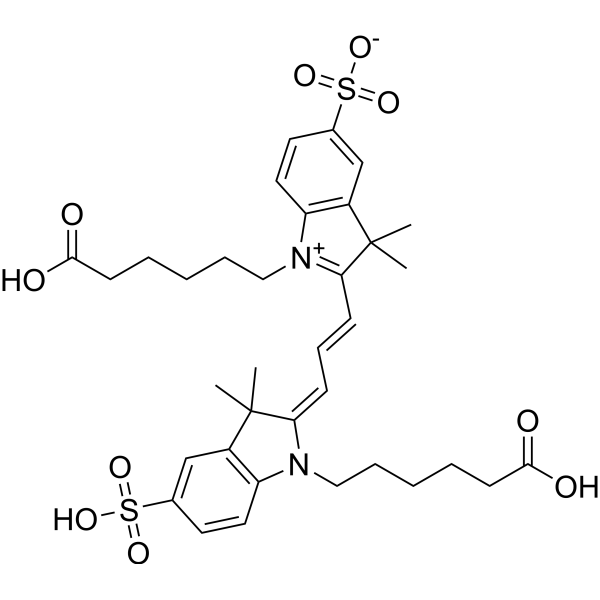 0 ImagesCat. No.: HY-D1097CAS No.: 146397-17-3Cyanine 3.18 belongs to the cyanine dye series and is a common fluorescent marker for biomolecules that can interact with biomolecules. Cyanine dyes may also bind to double-helical DNA through intercalation and exhibit enhanced fluorescence upon binding.

-
FAM labled Tofersen sodium
 0 ImagesCat. No.: HY-132580EFAM labled Tofersen sodiumis a FAM labled Tofersen sodium.
-
10-Dodecylacridine Orange Bromide
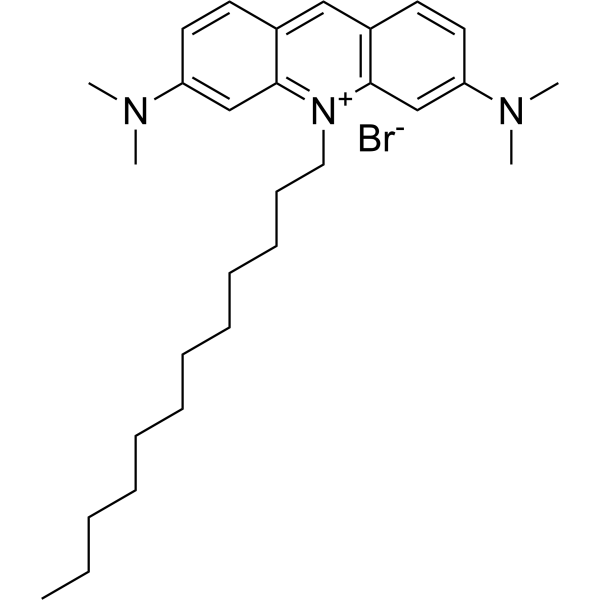 0 ImagesCat. No.: HY-D1211CAS No.: 41387-42-210-Dodecylacridine Orange Bromide is a multifunctional dye. Dyes are important tools in biological experiments. They can help researchers observe and analyze cell structures, track biomolecules, evaluate cell functions, distinguish cell types, detect biomolecules, study tissue pathology and monitor microorganisms. Their applications range from basic scientific research to clinical A wide range of diagnostics. Dyes are also widely used in traditional fields such as textile dyeing, as well as in emerging fields such as functional textile processing, food pigments and dye-sensitized solar cells.
-
Bathophenanthroline disulfonic acid sodium
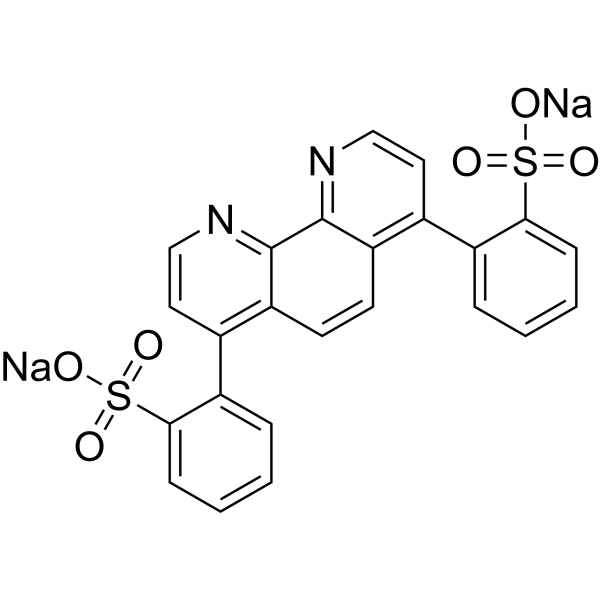 0 ImagesCat. No.: HY-D0006ACAS No.: 98645-86-4Bathophenanthroline disulfonic acid sodium is a multifunctional dye. Dyes are important tools in biological experiments. They can help researchers observe and analyze cell structures, track biomolecules, evaluate cell functions, distinguish cell types, detect biomolecules, study tissue pathology and monitor microorganisms. Their applications range from basic scientific research to clinical A wide range of diagnostics. Dyes are also widely used in traditional fields such as textile dyeing, as well as in emerging fields such as functional textile processing, food pigments and dye-sensitized solar cells.
-
Maackia Amurensis Lectin II
 0 ImagesCat. No.: HY-NP073Synonyms: MAL IIMaackia Amurensis Lectin II (MAL II) is a plant lectin that can be used as a probe to specifically bind biomolecules (such as polysaccharides, peptides, etc.).Maackia Amurensis Lectin II (MAL II) is a biological material or organic compound that can be used in life science research.
-
DHMQ
 0 ImagesCat. No.: HY-163618DHMQ is a NIR fluorescent probe that binds to the propylamino group of monoamine oxidase A (MAO-A). DHMQ tracks MAO-A activity in real-time by using fluorescence imaging on mice and cells.
-
BGSBD
 0 ImagesCat. No.: HY-D2939CAS No.: 1622078-12-9BGSBD is a SNAP-tag-based fluorescent probe (Ex/Em: 435 nm/516 nm) based on the environmentally sensitive fluorescent group SBD, specifically designed for protein labeling of live cells without washing. BGSBD achieves a 280-fold fluorescence enhancement after labeling by ingeniously utilizing the hydrophobic binding pocket of the SNAP-tag protein, providing an ideal tool for real-time monitoring of protein dynamics within cells.
-
14:0-6:0(C2 NBD) PI(4,5)P2 TEA
 0 ImagesCat. No.: HY-N16330CAS No.: 3091879-57-814:0-6:0(C2 NBD) PI(4,5)P2 TEA is a fluorescent lipid labeled with Nitrobenzoxadiazole (NBD) (Ex/Em = 460/540 nm).
-
RB-PEG6000-RB
 0 ImagesCat. No.: HY-D2893JSynonyms: Rhodamine B-PEG6000-Rhodamine BRB-PEG6000-RB (Rhodamine B-PEG6000-Rhodamine B) a fluorescent dye composed of two Rhodamine B (HY-Y0016) and PEG. RB-PEG6000-RB can be used for fluorescent labeling and imaging (Ex/Em=546/610 nm).




