



Fluorescent Dye
Fluorescence is a phenomenon of photoluminescence in luminescence. When an atom is irradiated by light, some electrons around the nucleus jump from their original orbitals to higher energy orbitals under the influence of light energy, i.e., from the ground state to the first or second excited single-line state, etc. Due to the instability of the first or second excited singlet state, the electron returns from the excited singlet state to the ground state accompanied by released energy, resulting in fluorescence.
Fluorescent dyes can be covalently bound or physically adsorbed in the structure of the substance. The fluorescence properties allow for the characterization, localization and quantitative analysis of the labeled object. Fluorescent dyes have shown great potential for the detection of proteins, nucleic acids, cells, and immunoassays, attributed to the advantages in non-radioactive contamination, simple experimental operation and easy observation.
Fluorescent dyes have penetrated many fields such as pharmacology, physiology, environmental science, and information science, as well as functional studies of proteins and drug screening.
All Product Categories
-
Fluorescent Dye Related Products (4914)
Related Products (4914)

-
Antibodies (4)
-
4-Methylumbelliferyl phosphate (2-amino-2-methyl-1,3-propanediol)
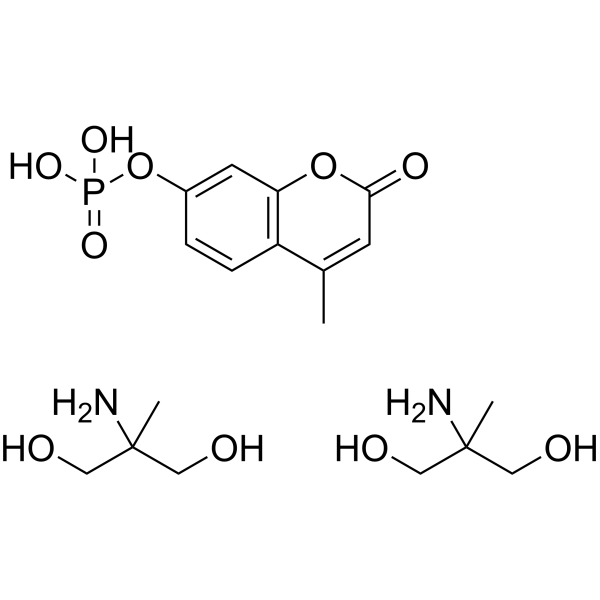 0 ImagesCat. No.: HY-D1529CAS No.: 107475-10-54-Methylumbelliferyl phosphate (2-amino-2-methyl-1,3-propanediol) is a fluorescent substrate, can be used as substrate buffer of enzyme assay.

-
Cy2 Iodide (solution)
 0 ImagesCat. No.: HY-DY1119CAS No.: 186205-37-8Cy2 Iodide (solution) is a CY dye. CY, short for Cyanine, is a compound consisting of two nitrogen atoms connected by an odd number of methyl units. Cyanine compounds have the characteristics of long wavelength, adjustable absorption and emission, high extinction coefficient, good water solubility and relatively simple synthesis. CY dyes are of en used for the labeling of proteins, antibodies and small molecular compounds. For the labeling of protein antibodies, the combination can be completed through a simple mixing reaction. Below, we introduce the labeling method of protein antibody labeling, which has certain reference significance.
Solvent and concentration: DMSO: 10 mM
-
Cy5 DBCO chloride
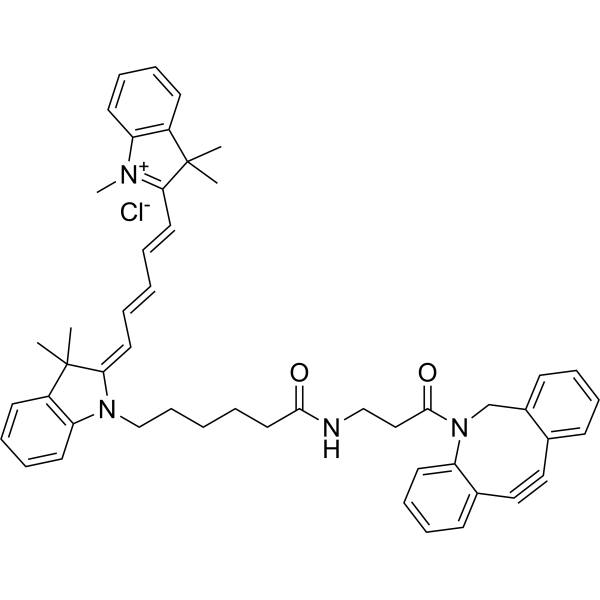 0 ImagesCat. No.: HY-D1625CAS No.: 2182601-72-3Cy5 DBCO chloride is an azide reaction probe and the addition of DBCO molecules allows the imaging of azide-labelled biomolecules by a copper-free "Click Chemistry" reaction. Cy5 DBCO (chloride) is a click chemistry reagent, it contains a DBCO group that can undergo strain-promoted alkyne-azide cycloaddition (SPAAC) with molecules containing Azide groups.
-
Cy3 labled Patisiran sodium
 0 ImagesCat. No.: HY-132609CCy3 labled Patisiran sodium is a Cy3 labled Patisiran sodium.
-
FAM labled IONIS-DGAT 2Rx sodium
 0 ImagesCat. No.: HY-159698CFAM labled IONIS-DGAT 2Rx sodiumis a FAM labled IONIS-DGAT 2Rx sodium.
-
RL450
 0 ImagesCat. No.: HY-D3363RL450 is an RNA-selective fluorescent covalent probe that binds covalently to the 2′-hydroxyl group of RNA via an acylimidazole-mediated reaction. RL450 has excitation/emission wavelengths of 450/497 nm, exhibits a 970-fold selectivity for RNA over DNA, and features high labeling efficiency. RL450 can be used in studies related to in vitro RNA labeling, gel imaging, and cyan fluorescent imaging of RNA in fixed cells (e.g., nucleoli).
-
Hexyl 5-aminolevulinate
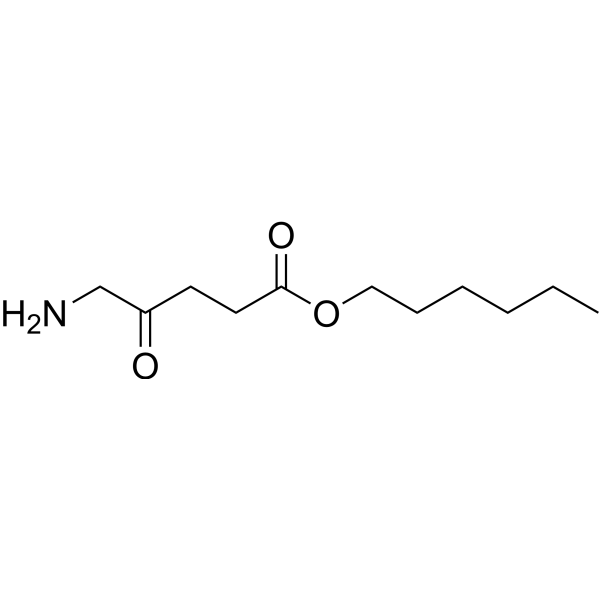 0 ImagesCat. No.: HY-157943CAS No.: 140898-97-1Synonyms: HALHexyl 5-aminolevulinate (HAL) is a photosensitizer, and can increase the efficiency of PDT due to the high lipophilicity. Hexyl 5-aminolevulinate can be used for research of photodynamic therapy (PDT).
-
Resorufin benzyl ether
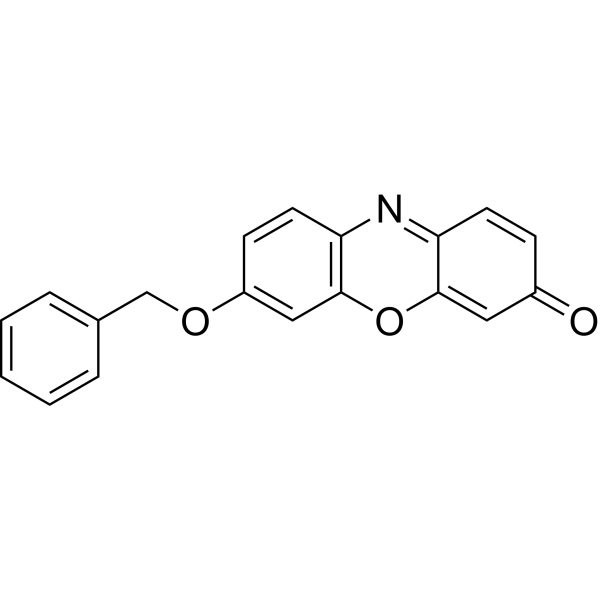 0 ImagesCat. No.: HY-D0146CAS No.: 87687-02-3Synonyms: BzRes; 7-Benzyloxyresorufin; 7-BenzyloxyphenoxazoneResorufin benzyl ether (BzRes), a fluorogenic enzyme substrate, can be used to detect CYP3A4 enzyme activity. Resorufin benzyl ether modified with a recognizing moiety boronate, can be used for ONOO- detection via a self-immolation mechanism. Ex/Em=530-570 nm/590 nm.
-
sCy5DL-amide
 0 ImagesCat. No.: HY-D3389sCy5DL-amide is an amidated fluorescent D-amino acid conjugated to Sulfo-Cyanine 5, and a peptidoglycan labeling agent. sCy5DL-amide incorporates into bacterial peptidoglycan cell wall via transpeptidase-mediated reactions, replacing the fourth or fifth D-amino acid of the peptidoglycan stem peptide for visualization of nascent peptidoglycan biosynthesis. sCy5DL-amide produces clear cell outline, septum labeling, and high localization density in Bacillus subtilis, including a 'V-shape' pattern at cell-cell contact areas. sCy5DL-amide exhibits robust incorporation into Gram-positive bacteria and mycobacteria, with reduced incorporation into Gram-negative bacteria (Ex/Em = 646/666 nm).
-
Cy3 labled Lumasiran sodium
 0 ImagesCat. No.: HY-132613CCy3 labled Lumasiran sodium is a Cy3 labled Lumasiran sodium.
-
Z-LRGG-AMC TFA
 0 ImagesCat. No.: HY-P2176ASynonyms: Z-Leu-Arg-Gly-Gly-AMC TFAZ-LRGG-AMC TFA is the trifluoroacetate salt of Z-LRGG-AMC (HY-P2176). Z-LRGG-AMC TFA is a fluorogenic substrate for isopeptidase T. Upon cleavage of Z-LRGG-AMC TFA by isopeptidase T, 7-amino-4-methylcoumarin (AMC) is released, and its fluorescence can be used to quantify isopeptidase T activity (Ex/Em : 360/460 nm).
-
5(6)-Carboxy-eosin
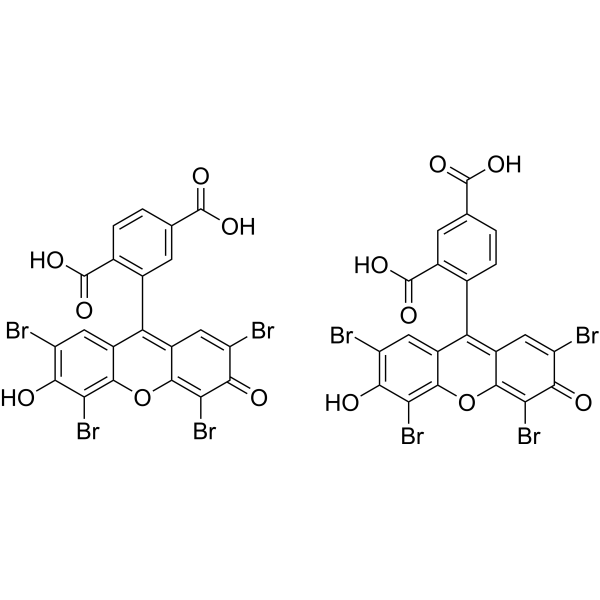 0 ImagesCat. No.: HY-D0051CAS No.: 132201-84-45(6)-Carboxy-eosin is a multifunctional dye. Dyes are important tools in biological experiments. They can help researchers observe and analyze cell structures, track biomolecules, evaluate cell functions, distinguish cell types, detect biomolecules, study tissue pathology and monitor microorganisms. Their applications range from basic scientific research to clinical A wide range of diagnostics. Dyes are also widely used in traditional fields such as textile dyeing, as well as in emerging fields such as functional textile processing, food pigments and dye-sensitized solar cells.
-
Basic red 18
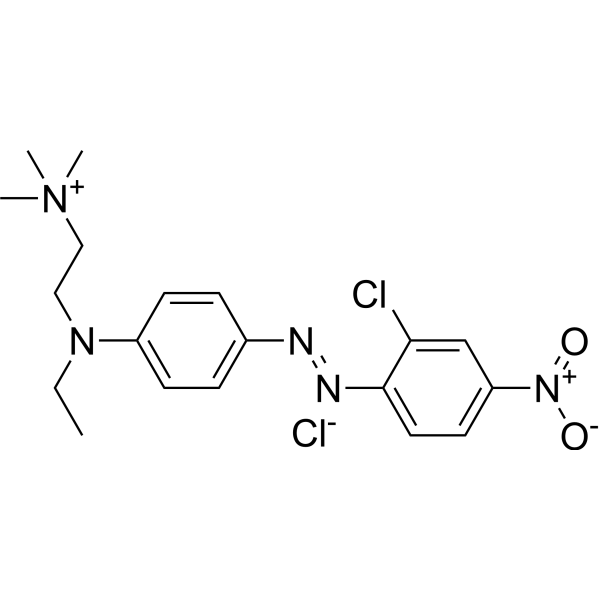 0 ImagesCat. No.: HY-D1036ACAS No.: 25198-22-5Basic red 18 is a basic red dye whose dyeing effect can be removed by nanoclay adsorbent.
-
CY7.5-Alginate
 0 ImagesCat. No.: HY-D3022CY7.5-Alginate is a CY7.5 (HY-D0926)-labeled alginate. CY7.5-Alginate combines the polysaccharide properties of alginate with the fluorescence properties of CY7.5, playing an important role in fields such as fluorescent labeling, cell imaging, and drug delivery research (Ex/Em = 770/820 nm).

-
RB-PEG5000-RB
 0 ImagesCat. No.: HY-D2893HSynonyms: Rhodamine B-PEG5000-Rhodamine BRB-PEG5000-RB (Rhodamine B-PEG5000-Rhodamine B) a fluorescent dye composed of two Rhodamine B (HY-Y0016) and PEG. RB-PEG5000-RB can be used for fluorescent labeling and imaging (Ex/Em=546/610 nm).




