



α-synuclein Inhibitor
-
Movronersen sodium scrambled negative control
 0 ImagesCat. No.: HY-177647B
Movronersen sodium scrambled negative control is the sequence scrambled negative control of Movronersen sodium.
-
Movronersen
 0 ImagesCat. No.: HY-177647CAS No.: 2411937-33-0Synonyms: BIIB-101; ION-464
Movronersen is an antisense oligonucleotide targeted to α-synuclein.
-
Crocin II (Standard)
 0 ImagesCat. No.: HY-N0698RCAS No.: 55750-84-0
Crocin II (Standard) is the analytical standard of Crocin II. This product is intended for research and analytical applications. Crocin II is an inhibitor targeting α-synuclein aggregation, with a IC50 of 0.541 μM and a EC50 of 3.63 μM. Crocin II inhibits α-synuclein aggregation and dissociates pre-formed α-synuclein fibrils. Crocin II possesses antioxidant, anticancer and antidepressant activities. Crocin II is applicable to research related to neurological disorders such as Parkinson's disease, dementia with Lewy bodies and multiple system atrophy, as well as cancers.
-
MAAAHR
 0 ImagesCat. No.: HY-P12279
MAAAHR is a neuroprotective agent. MAAAHR is isolated and purified from C-phycocyanin of Spirulina platensis. MAAAHR induces antioxidant gene expression through activating the Nrf2 signaling pathway. MAAAHR inhibits excessive Autophagy by reducing the expression of proteins such as α-Syn and Parkin. MAAAHR inhibits Apoptosis. MAAAHR scavenges excessive ROS, enhances SOD, CAT, and GSH-Px activities, and reduces protein carbonyl content. MAAAHR inhibits Acetylcholinesterase. MAAAHR protects zebrafish against MPTP (HY-15608)-induced dopaminergic neuronal and neurovascular loss and alleviates motor impairment. MAAAHR can be used for research on Parkinson's disease.
-
MNP2
 0 ImagesCat. No.: HY-P11581
MNP2 is a NLRP3-ASC interaction inhibitor. MNP2 selectively binds to the PYD domain of ASC (Ka=149 nM) and blocks ASC-PYM binding (Ka=58 nM), thereby inhibiting the interaction between ASC and NLRP3 and suppressing the formation of the NLRP3 inflammasome. MNP2 inhibits IL-1β release and caspase-1 maturation, and reduces the efflux of potassium and chloride ions. MNP2 prevents mitochondrial damage and reactive oxygen species production, and significantly decreases NLRP3 inflammasome formation in neurodegenerative pathologies induced by β-amyloid, Tau protein and α-synuclein. MNP2 is applicable for the research of neurodegenerative diseases.
-
DA5-CH
 0 ImagesCat. No.: HY-P12141CAS No.: 2227651-65-0Synonyms: KP405
DA5-CH (KP405) is a blood-brain barrier-permeable GLP-1/GIP receptor agonist. DA5-CH activates GLP-1 and GIP receptors, inhibits the NF-κB inflammatory pathway, reduces α-synuclein (α-synuclein) levels, restores the expression of tyrosine hydroxylase and neurotrophic factors, improves motor function, decreases amyloid plaques and phosphorylated tau protein levels in the hippocampus, restores synaptic plasticity, regulates the PI3K/AKT/GSK3β and CREB signaling pathways, and alleviates mitochondrial stress. DA5-CH can be used for research on Parkinson's disease and Alzheimer's disease.
-
SK-129
 0 ImagesCat. No.: HY-182893CAS No.: 1919889-97-6
SK-129 is a blood-brain barrier-permeable inhibitor of α-synuclein (αS) oligomers with a Kd of 221 nM. SK-129 preferentially binds to neurotoxic αS oligomers over physiological αS monomers, inhibits αS aggregation, blocks the interaction and co-aggregation of αS with tau protein, and prevents the maturation of αS-tau condensates into amyloid aggregates. SK-129 reduces ROS production, rescues dopaminergic neuron degeneration, improves motor function, restores endogenous dopamine synthesis, increases the number of Tyrosine Hydroxylase-positive neurons, prevents brain histopathological changes, alleviates neuroinflammation, and improves survival rates in relevant models. SK-129 can be used in research related to Parkinson's disease (PD) and Lewy body dementia (LBD).
-
α-synuclein-IN-16
 0 ImagesCat. No.: HY-175737
α-synuclein-IN-16 (Compound H1) is a α-synuclein inhibitor. α-synuclein-IN-16 significantly inhibits the secondary nucleation in α-synuclein aggregation. α-synuclein-IN-16 can be used for Parkinson’s disease research.
-
D-Trp-Aib
 0 ImagesCat. No.: HY-114613CAS No.: 1123071-24-8
D-Trp-Aib is a dipeptide and amyloid-β inhibitor with a Kd of 29.6 nM. D-Trp-Aib triggers formation of non-toxic, non-β-sheet, amorphous amyloid β clusters from misfolded amyloid β monomers and toxic amyloid β oligomers, and reduces toxic amyloid β1-42 deposits. D-Trp-Aib inhibits amyloid fibril formation of α‑synuclein, IAPP and calcitonin. D-Trp-Aib can be used for the research of Alzheimer's disease.
-
Dopal-d5
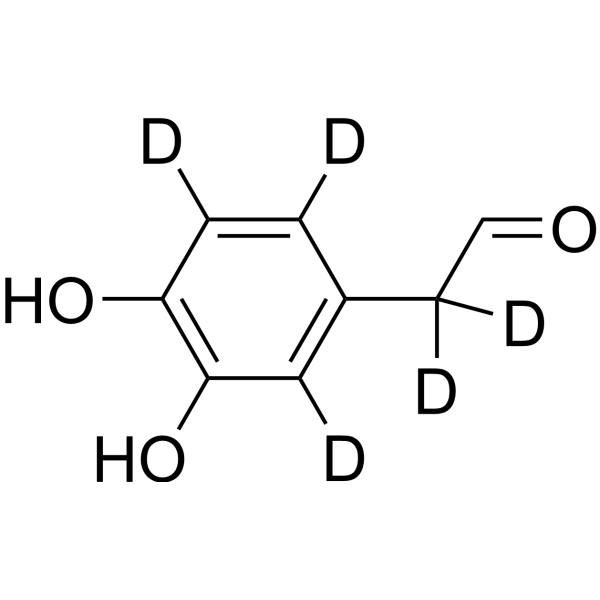 0 ImagesCat. No.: HY-121252S
Dopal-d5 is the deuterium labeled Dopal (HY-121252). Dopal is a metabolite and aldehyde neurotoxin of Dopamine (HY-B0451). Dopal exhibits cytotoxicity, induces α-synuclein oligomerization and aggregation, and is closely associated with the pathogenesis of Parkinson's disease. Dopal can be used in research related to Parkinson's disease.
-
HUP-46
 0 ImagesCat. No.: HY-176749CAS No.: 3007689-83-7
-
Hordenine (Standard)
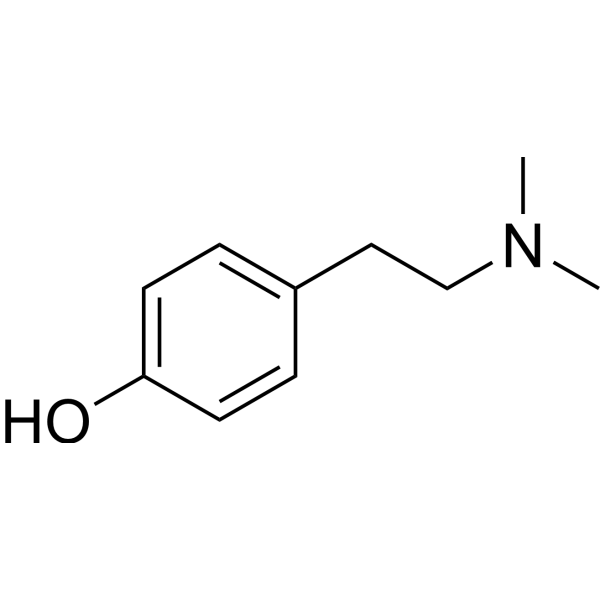 0 ImagesSynonyms: Ordenina (Standard); Peyocactine (Standard)
Hordenine (Standard) (Ordenina (Standard); Peyocactine (Standard)) is the analytical standard of Hordenine (HY-N0113). This product is intended for research and analytical applications. Hordenine (Ordenina; Peyocactine) is a multifunctional alkaloid with oral activity and blood-brain barrier penetration. Hordenine inhibits LPS-induced phosphorylation of p38, JNK, ERK1/2, p65, IκB, and AKT, prevents p65 nuclear translocation, and suppresses inflammatory cytokines and mediators. Hordenine promotes M2 macrophage polarization, restores blood-milk barrier integrity, alleviates oxidative stress by reducing ROS and MDA, and attenuates LPS-induced lung injury and pulmonary edema. Hordenine inhibits cAMP production, CREB phosphorylation, and MITF expression, thereby suppressing melanin synthesis in melanocytes and reconstructed epidermis. Hordenine activates the Wnt/β-catenin signaling pathway, promotes dermal papilla cell proliferation and hair shaft elongation, and accelerates hair regeneration. Hordenine activates DRD2, acts as a D3R partial agonist, α2A-AR full agonist, and 5-HT2A-R antagonist, and inhibits SERT and DAT. Hordenine inhibits α-synuclein accumulation and ameliorates motor deficits in Parkinson's disease models. Hordenine limits alcohol intake, reduces relapse drinking behavior, and modulates alcohol-induced conditioned place preference. Hordenine can be used for research on mastitis, skin pigmentation, acute lung injury, foodborne diseases, hair loss, Parkinson's disease, bacterial infections, and alcohol use disorder.
-
FTY720-C2
 0 Images
FTY720-C2 is a derivative of FTY72 (HY-12005). FTY720-C2 promotes the expression of brain-derived neurotrophic factor (BDNF) and glial cell-derived neurotrophic factor (GDNF) in multiple system atrophy (MSA) models, without causing immunosuppression. FTY720-C2 improves motor dysfunction and reduces the levels of insoluble alpha-synuclein (αSyn) in MSA mouse models. FTY720-C2 is blood-brain barrier penetrate.
-
Synucleozid-2.0
 0 Images
Synucleozid-2.0 is a blood-brain barrier-permeable inhibitor that binds to the IRE of SNCA mRNA, with a EC50 of 2.9 µM and a Kd value of 1.8 µM. Synucleozid-2.0 selectively binds to and stabilizes the A bulge and adjacent closed base pairs in the 5' UTR IRE of SNCA mRNA, blocks the translation process and reduces intracellular levels of α-synuclein. Synucleozid-2.0 exerts cytoprotective effects against cytotoxicity induced by α-synuclein preformed fibrils. Synucleozid-2.0 is applicable to the research of Parkinson's disease.
-
PQK7
 0 ImagesCat. No.: HY-P11908
PQK7 is an α-synuclein (α-synuclein) binder with a Kd value of 4 μM. PQK7 binds to key residues in the NAC region of ⍺-Syn, enhances the fluctuation of ⍺-Syn, reduces β-sheet content, maintains the solubility of ⍺-Syn monomers, and preserves the normal function of the protein. PQK7 reduces the toxicity of ⍺-Syn aggregates, restores cell cycle progression, decreases apoptosis (apoptosis), and inhibits ROS production. PQK7 can be used for the research of Parkinson's disease.
-
NP7r
 0 ImagesCat. No.: HY-184558CAS No.: 2641092-28-4
NP7r is an antioxidant and neuroprotective agent. NP7r regulates oxidative stress, upregulates downstream antioxidant genes, reduces mitochondrial ROS, initiates Autophagy and clears α-synuclein aggregates. NP7r alleviates dopaminergic neuron degeneration, restores fat content, reduces lipid peroxidation, and improves motor impairment and abnormal food perception. NP7r is applicable to the research of Parkinson's disease.
-
Syn-516
 0 ImagesCat. No.: HY-125984CAS No.: 695209-67-7
Syn-516 is an inhibitor of α-synuclein (α-Syn). Syn-516 targets the 5' untranslated region (5'UTR) of α-Syn mRNA, with an IC50 value of 1.8 μM, thereby inhibiting the translation process of α-Syn. Syn-516 improves motor dysfunction and colonic motility abnormalities associated with α-Syn overexpression in mouse models. α-Syn can be used to study diseases such as Parkinson's disease and Lewy body dementia.
-
α-Synuclein inhibitor 15
 0 ImagesCat. No.: HY-175308CAS No.: 414880-30-1
α-Synuclein inhibitor 15 (Compound 1) is an inhibitor targeting the fibrillation growth of α-synuclein (IC50=18 μM). α-Synuclein inhibitor 15 is promising for research of neurodegenerative diseases, such as Parkinson's disease (PD) and Lewy body dementia (LBD).
-
Squalamine phosphate
 0 ImagesCat. No.: HY-16468ACAS No.: 1309370-82-8Synonyms: ENT 01; MSI-1256 phosphate
Squalamine phosphate (Compound ENT-01) is an orally active neuroprotective agent. Squalamine phosphate can displace α-Syn that is bound electrostatically to nerve cell membranes and prevent aggregation of α-Syn. Squalamine phosphate can be used for the research of neurological disease, such as Parkinson’s disease.
-
SMER10
 0 ImagesCat. No.: HY-165539CAS No.: 221238-83-1
SMER10 is a small-molecule enhancer that can induce autophagy. SMER10 can increase the number of EGFP-LC3 positive autophagosoms in COS-7 and HeLa cells, promoting the conversion of LC3-I to autophagosome-associated LC3-II. SMER10 can efficiently promote the degradation of autophagy substrates, including the mutant huntingtin protein (EGFP-HDQ74) associated with Huntington's disease and the A53T α-synuclein protein associated with Parkinson's disease. SMER10 exerts neuroprotective effect.



