



Alphadolone

Based on 1 Customer Validation
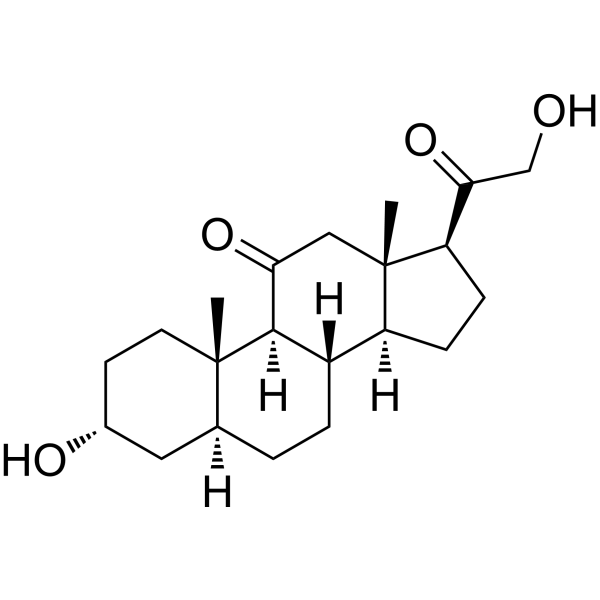
Alphadolone (Alfadolone) is a GABAA positive allosteric modulator with antinociceptive activity. Alphadolone produces GABAA-mediated antinociception and analgesia, and can induce anesthesia, loss of righting reflex, and deep sedation. Alphadolone blocks calcium channels and downstream cascades of calcium influx, and inhibits histamine release from mast cells. Alphadolone enhances the antinociceptive effects of opioids. Alphadolone promotes Candida albicans yeast/hyphal growth, increases lipid and oxygen uptake, alters sterol composition, and enhances tolerance to polyene antifungals. Alphadolone can be used in pain-related research.
연구목적의 판매만을 진행합니다. 환자를 대상으로 한 판매는 하지 않습니다.
- Purity : 98.71%
- CAS No.: 14107-37-0
- 화학식: C21H32O4
- 분자량:348.48
-
보관:Powder -20°C, 3 years , 4°C, 2 years ; In solvent -80°C, 6 months , -20°C, 1 month

To place orders, for customer services and technical support, please contact: MedChemExpress USA
Tel: 609-228-6898 E-mail: [email protected] [email protected]


-
 Biological Activity
-
Chemical Information
-
용액&용해도
- Protocol
- 순도&문서
- References
-
 Help & FAQs




Biological Activity
제품 설명
In Vitro
Alphadolone acetate promotes the growth of Candida albicans, alters yeast-hyphal morphology, changes intracellular sterol composition, and enhances resistance to polyene antifungals[2].
Alphadolone inhibits Concanavalin A (HY-P2149)- and A23187-induced histamine release from mast cells, and blocks 45Ca uptake in rat mast cells stimulated by Concanavalin A[3].
MedChemExpress (MCE) has not independently confirmed the accuracy of these methods. They are for reference only.
In Vivo
Alphadolone (0.06-60 mg/kg; i.p.; single injection) produces dose-related non-sedative analgesic effects in healthy male Wistar rats[1].
Alphadolone (750 mg/kg; i.g.; single administration) produces a non-sedative analgesic effect in healthy male Wistar rats, which can be reversed by intrathecal injection of Bicuculline (HY-N0219) at the tail, indicating the involvement of spinal GABAA receptors[1].
Alphadolone (250 mg/kg; s.c.; once daily in the morning on Day 1 and Day 2; two injections in total) co-administered with opioids prevents the development of opioid tolerance in Wistar rats[4].
MedChemExpress (MCE) has not independently confirmed the accuracy of these methods. They are for reference only.
-
Animal Model:Wistar (male, 150-200 g)[1]
-
Dosage:0.06, 0.6, 6.0, and 60 mg/kg
-
Administration:i.p.; single injection; 2 mL/kg
-
Result:I.p. alphadolone produced a dose-related increase in antinociceptive effect, with a maximum response of approximately 2.23 control (pre-drug) values.
At 6 mg/kg i.p., the ECT antinociceptive effect was 2.23 times control (pre-drug) values.
No overt signs of sedation were seen even at the highest i.p. dose of 60 mg/kg; rats exhibited normal startle reflexes and exploratory behaviour, including after release from the restrainer 30 min after injection when full tail ECT antinociceptive effects were still present.
Doses of alphadolone up to 100 mg/kg i.p. caused no signs of sedation over a total observation time of 40 min.
-
Animal Model:Wistar (male, 150-200 g)[1]
-
Dosage:750 mg/kg
-
Administration:i.g.; single administration; 2 mL/kg
-
Result:Intragastric vehicle produced no antinociceptive effects in either tail or neck electrodes.
Intragastric alphadolone 750 mg/kg produced an increase in electrical current thresholds in the skin of the tail and neck (n=5).
No differences between groups were observed with regard to sedation; none of the rats showed overt signs of sedation or decreased exploratory behaviour.
In experiments with intragastric vehicle, intrathecal bicuculline 10 pmol produced no changes in ECT threshold in the tail or neck.
Intrathecal bicuculline 10 pmol completely reversed the antinociceptive effects of intragastric alphadolone assessed by ECT measurements in the tail; no change occurred in the neck thresholds.
An ECT response of 2.23 times pre-drug control values was reported after intragastric alphadolone 750 mg/kg without sedation.


Chemical Information
-
CAS No. 14107-37-0
-
Appearance Solid
-
분자량 348.48
-
화학식 C21H32O4
-
Color White to off-white
-
SMILES
C[C@]1([C@H](CC[C@]1([C@@]2(CC[C@]3(C[C@@H](CC[C@@]3([C@]24[H])C)O)[H])[H])[H])C(CO)=O)CC4=O
-
Synonyms
Alfadolone
-
선적
Room temperature in continental US; may vary elsewhere.
-
보관
Powder -20°C 3 years 4°C 2 years In solvent -80°C 6 months -20°C 1 month


용액&용해도
In Vitro:
DMSO : 100 mg/mL (286.96 mM; Need ultrasonic; Hygroscopic DMSO has a significant impact on the solubility of product, please use newly opened DMSO)
Please refer to the solubility information to select the appropriate solvent. Once prepared, please aliquot and store the solution to prevent product inactivation from repeated freeze-thaw cycles.
Storage method and period of stock solution: -80°C, 6 months; -20°C, 1 month. When stored at -80°C, please use it within 6 months. When stored at -20°C, please use it within 1 month.
Please refer to the solubility information to select the appropriate solvent. Once prepared, please aliquot and store the solution to prevent product inactivation from repeated freeze-thaw cycles.
Storage method and period of stock solution: -80°C, 6 months; -20°C, 1 month. When stored at -80°C, please use it within 6 months. When stored at -20°C, please use it within 1 month.
Concentration (start) × Volume (start) = Concentration (final) × Volume (final)
In Vivo:
Select the appropriate dissolution method based on your experimental animal and administration route.
- For the following dissolution methods, please ensure to first prepare a clear stock solution using an In Vitro approach and then sequentially add co-solvents:
- To ensure reliable experimental results, the clarified stock solution can be appropriately stored based on storage conditions. As for the working solution for In Vivo experiments, it is recommended to prepare freshly and use it on the same day.
- The percentages shown for the solvents indicate their volumetric ratio in the final prepared solution. If precipitation or phase separation occurs during preparation, heat and/or sonication can be used to aid dissolution.
Add each solvent one by one: 10% DMSO 40% PEG300 5% Tween-80 45% Saline
Solubility: ≥ 5 mg/mL (14.35 mM); Clear solution
This protocol yields a clear solution of ≥ 5 mg/mL (saturation unknown).
Taking 1 mL working solution as an example, add 100 μL DMSO stock solution (50.0 mg/mL) to 400 μL PEG300, and mix evenly; then add 50 μL Tween-80 and mix evenly; then add 450 μL Saline to adjust the volume to 1 mL.
Preparation of Saline: Dissolve 0.9 g sodium chloride in ddH₂O and dilute to 100 mL to obtain a clear Saline solution.
Add each solvent one by one: 10% DMSO 90% (20% SBE-β-CD in Saline)
Solubility: ≥ 5 mg/mL (14.35 mM); Clear solution
This protocol yields a clear solution of ≥ 5 mg/mL (saturation unknown).
Taking 1 mL working solution as an example, add 100 μL DMSO stock solution (50.0 mg/mL) to 900 μL 20% SBE-β-CD in Saline, and mix evenly.
Preparation of 20% SBE-β-CD in Saline (4°C, storage for one week): 2 g SBE-β-CD powder is dissolved in 10 mL Saline, completely dissolve until clear.
In Vivo Dissolution Calculator
Please enter the basic information of animal experiments:
-
-
-
-
Recommended: Prepare an additional quantity of animals to account for potential losses during experiments.
Please enter your animal formula composition:
-
%DMSO +
Recommended: Keep the proportion of DMSO in working solution below 2% if your animal is weak.
-
%+
-
+%Tween-80 + +
-
%Saline +
The co-solvents required include: DMSO, . All of co-solvents are available by MedChemExpress (MCE). , Tween 80. All of co-solvents are available by MedChemExpress (MCE).
Working solution concentration: 0.22 mg/mL
Method for preparing stock solution: mg drug dissolved in μL DMSO. Stock solution concentration: mg/mL.
1. Take μL DMSO stock solution;
2. Add μL .
μL , mix evenly;
3. Then add μL Tween 80, mix evenly;
4. Then add μL
Please ensure that the stock solution in the first step is dissolved to a clear state, and add co-solvents in sequence. You can use ultrasonic heating (ultrasonic cleaner, recommended frequency 20-40 kHz), vortexing, etc. to assist dissolution.


순도&문서
-
Data Sheet (292 KB)
-
SDS (254 KB)
- English - EN (254 KB)
- Français - FR (254 KB)
- Deutsch - DE (254 KB)
- Norwegian - NO (254 KB)
- Español - ES (254 KB)
- Swedish - SV (254 KB)
- Italian - IT (254 KB)
- Korean - KR (254 KB)
- Portuguese - PT (254 KB)
-
Handling Instructions (2659 KB)
References


Complete Stock Solution Preparation Table
Please refer to the solubility information to select the appropriate solvent. Once prepared, please aliquot and store the solution to prevent product inactivation from repeated freeze-thaw cycles.
Storage method and period of stock solution: -80°C, 6 months; -20°C, 1 month. When stored at -80°C, please use it within 6 months. When stored at -20°C, please use it within 1 month.
| Optional Solvent | Concentration Solvent Mass | 1 mg | 5 mg | 10 mg | 25 mg |
|---|---|---|---|---|---|
| DMSO | 1 mM | 2.8696 mL | 14.3480 mL | 28.6961 mL | 71.7401 mL |
| 5 mM | 0.5739 mL | 2.8696 mL | 5.7392 mL | 14.3480 mL | |
| 10 mM | 0.2870 mL | 1.4348 mL | 2.8696 mL | 7.1740 mL | |
| 15 mM | 0.1913 mL | 0.9565 mL | 1.9131 mL | 4.7827 mL | |
| 20 mM | 0.1435 mL | 0.7174 mL | 1.4348 mL | 3.5870 mL | |
| 25 mM | 0.1148 mL | 0.5739 mL | 1.1478 mL | 2.8696 mL | |
| 30 mM | 0.0957 mL | 0.4783 mL | 0.9565 mL | 2.3913 mL | |
| 40 mM | 0.0717 mL | 0.3587 mL | 0.7174 mL | 1.7935 mL | |
| 50 mM | 0.0574 mL | 0.2870 mL | 0.5739 mL | 1.4348 mL | |
| 60 mM | 0.0478 mL | 0.2391 mL | 0.4783 mL | 1.1957 mL | |
| 80 mM | 0.0359 mL | 0.1794 mL | 0.3587 mL | 0.8968 mL | |
| 100 mM | 0.0287 mL | 0.1435 mL | 0.2870 mL | 0.7174 mL |


Alphadolone Related Classifications
HY-117979 Related Classifications
 Powered by Bioz