



MCU Antibody (YA704)
(Synonyms: C10orf42, CCDC109A, MCU, HsMCU, Coiled-coil domain-containing protein 109A)Based on 1 publication(s) in Google Scholar
MCU Antibody (YA704) is a Mouse-derived and non-conjugated IgM monoclonal antibody, targeting to MCU.
-
Host:
Mouse
-
Isotype:
IgM
-
Application:
WB, IHC-P, ICC/IF
-
Reactivity :
Human, Mouse, Rat, Monkey
-
Formulation:
1.Supplied in PBS (pH7.4), 0.2% BSA and 50% Glycerol. Preservative: 0.05% Sodium Azide.
2.Supplied in PBS (pH7.4), 0.1% BSA and 40% Glycerol. Preservative: 0.05% Sodium Azide.
Please refer to the lot-specific COA for specific buffer information.
-
Conjugation:
Non-conjugated


To place orders, for customer services and technical support, please contact: MedChemExpress USA
Tel: 609-228-6898 E-mail: [email protected] [email protected]



Publications Citing Use of MedChemExpress (MCE) MCU Antibody (YA704)
More

Applications
| Application |
WB

WB: Western Blot
|
IHC-P
IHC-P: Immunohistochemistry-Paraffin
|
IF/ICC
|
|---|---|---|---|
| Dilution Ratio | 1:5000 | 1:50 | 1:50 |


Product Details
MCU Antibody (YA704) is a Mouse-derived and non-conjugated IgM monoclonal antibody, targeting to MCU.
-
Host Mouse

-
Clonality Monoclonal

-
Species ReactivityHuman, Mouse, Rat, Monkey
-
Observed Molecular WeightObserved band size: 35 kDa
Note: Due to possible protein modifications or aggregation, the molecular weight should be confirmed by actual measurement, and the predicted value is for reference only.

-
Calculated Molecular Weight Predicted band size: 40 kDa,

Synthetic peptide corresponding to Human MCU.AA range:51-325 / 351.
Endogenous
Protein G affinity purified.
Non-conjugated
Unmodified
IgM


Product Properties
-
Appearance
Solution
-
Formulation
1.Supplied in PBS (pH7.4), 0.2% BSA and 50% Glycerol. Preservative: 0.05% Sodium Azide.
2.Supplied in PBS (pH7.4), 0.1% BSA and 40% Glycerol. Preservative: 0.05% Sodium Azide.
Please refer to the lot-specific COA for specific buffer information. -
Concentration
Batch-dependent, Please check the COA for the concentration of each lot. Check Lot Concentration
-
Storage & Stability
Stored at -20°C for 1 year. Avoid repeated freeze / thaw cycles.
-
Shipping
Shipping with blue ice.


Publications (1)
-
Journal Impact Factor
-
Most Recent
-
iScience
GATA-4 overexpressing BMSC-derived exosomes suppress H/R-induced cardiomyocyte ferroptosis. [Abstract]2024 Aug 22;27(10):110784. PMID: 39391723


Verification Images
-
 Western blot analysis was performed on protein extracts (25 μg) from 293T (lane 2), HepG2 (lane 3), HCT116 (lane 4), HeLa (lane 5) and Jurkat (lane 6) using MCU antibody. Proteins were transferred onto a 0.45 μm PVDF membrane using the Trans-Blot® Turbo™ system for 13 min. The membrane was then blocked with 5% nonfat milk in TBST (HY-K1025) for 1 h at room temperature. The primary antibody (1:1000) and loading control antibody GAPDH Antibody (HRP) (HY-P80954A) (1:5000) were diluted in 5% nonfat milk in TBST and incubated with the membrane overnight at 4°C. After washing, the membrane of primary antibody was incubated with HRP-conjugated goat anti-rabbit/mouse IgG secondary antibody (HY-P8001/HY-P8004) (1:5000) diluted in 5% nonfat milk in TBST for 1 h at room temperature. Protein bands were visualized using an Ultra High Sensitivity ECL detection kit (HY-K1005).
 -
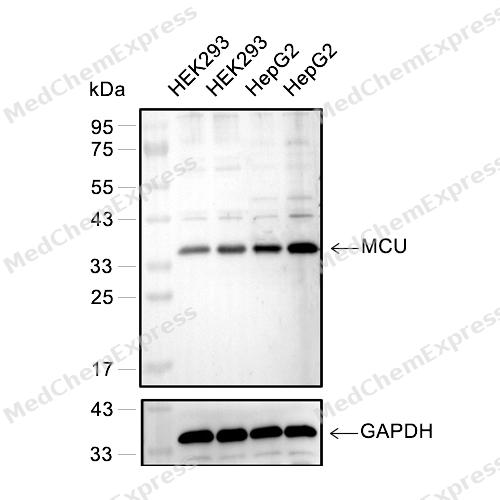 Western blot analysis of extracts from HEK293(lane 2(20μg) or lane 3(40μg)) and HepG2(lane 4(20μg) or lane 5(40μg)), using MCU (HY-P80216) Mouse mAb. Proteins were transferred to a PVDF membrane and blocked with 5% BSA in TBST for 2 hour at room temperature. The primary antibody (HY-P80216, 1/1000) and Loading control antibody (GAPDH, HY-P80954, 1/3000) was used in 5% BSA in TBST at 4°C overnight. Goat Anti-Mouse/Rabbit IgG-HRP Secondary Antibody (HY-P8004/HY-P8001, 1/10,000) was used for 1 hour at room temperature.
 -
 Immunocytochemistry analysis of NIH-3T3 cells labeling MCU with MCU Antibody (HY-P80216) at 1/50 dilution. Cells were fixed in 4% paraformaldehyde for 15 minutes at room temperature, permeabilized with 0.1% Triton X-100 in PBS for 15 minutes at room temperature, then blocked with quick block buffer for 10 minutes at room temperature. Cells were then incubated with MCU Antibody (HY-P80216) at 1/50 dilution in quick block buffer overnight at 4 ℃.AF488-conjugated Goat Anti-Mouse IgG H&L (HY-P8005, Green) was used as the secondary antibody at 1/1,000 dilution. PBS instead of the primary antibody was used as the secondary antibody only control. The Nuclear counterstain was DAPI (Blue).
 -
 Immunocytochemistry analysis of U2OS cells labeling MCU with MCU Antibody (HY-P80216) at 1/50 dilution. Cells were fixed in 4% paraformaldehyde for 15 minutes at room temperature, permeabilized with 0.1% Triton X-100 in PBS for 15 minutes at room temperature, then blocked with quick block buffer for 10 minutes at room temperature. Cells were then incubated with MCU Antibody (HY-P80216) at 1/50 dilution in quick block buffer overnight at 4 ℃.AF488-conjugated Goat Anti-Mouse IgG H&L (HY-P8005, Green) was used as the secondary antibody at 1/1,000 dilution. PBS instead of the primary antibody was used as the secondary antibody only control. The Nuclear counterstain was DAPI (Blue).


Background
-
Function
MCU is a Channel-forming and calcium-conducting subunit of the mitochondrial inner membrane calcium uniporter complex (uniplex), which mediates calcium uptake into the mitochondrial matrix. MCU channel activity is regulated by the calcium-sensor subunits of the uniplex MICU1 and MICU2 (or MICU3). Mitochondrial calcium homeostasis plays key roles in cellular physiology and regulates ATP production, cytoplasmic calcium signals and activation of cell death pathways. Involved in buffering the amplitude of systolic calcium rises in cardiomyocytes. While dispensable for baseline homeostatic cardiac function, acts as a key regulator of short-term mitochondrial calcium loading underlying a 'fight-or-flight' response during acute stress: acts by mediating a rapid increase of mitochondrial calcium in pacemaker cells. Participates in mitochondrial permeability transition during ischemia-reperfusion injury. Mitochondrial calcium uptake in skeletal muscle cells is involved in muscle size in adults. Regulates synaptic vesicle endocytosis kinetics in central nerve terminal. Regulates glucose-dependent insulin secretion in pancreatic beta-cells by regulating mitochondrial calcium uptake. Involved in antigen processing and presentation[1][2][3][4][5][6][7][8][9][10][11][12][13][14][15][16][17][18][19][20][21][22][23].
-
Subcellular Localization
Mitochondrion inner membrane; Multi-pass membrane protein
-
Expression
Induction:MCU transcripts are down-regulated by microRNA miR-25 (PubMed:23246404) . Down-regulation by miR-25 may protect cardiomyocytes against oxidative damage in cardiomyocytes (PubMed:25764156) -
Isoforms & Post-Translational Modification
Q8NE86 has 3 isomers: Q8NE86-1: 39867 Da (predicted); Q8NE86-2: 36996 Da (predicted); Q8NE86-3: 35159 Da (predicted).
Phosphorylation by CaMK2 in heart leads to increased MCU current (PubMed:23051746, PubMed:25254481). The regulation of MCU by CaMK2 is however subject to discussion: another group was unable to reproduce these results (PubMed:25254480). Phosphorylated on tyrosines by PTK2B/PYK2, promoting oligomerization (PubMed:24800979);Glutathionylation at Cys-97 in response to reactive oxygen species (ROS) promotes MCU higher-order assembly, leading to constitutive activation of the MCU channel and mitochondrial calcium overload;Undergoes proteolytic degradation by SPG7 -
Subunit
Homotetramer (PubMed:32494073). Component of the uniplex complex, composed of MCU, EMRE/SMDT1, MICU1 and MICU2 (or MICU3) in a 4:4:1:1 stoichiometry (PubMed:24231807, PubMed:26341627, PubMed:31080062, PubMed:32494073, PubMed:32862359). Interacts with CCDC109B/MCUB; this inhibits channel activity (PubMed:27184846). Interacts with MCUR1 (PubMed:23178883, PubMed:26341627, PubMed:26976564, PubMed:27184846). Interactions with MICU1 and MCUR1 are mutually exclusive (PubMed:23178883). Interacts with SLC25A23 (PubMed:24430870)
-
SwissProt ID
-
Synonyms
C10orf42, CCDC109A, MCU, HsMCU, Coiled-coil domain-containing protein 109A
-
Research Field
Cardiovascular
Documentation
-
Data Sheet (264 KB)
-
SDS (251 KB)
- English - EN (251 KB)
- Français - FR (251 KB)
- Deutsch - DE (251 KB)
- Norwegian - NO (251 KB)
- Español - ES (251 KB)
- Swedish - SV (251 KB)
- Italian - IT (251 KB)
- Korean - KR (251 KB)
- Portuguese - PT (251 KB)
-
User Guide for Antibodies (1077 KB)
References
[1]. Baughman JM, et al. Integrative genomics identifies MCU as an essential component of the mitochondrial calcium uniporter. Nature. 2011 Jun 19;476(7360):341-5. [Content Brief]
[2]. De Stefani D, et al. A forty-kilodalton protein of the inner membrane is the mitochondrial calcium uniporter. Nature. 2011 Jun 19;476(7360):336-40. [Content Brief]
[3]. Drago I, et al. Mitochondrial Ca2+ uptake contributes to buffering cytoplasmic Ca2+ peaks in cardiomyocytes. Proc Natl Acad Sci U S A. 2012 Aug 7;109(32):12986-91. [Content Brief]
[4]. Tarasov AI, et al. The mitochondrial Ca2+ uniporter MCU is essential for glucose-induced ATP increases in pancreatic β-cells. PLoS One. 2012;7(7):e39722. [Content Brief]
[5]. Alam MR, et al. Mitochondrial Ca2+ uptake 1 (MICU1) and mitochondrial ca2+ uniporter (MCU) contribute to metabolism-secretion coupling in clonal pancreatic β-cells. J Biol Chem. 2012 Oct 5;287(41):34445-54. [Content Brief]
[6]. Mallilankaraman K, et al. MICU1 is an essential gatekeeper for MCU-mediated mitochondrial Ca(2+) uptake that regulates cell survival. Cell. 2012 Oct 26;151(3):630-44. [Content Brief]
[7]. Mallilankaraman K, et al. MCUR1 is an essential component of mitochondrial Ca2+ uptake that regulates cellular metabolism. Nat Cell Biol. 2012 Dec;14(12):1336-43. [Content Brief]
[8]. Chaudhuri D, et al. MCU encodes the pore conducting mitochondrial calcium currents. Elife. 2013 Jun 4;2:e00704. [Content Brief]
[9]. Hoffman NE, et al. MICU1 motifs define mitochondrial calcium uniporter binding and activity. Cell Rep. 2013 Dec 26;5(6):1576-1588. [Content Brief]
[10]. Patron M, et al. MICU1 and MICU2 finely tune the mitochondrial Ca2+ uniporter by exerting opposite effects on MCU activity. Mol Cell. 2014 Mar 6;53(5):726-37. [Content Brief]
[11]. Lee Y, et al. Structure and function of the N-terminal domain of the human mitochondrial calcium uniporter. EMBO Rep. 2015 Oct;16(10):1318-33. [Content Brief]
[12]. Yoo J, et al. Cryo-EM structure of a mitochondrial calcium uniporter. Science. 2018 Aug 3;361(6401):506-511. [Content Brief]
[13]. Baradaran R, et al. Cryo-EM structures of fungal and metazoan mitochondrial calcium uniporters. Nature. 2018 Jul;559(7715):580-584. [Content Brief]
[14]. Paillard M, et al. MICU1 Interacts with the D-Ring of the MCU Pore to Control Its Ca(2+) Flux and Sensitivity to Ru360. Mol Cell. 2018 Nov 15;72(4):778-785.e3. [Content Brief]
[15]. Phillips CB, et al. The conserved aspartate ring of MCU mediates MICU1 binding and regulation in the mitochondrial calcium uniporter complex. Elife. 2019 Jan 15;8:. [Content Brief]
[16]. Wang Y, et al. Structural Mechanism of EMRE-Dependent Gating of the Human Mitochondrial Calcium Uniporter. Cell. 2019 May 16;177(5):1252-1261.e13. [Content Brief]
[17]. Fan M, et al. Structure and mechanism of the mitochondrial Ca(2+) uniporter holocomplex. Nature. 2020 Jun;582(7810):129-133. [Content Brief]
[18]. Wang Y, et al. Structural insights into the Ca(2+)-dependent gating of the human mitochondrial calcium uniporter. Elife. 2020 Aug 7;9:. [Content Brief]
[19]. Van Keuren AM, et al. Mechanisms of EMRE-Dependent MCU Opening in the Mitochondrial Calcium Uniporter Complex. Cell Rep. 2020 Dec 8;33(10):108486. [Content Brief]
[20]. Tsai CW, et al. Evidence supporting the MICU1 occlusion mechanism and against the potentiation model in the mitochondrial calcium uniporter complex. Proc Natl Acad Sci U S A. 2023 Apr 18;120(16):e2217665120. [Content Brief]
[21]. Rodríguez-Prados M, et al. MICU1 occludes the mitochondrial calcium uniporter in divalent-free conditions. Proc Natl Acad Sci U S A. 2023 May 9;120(19):e2218999120. [Content Brief]
[22]. Matesanz-Isabel J, et al. Functional roles of MICU1 and MICU2 in mitochondrial Ca(2+) uptake. Biochim Biophys Acta. 2016 Jun;1858(6):1110-7. [Content Brief]
[23]. Wu Y, et al. The mitochondrial uniporter controls fight or flight heart rate increases. Nat Commun. 2015 Jan 20;6:6081. [Content Brief]

 Powered by Bioz
