



Menadiol

Based on 1 Customer Validation
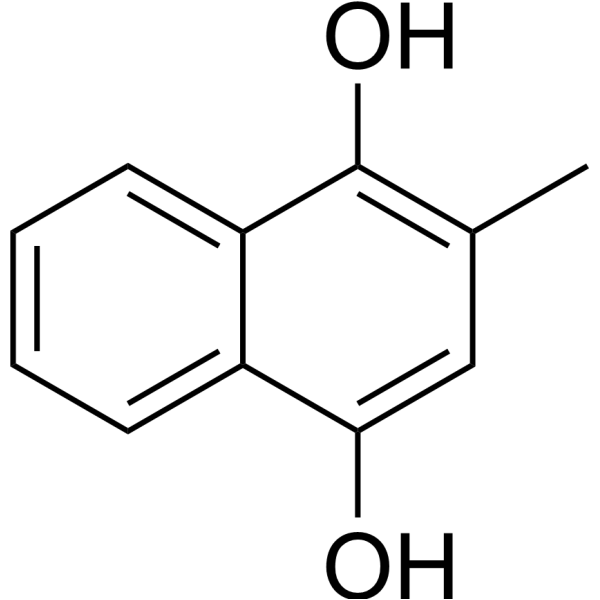
Menadiol (Dihydrovitamin K3) is a menadione analog that acts as an electron donor. Menadiol transfers electrons to the heme bL of E. coli nitrate reductase A and, via heme bH, to the catalytic NarGH dimer. Menadiol drives ATP-dependent NAD⁺ reduction (reverse electron transport) in submitochondrial particles. Menadiol selectively inhibits the growth of lymphoid tumor cells. Menadiol enhances the growth-inhibitory effects of Mechlorethamine, Vincristine (HY-N0488A), and Dexamethasone (HY-14648) on tumor cells, converting a drug-resistant phenotype to a sensitive phenotype. Menadiol is used in research related to lymphoid tumors.
Nur für Forschungszwecke. Wir verkaufen nicht an Patienten.
- Reinheit : 97.0%
- CAS. Nr.: 481-85-6
- Formel: C11H10O2
- Molecular Weight:174.20
-
Speicherung:
4°C, protect from light
* In solvent : -80°C, 6 months; -20°C, 1 month (protect from light)

To place orders, for customer services and technical support, please contact: MedChemExpress USA
Tel: 609-228-6898 E-mail: [email protected] [email protected]


-
 Biologische Aktivität
-
Chemical Information
-
Lösungsmittel & Löslichkeit
- Reinheit & Dokumentation
- Verweise
-
 Help & FAQs





Biologische Aktivität
Beschreibung
In Vitro
Menadiol (500 μM; 20 s) first transfers electrons to heme bL, and this process is a prerequisite for electron transfer to heme bH[1].
Menadiol (500 μM; 100 s) cannot reduce heme bH alone in the absence of heme bL, indicating that heme bL is a prerequisite for heme bH reduction[1].
After reduction with Menadiol (5 μM), wild-type NarGHI still shows heme re-oxidation upon the addition of Nitrate, whereas the four NarI mutants (H66Y, H187Y, H56R, H205Y) all show no significant change[2].
Menadiol is the reduced form of menadione/menaquinone and can act as an electron donor in mitochondrial reverse electron transport; in bovine heart submitochondrial particles, the rate of ATP-dependent NAD+ reduction mediated by menadiol is comparable to that of succinate, and this process is insensitive to antimycin and inhibited by uncouplers, suggesting that electrons enter the respiratory chain in an energy-dependent manner[2].
Menadiol (2.0 μg/mL (4.7 μM)) exhibits moderate toxicity toward HLN cells and enhances the cytotoxic effects of standard chemotherapeutic agents on HLN cells, but not on normal lymphocytes[3].
MedChemExpress (MCE) has not independently confirmed the accuracy of these methods. They are for reference only.


Chemical Information
-
CAS. Nr. 481-85-6
-
Appearance Solid
-
Molecular Weight 174.20
-
Formel C11H10O2
-
Color Pale purple to purple
-
SMILES
CC1=C(C2=CC=CC=C2C(=C1)O)O
-
Synonyms
Dihydrovitamin K3
-
Versand
Room temperature in continental US; may vary elsewhere.
-
Speicherung
4°C, protect from light
* In solvent : -80°C, 6 months; -20°C, 1 month (protect from light)


Lösungsmittel & Löslichkeit
In Vitro:
DMSO : 100 mg/mL (574.05 mM; Need ultrasonic; Hygroscopic DMSO has a significant impact on the solubility of product, please use newly opened DMSO)
Please refer to the solubility information to select the appropriate solvent. Once prepared, please aliquot and store the solution to prevent product inactivation from repeated freeze-thaw cycles.
Storage method and period of stock solution: -80°C, 6 months; -20°C, 1 month (protect from light). When stored at -80°C, please use it within 6 months. When stored at -20°C, please use it within 1 month.
Please refer to the solubility information to select the appropriate solvent. Once prepared, please aliquot and store the solution to prevent product inactivation from repeated freeze-thaw cycles.
Storage method and period of stock solution: -80°C, 6 months; -20°C, 1 month (protect from light). When stored at -80°C, please use it within 6 months. When stored at -20°C, please use it within 1 month.
Konzentration (Stammlösung) × Volumen (Stammlösung) = Konzentration (Ziellösung) × Volumen (Ziellösung)
In Vivo:
Select the appropriate dissolution method based on your experimental animal and administration route.
- For the following dissolution methods, please ensure to first prepare a clear stock solution using an In Vitro approach and then sequentially add co-solvents:
- To ensure reliable experimental results, the clarified stock solution can be appropriately stored based on storage conditions. As for the working solution for In Vivo experiments, it is recommended to prepare freshly and use it on the same day.
- The percentages shown for the solvents indicate their volumetric ratio in the final prepared solution. If precipitation or phase separation occurs during preparation, heat and/or sonication can be used to aid dissolution.
Add each solvent one by one: 10% DMSO 40% PEG300 5% Tween-80 45% Saline
Solubility: ≥ 2.08 mg/mL (11.94 mM); Clear solution
This protocol yields a clear solution of ≥ 2.08 mg/mL (saturation unknown).
Taking 1 mL working solution as an example, add 100 μL DMSO stock solution (20.8 mg/mL) to 400 μL PEG300, and mix evenly; then add 50 μL Tween-80 and mix evenly; then add 450 μL Saline to adjust the volume to 1 mL.
Preparation of Saline: Dissolve 0.9 g sodium chloride in ddH₂O and dilute to 100 mL to obtain a clear Saline solution.
Add each solvent one by one: 10% DMSO 90% (20% SBE-β-CD in Saline)
Solubility: ≥ 2.08 mg/mL (11.94 mM); Clear solution
This protocol yields a clear solution of ≥ 2.08 mg/mL (saturation unknown).
Taking 1 mL working solution as an example, add 100 μL DMSO stock solution (20.8 mg/mL) to 900 μL 20% SBE-β-CD in Saline, and mix evenly.
Preparation of 20% SBE-β-CD in Saline (4°C, storage for one week): 2 g SBE-β-CD powder is dissolved in 10 mL Saline, completely dissolve until clear.
In Vivo Dissolution Calculator
Please enter the basic information of animal experiments:
-
-
-
-
Recommended: Prepare an additional quantity of animals to account for potential losses during experiments.
Please enter your animal formula composition:
-
%DMSO +
Recommended: Keep the proportion of DMSO in working solution below 2% if your animal is weak.
-
%+
-
+%Tween-80 + +
-
%Saline +
The co-solvents required include: DMSO, . All of co-solvents are available by MedChemExpress (MCE). , Tween 80. All of co-solvents are available by MedChemExpress (MCE).
Working solution concentration: 0.22 mg/mL
Method for preparing stock solution: mg drug dissolved in μL DMSO. Stock solution concentration: mg/mL. * In solvent : -80°C, 6 months; -20°C, 1 month (protect from light)
1. Take μL DMSO stock solution;
2. Add μL .
μL , mix evenly;
3. Then add μL Tween 80, mix evenly;
4. Then add μL
Please ensure that the stock solution in the first step is dissolved to a clear state, and add co-solvents in sequence. You can use ultrasonic heating (ultrasonic cleaner, recommended frequency 20-40 kHz), vortexing, etc. to assist dissolution.


Reinheit & Dokumentation
-
Data Sheet (278 KB)
-
SDS (477 KB)
- English - EN (477 KB)
- Français - FR (477 KB)
- Deutsch - DE (477 KB)
- Norwegian - NO (477 KB)
- Español - ES (477 KB)
- Swedish - SV (477 KB)
- Italian - IT (477 KB)
- Korean - KR (477 KB)
- Portuguese - PT (477 KB)
-
Handling Instructions (2659 KB)
Verweise
[1]. Zhao Z, et al. Effects of site-directed mutations on heme reduction in Escherichia coli nitrate reductase A by menaquinol: a stopped-flow study. Biochemistry. 2003 Dec 09;42(48):14225-33. [Content Brief]
[2]. Taggart WV, et al. Menadiol as an electron donor for reversed oxidative phosphorylation in submitochondrial particles. Biochim Biophys Acta. 1972 Jun 23;267(3):439-43. [Content Brief]


Complete Stock Solution Preparation Table
Please refer to the solubility information to select the appropriate solvent. Once prepared, please aliquot and store the solution to prevent product inactivation from repeated freeze-thaw cycles.
Storage method and period of stock solution: -80°C, 6 months; -20°C, 1 month (protect from light). When stored at -80°C, please use it within 6 months. When stored at -20°C, please use it within 1 month.
| Optional Solvent | Concentration Solvent Mass | 1 mg | 5 mg | 10 mg | 25 mg |
|---|---|---|---|---|---|
| DMSO | 1 mM | 5.7405 mL | 28.7026 mL | 57.4053 mL | 143.5132 mL |
| 5 mM | 1.1481 mL | 5.7405 mL | 11.4811 mL | 28.7026 mL | |
| 10 mM | 0.5741 mL | 2.8703 mL | 5.7405 mL | 14.3513 mL | |
| 15 mM | 0.3827 mL | 1.9135 mL | 3.8270 mL | 9.5675 mL | |
| 20 mM | 0.2870 mL | 1.4351 mL | 2.8703 mL | 7.1757 mL | |
| 25 mM | 0.2296 mL | 1.1481 mL | 2.2962 mL | 5.7405 mL | |
| 30 mM | 0.1914 mL | 0.9568 mL | 1.9135 mL | 4.7838 mL | |
| 40 mM | 0.1435 mL | 0.7176 mL | 1.4351 mL | 3.5878 mL | |
| 50 mM | 0.1148 mL | 0.5741 mL | 1.1481 mL | 2.8703 mL | |
| 60 mM | 0.0957 mL | 0.4784 mL | 0.9568 mL | 2.3919 mL | |
| 80 mM | 0.0718 mL | 0.3588 mL | 0.7176 mL | 1.7939 mL | |
| 100 mM | 0.0574 mL | 0.2870 mL | 0.5741 mL | 1.4351 mL |


Menadiol Related Classifications
HY-W128525 Related Classifications
 Powered by Bioz
Keywords
- Menadiol
- 481-85-6
- Dihydrovitamin K3
- Dihydrovitamin K 3
- Dihydrovitamin K-3
- Mitochondrial Metabolism
- Oxidative Phosphorylation
- mitochondrial respiratory chain
- NarGH dimer
- human lymphatic neoplasm cells
- heme b_L
- menadione semiquinone radical anion
- E. coli nitrate reductase A
- reversed electron flow
- heme b_H
- bovine heart submitochondrial particles
- menaquinol analogue
- Inhibitor
- inhibitor
- inhibit