



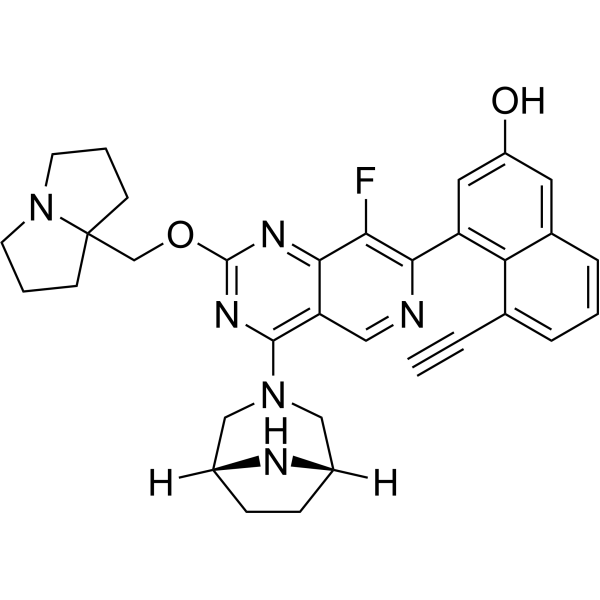
MRTX-EX185
MRTX-EX185 is a potent KRAS (G12D) inhibitor with an IC50 of 90 nM. MRTX-EX185 can binds both GDP-loaded and active GNP states of KRAS and KRAS (G12D). MRTX-EX185 exhibits broad-spectrum binding properties with IC50s of 110, 290, 130 and 240 nM for KRAS WT, KRAS (G12C), KRAS (Q61H), KRAS (G13D). MRTX-EX185 also binds GDP-loaded HRAS. MRTX-EX185 can be used to study various RAS-driven tumors (such as pancreatic cancer) .
Nur für Forschungszwecke. Wir verkaufen nicht an Patienten.
- CAS. Nr.: 2621927-57-7
- Formel: C33H33FN6O2
- Molecular Weight:564.65
-
Speicherung:
Please store the product under the recommended conditions in the Certificate of Analysis.

To place orders, for customer services and technical support, please contact: MedChemExpress USA
Tel: 609-228-6898 E-mail: [email protected] [email protected]


-
 Biologische Aktivität
-
Chemical Information
- Reinheit & Dokumentation
- Verweise
-
 Help & FAQs




Biologische Aktivität
Beschreibung
IC50 & Target
[1]|
KRas G12D 90 nM (IC50) |
K-Ras WT 110 nM (IC50) |
KRas G12C 290 nM (IC50) |
KRas G12V 700 nM (IC50) |
KRAS G13D 240 nM (IC50) |
KRas Q61H 130 nM (IC50) |
In Vitro
MRTX-EX185 (0.1 nM-100 μM) suppresses cell proliferation (IC50 = 70 nM) in KRAS (G12D)-driven SW-1990 pancreatic cancer cells, and is non-toxic to non-KRAS-dependent cell lines (HEK293 cells)[1].
MRTX-EX185 (1 nM-100 μM) significantly inhibits ERK phosphorylation (p-ERK) in KRAS(G12C)-driven cell lineages[1].
MedChemExpress (MCE) has not independently confirmed the accuracy of these methods. They are for reference only. .


Chemical Information
-
CAS. Nr. 2621927-57-7
-
Appearance Solid
-
Molecular Weight 564.65
-
Formel C33H33FN6O2
-
Color Light brown to brown
-
SMILES
OC1=CC(C2=C(F)C3=NC(OCC45CCCN4CCC5)=NC(N6C[C@@](N7)([H])CC[C@@]7([H])C6)=C3C=N2)=C8C(C#C)=CC=CC8=C1
-
Versand
Room temperature in continental US; may vary elsewhere.
-
Speicherung
Please store the product under the recommended conditions in the Certificate of Analysis.


Reinheit & Dokumentation
-
Data Sheet (273 KB)
-
SDS (252 KB)
- Français - FR (252 KB)
- Deutsch - DE (252 KB)
- Norwegian - NO (252 KB)
- Español - ES (252 KB)
- Swedish - SV (252 KB)
- Italian - IT (252 KB)
- Korean - KR (252 KB)
- Portuguese - PT (252 KB)
-
Handling Instructions (2659 KB)
Verweise

Calculators
Konzentration (Stammlösung) × Volumen (Stammlösung) = Konzentration (Ziellösung) × Volumen (Ziellösung)


MRTX-EX185 Related Classifications
HY-145962 Related Classifications
 Powered by Bioz