



Zinc Phytate
Based on 1 publication(s) in Google Scholar
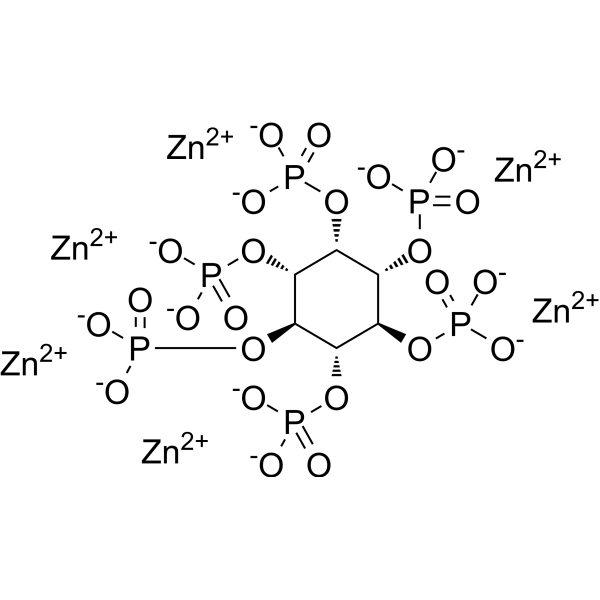
Zinc Phytate (myo-Inositol; hexakis dihydrogen phosphate; Inositol hexaphosphate) is an orally active compound. Zinc Phytate can be derived from the seeds of legumes. Zinc Phytate is a [PO4]3- storage depot and precursor for other inositol phosphates and pyrophosphates. Zinc Phytate attenuates Aβ oligomers and upregulates autophagy protein. Zinc Phytate can be used in cardiovascular disease, metabolic disease, nervous system disease and cancer research.
Nur für Forschungszwecke. Wir verkaufen nicht an Patienten.
- Reinheit : 99.77%
- CAS. Nr.: 63903-51-5
- Formel: C6H6O24P6Zn6
- Molecular Weight:1040.22
-
Speicherung:
4°C, sealed storage, away from moisture and light
* In solvent : -80°C, 6 months; -20°C, 1 month (sealed storage, away from moisture and light)

To place orders, for customer services and technical support, please contact: MedChemExpress USA
Tel: 609-228-6898 E-mail: [email protected] [email protected]


-
 Biologische Aktivität
-
Chemical Information
-
Lösungsmittel & Löslichkeit
- Protokoll
- Reinheit & Dokumentation
- Verweise
-
 Help & FAQs


Publications Citing Use of MedChemExpress (MCE) Zinc Phytate
MoreAlle Endogenous Metabolite Isoform-spezifische Produkte anzeigen
More

Biologische Aktivität
Beschreibung
IC50 & Target
|
Human Endogenous Metabolite |
In Vitro
Zinc Phytate (Phytic acid; 0.05%-0.4% (wt/wt), 5 min) and sodium chloride show marked synergistic bactericidal effects against nonadapted and acid-adapted Escherichia coli O157:H7 strains[2].
Zinc Phytate (Phytic acid; 1-5 mM, 2-3 h) decreases the integrity of Caco-2 cell monolayers by modulating the TJ proteins' localization and down-regulating the expression levels of TJ proteins, and does not cause cytotoxicity to Caco-2 cells[3].
Zinc Phytate (Phytic acid; 48-72 h) provides complete protection against amyloid precursor protein-C-terminal fragment-induced cytotoxicity by attenuating levels of increased intracellular calcium, hydrogen peroxide, superoxide, Aβ oligomers, and moderately upregulated the expression of autophagy (beclin-1) protein in MC65 cells[5].
Zinc Phytate (Phytic acid; ≥1 mM) stimulates suicidal human erythrocyte death[6].
MedChemExpress (MCE) has not independently confirmed the accuracy of these methods. They are for reference only.
-
Cell Line:Caco-2
-
Concentration:1, 2, 2.5, 3.5, 5 mM
-
Incubation Time:3 h
-
Result:Showed over 90% of the cells were viable when IP6 concentrations of 1-5 mM were used during the experiments.
In Vivo
Zinc Phytate (Phytic acid; 2%, drinking water, 6 months) improves Alzheimer's pathology (AP180, beclin-1, LC3B, sirtuin 1) in Tg2576 mice[5].
Zinc Phytate (Phytic acid; 20 mg/kg, i.p., pretreatment at 5 h before coronary artery occlusion) suppresses ischemia-induced hydroxyl radical generation in rat myocardium[7].
Zinc Phytate (Phytic acid; 100 mg/kg/d, gavage, five days a week, 8 weeks) shows protective effects against CCl4-induced liver fibrosis in mice[8].
Phytic acid (Phytic acid; 4% of rodent chow, diet, 30 days) reduces lipogenic enzyme activities in diabetic rats[9].
Zinc Phytate (Phytic acid; 1-2 g/100 g, in water, 13 weeks) shows anticarcinogenic effect in colon carcinoma rats, with 36% (1 g/100 g Phytic acid) and 42% (2 g/100 g Phytic acid) reduction in ACF, respectively[10].
MedChemExpress (MCE) has not independently confirmed the accuracy of these methods. They are for reference only.
-
Animal Model:Piglets with an initial BW of 7.40 kg[4]
-
Dosage:2% (Phytic acid/food)
-
Administration:diet, 21 days
-
Result:Did not affect the blood plasma glucose and Na concentrations.
Reduced total potential difference and total short-circuit current.
Did not affect the blood plasma glucose and Na concentrations.
Did not affect the SGLT1 protein expression.


Chemical Information
-
CAS. Nr. 63903-51-5
-
Appearance Solid
-
Molecular Weight 1040.22
-
Formel C6H6O24P6Zn6
-
Color White to off-white
-
SMILES
O=P([O-])([O-])O[C@H]([C@H]([C@H](OP([O-])([O-])=O)[C@H]1OP([O-])([O-])=O)OP([O-])([O-])=O)[C@H]([C@H]1OP([O-])([O-])=O)OP([O-])([O-])=O.[Zn+2].[Zn+2].[Zn+2].[Zn+2].[Zn+2].[Zn+2]
-
Structure Classification
-
Initial Source
-
Versand
Room temperature in continental US; may vary elsewhere.
-
Speicherung
4°C, sealed storage, away from moisture and light
* In solvent : -80°C, 6 months; -20°C, 1 month (sealed storage, away from moisture and light)


Publications (1)
-
Journal Impact Factor
-
Most Recent


Lösungsmittel & Löslichkeit
In Vitro:
H2O : 50 mg/mL (48.07 mM; Need ultrasonic)
10%TFA : 50 mg/mL (48.07 mM; ultrasonic and adjust pH to 2 with 10%TFA)
Please refer to the solubility information to select the appropriate solvent. Once prepared, please aliquot and store the solution to prevent product inactivation from repeated freeze-thaw cycles.
Storage method and period of stock solution: -80°C, 6 months; -20°C, 1 month (sealed storage, away from moisture and light). When stored at -80°C, please use it within 6 months. When stored at -20°C, please use it within 1 month.
* Note: If you choose water as the stock solution, please dilute it to the working solution, then filter and sterilize it with a 0.22 μm filter before use.
Please refer to the solubility information to select the appropriate solvent. Once prepared, please aliquot and store the solution to prevent product inactivation from repeated freeze-thaw cycles.
Storage method and period of stock solution: -80°C, 6 months; -20°C, 1 month (sealed storage, away from moisture and light). When stored at -80°C, please use it within 6 months. When stored at -20°C, please use it within 1 month.
* Note: If you choose water as the stock solution, please dilute it to the working solution, then filter and sterilize it with a 0.22 μm filter before use.
Konzentration (Stammlösung) × Volumen (Stammlösung) = Konzentration (Ziellösung) × Volumen (Ziellösung)


Reinheit & Dokumentation
-
Data Sheet (288 KB)
-
SDS (252 KB)
- English - EN (252 KB)
- Français - FR (252 KB)
- Deutsch - DE (252 KB)
- Norwegian - NO (252 KB)
- Español - ES (252 KB)
- Swedish - SV (252 KB)
- Italian - IT (252 KB)
- Korean - KR (252 KB)
- Portuguese - PT (252 KB)
-
Handling Instructions (2659 KB)
Verweise
[1]. Shears SB, et al.Assessing the omnipotence of inositol hexakisphosphate.Cell Signal. 2001 Mar;13(3):151-8. [Content Brief]
[2]. Kim NH, et al. Phytic Acid and Sodium Chloride Show Marked Synergistic Bactericidal Effects against Nonadapted and Acid-Adapted Escherichia coli O157:H7 Strains. Appl Environ Microbiol. 2015 Dec 4;82(4):1040-1049. [Content Brief]
[3]. Fu Q, et al. The effect of phytic acid on tight junctions in the human intestinal Caco-2 cell line and its mechanism. Eur J Pharm Sci. 2015 Dec 1;80:1-8. [Content Brief]
[4]. Woyengo TA, et al. Effect of dietary phytic acid on performance and nutrient uptake in the small intestine of piglets. J Anim Sci. 2012 Feb;90(2):543-9. [Content Brief]
[5]. Anekonda TS, et al. Phytic acid as a potential treatment for alzheimer's pathology: evidence from animal and in vitro models. J Alzheimers Dis. 2011;23(1):21-35. [Content Brief]
[6]. Eberhard M, et al. Effect of phytic acid on suicidal erythrocyte death. J Agric Food Chem. 2010 Feb 10;58(3):2028-33. [Content Brief]
[7]. Obata T, et al. Phytic acid suppresses ischemia-induced hydroxyl radical generation in rat myocardium. Eur J Pharmacol. 2016 Mar 5;774:20-4. [Content Brief]
[9]. Omoruyi FO, et al. The potential benefits and adverse effects of phytic Acid supplement in streptozotocin-induced diabetic rats. Adv Pharmacol Sci. 2013;2013:172494. [Content Brief]


Complete Stock Solution Preparation Table
Please refer to the solubility information to select the appropriate solvent. Once prepared, please aliquot and store the solution to prevent product inactivation from repeated freeze-thaw cycles.
Storage method and period of stock solution: -80°C, 6 months; -20°C, 1 month (sealed storage, away from moisture and light). When stored at -80°C, please use it within 6 months. When stored at -20°C, please use it within 1 month.
| Optional Solvent | Concentration Solvent Mass | 1 mg | 5 mg | 10 mg | 25 mg |
|---|---|---|---|---|---|
| H2O / 10%TFA | 1 mM | 0.9613 mL | 4.8067 mL | 9.6134 mL | 24.0334 mL |
| 5 mM | 0.1923 mL | 0.9613 mL | 1.9227 mL | 4.8067 mL | |
| 10 mM | 0.0961 mL | 0.4807 mL | 0.9613 mL | 2.4033 mL | |
| 15 mM | 0.0641 mL | 0.3204 mL | 0.6409 mL | 1.6022 mL | |
| 20 mM | 0.0481 mL | 0.2403 mL | 0.4807 mL | 1.2017 mL | |
| 25 mM | 0.0385 mL | 0.1923 mL | 0.3845 mL | 0.9613 mL | |
| 30 mM | 0.0320 mL | 0.1602 mL | 0.3204 mL | 0.8011 mL | |
| 40 mM | 0.0240 mL | 0.1202 mL | 0.2403 mL | 0.6008 mL |
* Note: If you choose water as the stock solution, please dilute it to the working solution, then filter and sterilize it with a 0.22 μm filter before use.


Zinc Phytate Related Classifications
HY-N2580 Related Classifications
 Powered by Bioz