



ATX-II
Based on 1 publication(s) in Google Scholar
ATX-II is a selective sodium channel modulator toxin. ATX-II enhances late sodium current, prevents full sodium channel inactivation, and generates persistent current fractions. ATX-II has pro-arrhythmic effect. ATX-II slows intrinsic heart rate, prolongs QT interval and sinus node recovery time, and causes sinus pauses and arrests. ATX-II can be used for the research of atrial fibrillation, long QT syndrome, and long QT3 syndrome.
For research use only. We do not sell to patients.
- Purity : 97.07%
- CAS No.: 60748-45-0
- Formula: C213H323N63O61S6
- Molecular Weight:4934.62
-
Storage:
Sealed storage, away from moisture and light.
Powder -80°C, 2 years , -20°C, 1 year* In solvent : -80°C, 6 months; -20°C, 1 month (sealed storage, away from moisture and light)

To place orders, for customer services and technical support, please contact: MedChemExpress USA
Tel: 609-228-6898 E-mail: [email protected] [email protected]


-
 Biological Activity
-
Chemical Information
-
Solvent & Solubility
- Purity & Documentation
- References
-
 Help & FAQs


Publications Citing Use of MedChemExpress (MCE) ATX-II
More

Biological Activity
Description
In Vitro
ATX-II (5 nM; 1.5 min post-application) enhances tetrodotoxin sensitive resurgent and persistent sodium currents in large diameter mouse DRG neurons at both 22°C and 30°C, and shifts the voltage dependence of activation and steady-state fast inactivation of TTXS sodium channels to more hyperpolarized potentials[3].
ATX-II (5 nM) enhances resurgent and persistent sodium currents in Nav1.7-expressing HEK293 cells when the β4-subunit C-terminus peptide is present in the pipette solution, shifts Nav1.7 activation to more depolarized potentials, and prolongs the slow time constant of Nav1.7 current decay[3].
ATX-II (5 nM) enhances resurgent and persistent sodium currents in Nav1.6-expressing N1E115 cells when the β4-subunit C-terminus peptide is present in the pipette solution, shifts Nav1.6 activation to more hyperpolarized potentials, reduces the fractional amplitude of the fast component of current decay, and prolongs the slow time constant of Nav1.6 current decay[3].
ATX-II (8.8-50 nM; 30 min) concentration-dependently increases diastolic tension and arrhythmia score in isolated rat right atrial tissue with IC50 values of 8.8 nM and 22.4 nM, respectively[4].
ATX-II (50 nM) significantly increases diastolic intracellular Ca2+ concentrations in isolated rat atrial myocytes[4].
MedChemExpress (MCE) has not independently confirmed the accuracy of these methods. They are for reference only.


Chemical Information
-
CAS No. 60748-45-0
-
Appearance Solid
-
Molecular Weight 4934.62
-
Formula C213H323N63O61S6
-
Color White to off-white
-
Sequence
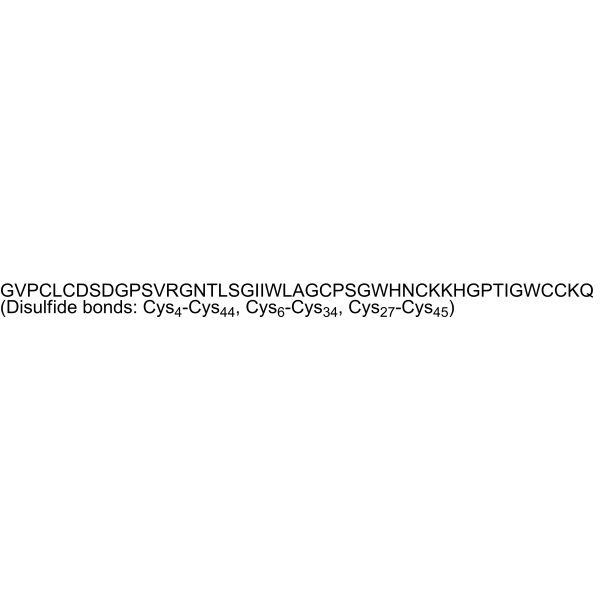
Gly-Val-Pro-Cys-Leu-Cys-Asp-Ser-Asp-Gly-Pro-Ser-Val-Arg-Gly-Asn-Thr-Leu-Ser-Gly-Ile-Ile-Trp-Leu-Ala-Gly-Cys-Pro-Ser-Gly-Trp-His-Asn-Cys-Lys-Lys-His-Gly-Pro-Thr-Ile-Gly-Trp-Cys-Cys-Lys-Gln (Disulfide bonds: Cys4-Cys44, Cys6-Cys34, Cys27-Cys45)
-
Sequence Shortening
GVPCLCDSDGPSVRGNTLSGIIWLAGCPSGWHNCKKHGPTIGWCCKQ (Disulfide bonds: Cys4-Cys44, Cys6-Cys34, Cys27-Cys45)
-
Shipping
Room temperature in continental US; may vary elsewhere.
-
Storage
Sealed storage, away from moisture and light
Powder -80°C 2 years -20°C 1 year * In solvent : -80°C, 6 months; -20°C, 1 month (sealed storage, away from moisture and light)


Publications (1)
-
Journal Impact Factor
-
Most Recent
-
Adv Healthc Mater
2025 Sep 15:e02975. PMID: 40954980


Solvent & Solubility
In Vitro:
DMSO : 100 mg/mL (20.26 mM; Need ultrasonic; Hygroscopic DMSO has a significant impact on the solubility of product, please use newly opened DMSO)
Please refer to the solubility information to select the appropriate solvent. Once prepared, please aliquot and store the solution to prevent product inactivation from repeated freeze-thaw cycles.
Storage method and period of stock solution: -80°C, 6 months; -20°C, 1 month (sealed storage, away from moisture and light). When stored at -80°C, please use it within 6 months. When stored at -20°C, please use it within 1 month.
Please refer to the solubility information to select the appropriate solvent. Once prepared, please aliquot and store the solution to prevent product inactivation from repeated freeze-thaw cycles.
Storage method and period of stock solution: -80°C, 6 months; -20°C, 1 month (sealed storage, away from moisture and light). When stored at -80°C, please use it within 6 months. When stored at -20°C, please use it within 1 month.
Concentration (start) × Volume (start) = Concentration (final) × Volume (final)


Purity & Documentation
-
Data Sheet (277 KB)
-
SDS (252 KB)
- English - EN (252 KB)
- Français - FR (252 KB)
- Deutsch - DE (252 KB)
- Norwegian - NO (252 KB)
- Español - ES (252 KB)
- Swedish - SV (252 KB)
- Italian - IT (252 KB)
- Korean - KR (252 KB)
- Portuguese - PT (252 KB)
-
Handling Instructions (2659 KB)
References
[1]. Lu YY, et al. ATX-II-induced pulmonary vein arrhythmogenesis related to atrial fibrillation and long QT syndrome. Eur J Clin Invest. 2012;42(8):823-831. [Content Brief]
[2]. Wu J, et al. Sinus node dysfunction in ATX-II-induced in-vitro murine model of long QT3 syndrome and rescue effect of ranolazine. Prog Biophys Mol Biol. 2008;98(2-3):198-207. [Content Brief]
[3]. Klinger AB, et al. Sea-anemone toxin ATX-II elicits A-fiber-dependent pain and enhances resurgent and persistent sodium currents in large sensory neurons. Mol Pain. 2012;8:69. Published 2012 Sep 15. [Content Brief]
[4]. Liang F, et al. Inhibitions of late INa and CaMKII act synergistically to prevent ATX-II-induced atrial fibrillation in isolated rat right atria. J Mol Cell Cardiol. 2016 May;94:122-130. [Content Brief]


Complete Stock Solution Preparation Table
Please refer to the solubility information to select the appropriate solvent. Once prepared, please aliquot and store the solution to prevent product inactivation from repeated freeze-thaw cycles.
Storage method and period of stock solution: -80°C, 6 months; -20°C, 1 month (sealed storage, away from moisture and light). When stored at -80°C, please use it within 6 months. When stored at -20°C, please use it within 1 month.
| Optional Solvent | Concentration Solvent Mass | 1 mg | 5 mg | 10 mg | 25 mg |
|---|---|---|---|---|---|
| DMSO | 1 mM | 0.2026 mL | 1.0132 mL | 2.0265 mL | 5.0662 mL |
| 5 mM | 0.0405 mL | 0.2026 mL | 0.4053 mL | 1.0132 mL | |
| 10 mM | 0.0203 mL | 0.1013 mL | 0.2026 mL | 0.5066 mL | |
| 15 mM | 0.0135 mL | 0.0675 mL | 0.1351 mL | 0.3377 mL | |
| 20 mM | 0.0101 mL | 0.0507 mL | 0.1013 mL | 0.2533 mL |


ATX-II Related Classifications
HY-P1604 Related Classifications
 Powered by Bioz