



BACE1-IN-5
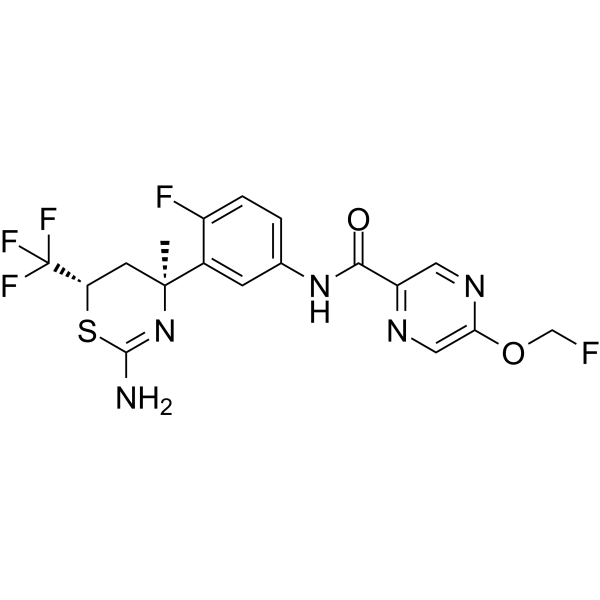
BACE1-IN-5 (Compound 15) is a β-site amyloid precursor protein cleaving enzyme 1 (BACE1) inhibitor with an IC50 of 9.1 nM, and also inhibits cellular amyloid-β (Aβ) with an IC50 of 0.82 nM. BACE1-IN-5 has a medicinal chemistry that improves hERG inhibition and P-gp efflux.
For research use only. We do not sell to patients.
- CAS No.: 2581114-83-0
- Formula: C18H16F5N5O2S
- Molecular Weight:461.41
-
Storage:
Please store the product under the recommended conditions in the Certificate of Analysis.

To place orders, for customer services and technical support, please contact: MedChemExpress USA
Tel: 609-228-6898 E-mail: [email protected] [email protected]


-
 Biological Activity
-
Chemical Information
- Protocols
- Purity & Documentation
- References
-
 Help & FAQs




Biological Activity
Description
IC50 & Target
|
BACE1 |
In Vivo
MedChemExpress (MCE) has not independently confirmed the accuracy of these methods. They are for reference only.
-
Animal Model:Male ICR mice[1]
-
Dosage:1 mg/kg, 3 mg/kg
-
Administration:Oral administration; for 2 hours, 4 hours, and 6 hours
-
Result:A significant and dose-dependent decrease of total Aβ was seen, reduced total Aβ by 76% (4 h) at a free brain concentration of 4.1 ng/mL (8.9 nM) at 1 mg/kg. Demonstrats a Kp,uu value close to 1 (Kp,uu of 1.3) at 1 mg/kg (4 h time point). At 3 mg/kg, a maximum Aβ reduction of 87% was achieved at a free brain concentration of 9.5 ng/mL (21 nM).


Chemical Information
-
CAS No. 2581114-83-0
-
Molecular Weight 461.41
-
Formula C18H16F5N5O2S
-
SMILES
O=C(C1=NC=C(OCF)N=C1)NC2=CC=C(F)C([C@@]3(C)N=C(N)S[C@H](C(F)(F)F)C3)=C2
-
Shipping
Room temperature in continental US; may vary elsewhere.
-
Storage
Please store the product under the recommended conditions in the Certificate of Analysis.

Protocols
-
Cell Cytotoxicity Assay
Cytotoxicity assays are usually based on the assessment of cell membrane damage, which can also be indirectly detected by measuring cell viability. Detection methods include MTT assay, CKK-8 assay, LDH assay and ATP assay, etc.
-
Amyloid: Congo Red Amyloid Staining
Congo red amyloid staining is a histochemical method used to detect extracellular amyloid deposits in tissue sections based on the affinity of Congo red dye for β-pleated sheet-rich protein aggregates. When bound to amyloid, Congo red produces characteristic apple-green birefringence under polarized light microscopy, which is widely regarded as a diagnostic feature of amyloid deposition in histopathology. The diagnostic principle relies on the combination of dye binding (congophilia) and optical anisotropy under polarized illumination, which distinguishes amyloid from most non-amyloid eosinophilic extracellular deposits in routine histological evaluation. Amyloid identification by Congo red staining remains a cornerstone in diagnostic pathology despite the availability of adjunct methods such as immunohistochemistry and mass spectrometry, particularly because of its ability to localize deposits directly within tissue architecture. The specificity of Congo red-positive deposits is incre
-
Alzheimer’s Disease Modeling
Alzheimer’s Disease (AD) is a neurodegenerative disorder characterized by a progressive decline in cognitive functions and loss of specific types of neurons and synapses. Alzheimer's symptoms can be simulated in mice by injecting drugs (such as Aβ) or genetically modified.


Purity & Documentation
References

Calculators
Concentration (start) × Volume (start) = Concentration (final) × Volume (final)


BACE1-IN-5 Related Classifications
HY-130244 Related Classifications
 Powered by Bioz