



Glufosinate
Based on 1 publication(s) in Google Scholar
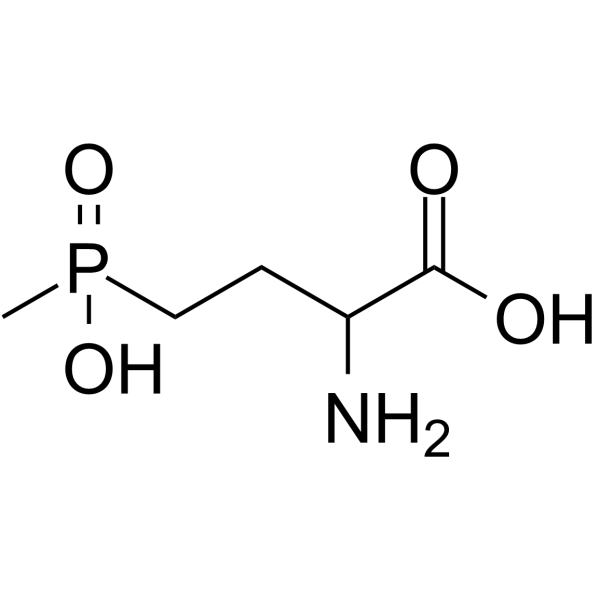
Glufosinate, a phosphinic acid analogue of glutamic acid, is a herbicide which is converted by plant cells into PT (L-phosphinothricin). Glufosinate exerts neurotoxic activity.
For research use only. We do not sell to patients.
- CAS No.: 51276-47-2
- Formula: C5H12NO4P
- Molecular Weight:181.13
-
Storage:Powder -20°C, 3 years ; In solvent -80°C, 6 months , -20°C, 1 month

To place orders, for customer services and technical support, please contact: MedChemExpress USA
Tel: 609-228-6898 E-mail: [email protected] [email protected]


-
 Biological Activity
-
Chemical Information
- Protocols
- Purity & Documentation
- References
-
 Help & FAQs


Publications Citing Use of MedChemExpress (MCE) Glufosinate
More

Biological Activity
Description
In Vitro
Glufosinate (1-100 μM; 12DIV) disrupts cell-cell adhesion in differentiated V-SVZ neural stem cells (NSCs)[2].
Glufosinate (1-100 μM; 12DIV) significantly decreases Celsr2 gene expression at 100 μM[2].
Glufosinate impairs ependymal cell capability to synthetize cilia[2].
MedChemExpress (MCE) has not independently confirmed the accuracy of these methods. They are for reference only.
In Vivo
The Elimination of Glufosinate (oral intubation) in the blood takes place with a half-life of less than 4 hours in male and female rats[3].
MedChemExpress (MCE) has not independently confirmed the accuracy of these methods. They are for reference only.


Chemical Information
-
CAS No. 51276-47-2
-
Appearance Solid
-
Molecular Weight 181.13
-
Formula C5H12NO4P
-
Color Light brown to brown
-
SMILES
CP(O)(CCC(N)C(O)=O)=O
-
Structure Classification
-
Initial Source
Streptomyces viridochromogenes
-
Shipping
Room temperature in continental US; may vary elsewhere.
-
Storage
Powder -20°C 3 years In solvent -80°C 6 months -20°C 1 month


Publications (1)
-
Journal Impact Factor
-
Most Recent
-
Microbiome
An iron-binding protein of entomopathogenic fungus suppresses the proliferation of host symbiotic bacteria. [Abstract]2024 Oct 15;12(1):202. PMID: 39407320


Purity & Documentation
-
Data Sheet (298 KB)
-
SDS (252 KB)
- Français - FR (252 KB)
- Deutsch - DE (252 KB)
- Norwegian - NO (252 KB)
- Español - ES (252 KB)
- Swedish - SV (252 KB)
- Italian - IT (252 KB)
- Korean - KR (252 KB)
- Portuguese - PT (252 KB)
-
Handling Instructions (2659 KB)
References
[1]. Áy Z, et al. The effect of high concentrations of glufosinate ammonium on the yield components of transgenic spring wheat (Triticum aestivum L.) constitutively expressing the bar gene. ScientificWorldJournal. 2012;2012:657945. [Content Brief]
[2]. Feat-Vetel J, et al. Multiple effects of the herbicide glufosinate-ammonium and its main metabolite on neural stem cells from the subventricular zone of newborn mice. Neurotoxicology. 2018 Dec;69:152-163. [Content Brief]
[3]. Ebert E, et al. Summary of safety evaluation toxicity studies of glufosinate ammonium. Food Chem Toxicol. 1990 May;28(5):339-49. [Content Brief]

Calculators
Concentration (start) × Volume (start) = Concentration (final) × Volume (final)


Glufosinate Related Classifications
HY-W019870A Related Classifications
 Powered by Bioz