



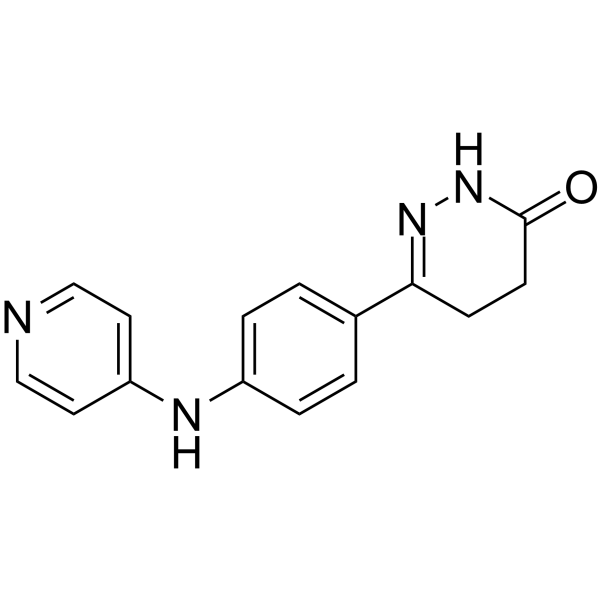
Senazodan
Senazodan (MCI 154) is a Ca2+ sensitiser, and also shows inhibition effect on PDE III.
Nos produits utilisent uniquement pour la recherche. Nous ne vendons pas aux patients.
- CAS No.: 98326-32-0
- Formule: C15H14N4O
- Masse moléculaire:266.30
-
Stockage:
Please store the product under the recommended conditions in the Certificate of Analysis.

To place orders, for customer services and technical support, please contact: MedChemExpress USA
Tel: 609-228-6898 E-mail: [email protected] [email protected]


-
 Activité biologique
-
Chemical Information
- Protocole
- Pureté et documentation
- Références
-
 Help & FAQs




Activité biologique
Description
IC50 & Target
PDE III[1]
Cellular Effect
|
Cell Line

|
Type | Value | Description | References |
|---|---|---|---|---|
| Platelet | IC50 |
0.36 μM
Compound: MCI-154
|
Antiplatelet activity in human platelet
Antiplatelet activity in human platelet
|
[PMID: 34902735] |
In Vitro
Senazodan seems to affect directly the actin-myosin crossbridge kinetics, and increase myosin ATPase activity[1]. Senazodan produces a concentration-dependent increase in tension development. Senazodan enhances Ca2+ binding to myofilaments and to purified cardiac troponin C. Senazodan also enhances contractility in guinea-pig papillary muscles by inhibiting PDE III[2]. Senazodan (0.1 nM~0.1 mM) shows that the contractile response of superior mesenteric arterie (SMA) to norepinephrine (NE) after hemorrhagic shock is significantly decreased as compared with the normal control group. Senazodan (0.01 mM) pretreatment prevents the effects of Ang II, and the concentration-response curve of Ca2+ is shifted to the right as compared with Ang II-alone group[3].
MedChemExpress (MCE) has not independently confirmed the accuracy of these methods. They are for reference only.
In Vivo
Senazodan (0.1 mg/kg; i.v.) makes LVSP, IP, MC, and Lo all increased significantly, while heart rate is not obviously changed and left ventricular end-diastolic pressure (LVEDP) is reduced remarkably[4].
MedChemExpress (MCE) has not independently confirmed the accuracy of these methods. They are for reference only.
-
Animal Model:Wistar rats (200~250 g)[3]
-
Dosage:0.1~2.0 mg/kg
-
Administration:Left femoral vein catheterization infusion
-
Result:Decreased the pressor effect of norepinephrine (NE).
-
Animal Model:Rabbits[4]
-
Dosage:0.1 mg/kg
-
Administration:I.v.
-
Result:LVSP, IP, MC, and Lo all were increased significantly while heart rate was not obviously changed and left ventricular end-diastolic pressure (LVEDP) was reduced remarkably.


Chemical Information
-
CAS No. 98326-32-0
-
Masse moléculaire 266.30
-
Formule C15H14N4O
-
SMILES
O=C1CCC(C2=CC=C(NC3=CC=NC=C3)C=C2)=NN1
-
Synonyms
MCI 154
-
Livraison
Room temperature in continental US; may vary elsewhere.
-
Stockage
Please store the product under the recommended conditions in the Certificate of Analysis.


Pureté et documentation
Références
[1]. Lehtonen LA, et al. Pharmacokinetics and pharmacodynamics of intravenous inotropic agents. Clin Pharmacokinet. 2004;43(3):187-203. [Content Brief]
[2]. Erhardt L. An emerging role for calcium sensitisation in the treatment of heart failure. Expert Opin Investig Drugs. 2005 Jun;14(6):659-70. [Content Brief]
[3]. Yang G, et al. Effects of MCI-154 on vascular reactivity and its mechanisms after hemorrhagic shock in rats. J Cardiovasc Pharmacol. 2006;47(6):751-757. [Content Brief]
[4]. Ming MJ, et al. Effects of MCI-154, a calcium sensitizer, on cardiac dysfunction in endotoxic shock in rabbits. Shock. 2000;13(6):459-463. [Content Brief]

Calculators
Concentration (start) × Volume (start) = Concentration (final) × Volume (final)


Senazodan Related Classifications
HY-101693 Related Classifications
 Powered by Bioz