



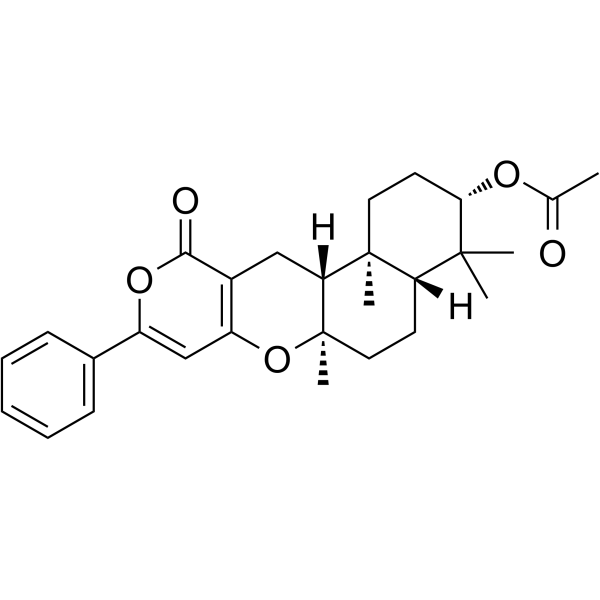
Phenylpyropene C
Phenylpyropene C (S14-95), a JAK/STAT pathway inhibitor, can inhibit IFN-γ mediated expression of the reporter gene (IC50=5.4~10.8 μM). Phenylpyropene C also is an inhibitor of acyl-CoA, with an IC50 of 16.0 μM.
Nos produits utilisent uniquement pour la recherche. Nous ne vendons pas aux patients.
- CAS No.: 419532-92-6
- Formule: C28H34O5
- Masse moléculaire:450.57
-
Stockage:
Please store the product under the recommended conditions in the Certificate of Analysis.

To place orders, for customer services and technical support, please contact: MedChemExpress USA
Tel: 609-228-6898 E-mail: [email protected] [email protected]


-
 Activité biologique
-
Chemical Information
- Protocole
- Pureté et documentation
- Références
-
 Help & FAQs




Activité biologique
Description
IC50 & Target
[1]|
ACAT 16.0 μM (IC50) |
In Vitro
Phenylpyropene C (0.1-1000 μM) inhibits ACAT activity with the IC50 of 16.0 μM in a dose dependent fashion[1].
Phenylpyropene C inhibits the IFN-γ mediated expression of the reporter gene with IC50s of 5.4 μM to approximately 10.8 μM[2].
Phenylpyropene C inhibits the expression of the proinflammatory enzymes COX-2 and NOS II at 10.8 μM in LPS/IFN-γ stimulated J774 mouse macrophages[2].
Phenylpyropene C inhibits the activation of the p38 MAP kinase, which is involved in the inducible expression of many proinflammatory genes[2].
MedChemExpress (MCE) has not independently confirmed the accuracy of these methods. They are for reference only. Further protocols information, click here.


Chemical Information
-
CAS No. 419532-92-6
-
Masse moléculaire 450.57
-
Formule C28H34O5
-
SMILES
C[C@@]12[C@]3([H])[C@](OC4=C(C(OC(C5=CC=CC=C5)=C4)=O)C3)(CC[C@@]1([H])C(C)([C@H](CC2)OC(C)=O)C)C
-
Synonyms
S14-95
-
Livraison
Room temperature in continental US; may vary elsewhere.
-
Stockage
Please store the product under the recommended conditions in the Certificate of Analysis.

Protocole
-
RNA extraction experimental
By lysing cells, releasing RNA, and removing impurities such as proteins and DNA, high-purity RNA products are finally obtained. The commonly used traditional method is the guanidine isothiocyanate/phenol/chloroform method (Trizol), which is suitable for a variety of animal materials including animal tissues, microorganisms, cultured cells, etc., and most plant materials.
-
Cell Cytotoxicity Assay
Cytotoxicity assays are usually based on the assessment of cell membrane damage, which can also be indirectly detected by measuring cell viability. Detection methods include MTT assay, CKK-8 assay, LDH assay and ATP assay, etc.


Pureté et documentation
Références
[1]. Rho MC, et, al. Phenylpyropene C, a new inhibitor of acyl-CoA: cholesterol acyltransferase produced by Penicillium griseofulvum F1959. J Antibiot (Tokyo). 2002 Feb;55(2):211-4. [Content Brief]
[2]. Erkel G, et, al. S14-95, a novel inhibitor of the JAK/STAT pathway from a Penicillium species. J Antibiot (Tokyo). 2003 Apr;56(4):337-43. [Content Brief]

Calculators
Concentration (start) × Volume (start) = Concentration (final) × Volume (final)


Phenylpyropene C Related Classifications
HY-115734 Related Classifications
 Powered by Bioz