

24 Results for "

chaperone function

" in MedChemExpress (MCE) Product Catalog:
Products (24)

24 Results for "chaperone function" in MCE Product Catalog:

7
7 Cited Publications
Cat. No.: HY-18705
CAS No.: 932986-18-0
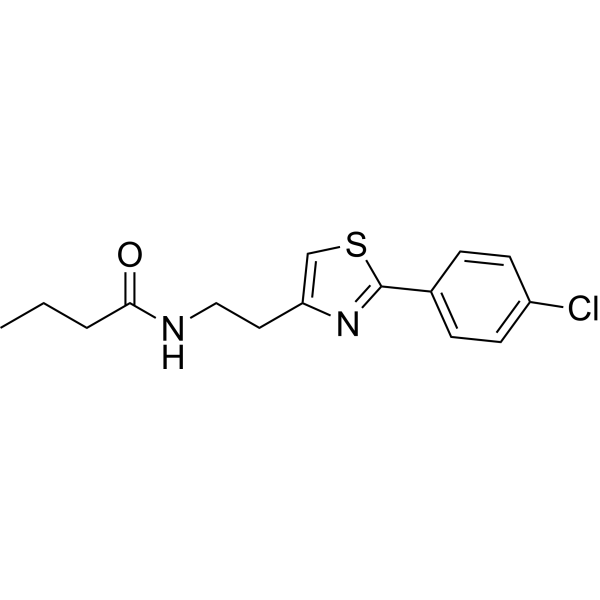
Azoramide is a potent, orally active small-molecule modulator of the unfolded protein response (UPR). Azoramide improves ER protein folding and elevates ER chaperone capacity, which together protects cells against ER stress. Azoramide alleviates PLA2G6 mutant-induced ER stress through modulating unfolded protein response, and enhances the CERB signaling to rescue mitochondrial function, thereby preventing apoptosis of DA neurons. Azoramide has antidiabetic activity .
loading...
    loading...
6
6 Cited Publications
Cat. No.: HY-124653
CAS No.: 2133499-85-9
Pureté:  99.70%
Synonyms: J2
Target:  

HSP

Domaines de recherche:  

Cancer

HSP27 inhibitor J2 (J2) is a HSP27 inhibitor, which significantly induces abnormal HSP27 dimer formation and inhibits a production of HSP27 giant polymers, thereby having an effect of inhibiting a chaperone function of the HSP27 and reducing a cell protection function thereof. HSP27 inhibitor J2 (J2) remarkably enhances the antiproliferative activity of 17-AAG and sensitizes cisplatin-induced lung cancer cell growth inhibition .
loading...
    loading...
Cat. No.: HY-112747
CAS No.: 97281-51-1
Synonyms: LPI; PE (soy)
Target:  

Phospholipase

Domaines de recherche:  

Infection

Soy PE (LPI) is the most abundant phospholipid in prokaryotes and the second most abundant found in the membrane of mammalian, plant, and yeast cells, comprising approximately 25% of total mammalian phospholipids. In the brain, phosphatidylethanolamine comprises almost half of the total phospholipids. It is synthesized mainly through the cytidine diphosphate-ethanolamine and phosphatidylserine decarboxylation pathways, which occur in the endoplasmic reticulum (ER) and mitochondrial membranes, respectively. It is a precursor in the synthesis of phosphatidylcholine and arachidonoyl ethanolamide and is a source of ethanolamine used in various cellular functions. In E.coli, phosphatidylethanolamine deficiency prevents proper assembly of lactose permease, suggesting a role as a lipid chaperone. It is a cofactor in the propagation of prions in vitro and can convert recombinant mammalian proteins into infectious molecules even in the absence of RNA. This product contains phosphatidylethanolamine molecular species with variable fatty acyl chain lengths at the sn-1 and sn-2 positions .
loading...
    loading...
Cat. No.: HY-148215A
CAS No.: 1253584-63-2
Pureté:  99.27%
Domaines de recherche:  

Cancer

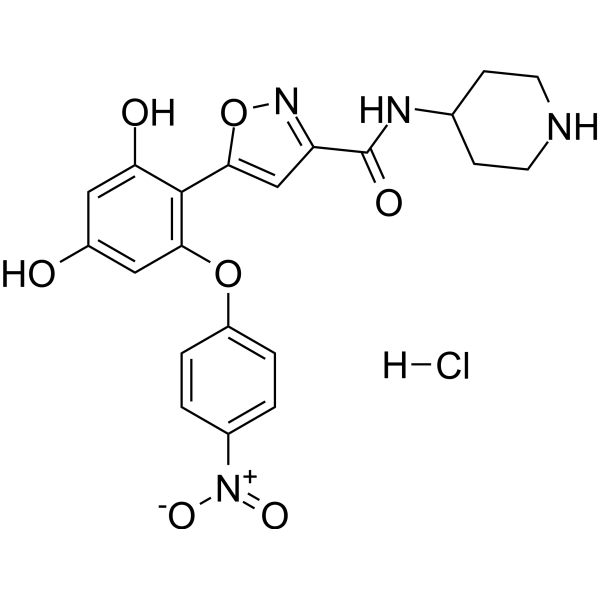
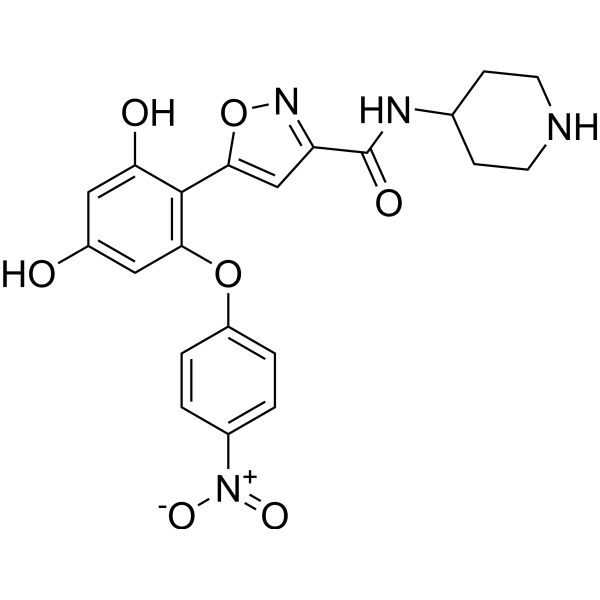
Hsp90-IN-17 hydrochloride is a Hsp90 inhibitor. Hsp90-IN-17 hydrochloride binds to the N-terminal ATP-binding pocket of Hsp90, inhibits its chaperone function, and induces the degradation of Hsp90 client proteins. Hsp90-IN-17 hydrochloride inhibits cancer cell proliferation. Hsp90-IN-17 hydrochloride can be used in the research of ovarian cancer .
loading...
    loading...
Cat. No.: HY-P2961
CAS No.: 50812-37-8
Domaines de recherche:  

Cancer

Glutathione S-transferase is a phase II metabolic enzyme consisting of three superfamilies: cytosolic, mitochondrial, and microsomal. Glutathione S-transferase possesses various catalytic activities such as catalytic detoxification and thiol transfer, as well as chaperone function. GSTP1, a subtype of Glutathione S-transferase, is highly expressed in malignant tissues and serves as a tumor marker .
loading...
    loading...
Cat. No.: HY-164399
CAS No.: 1799802-29-1
Target:  

HSP EGFR CDK Akt

Domaines de recherche:  

Cancer

SST0116CL1 is a HSP90 inhibitor (IC50: 0.21 μM). SST0116CL1 binds to the ATP binding pocket of Hsp90, and interferes with Hsp90 chaperone function thus resulting in client protein (EGFR, CDK4 and AKT) degradation. SST0116CL1 induces degradation of Her2 in BT-474 cell (IC50: 0.2 μM). SST0116CL1 has antiproliferative activity and inhibits tumor growth. SST0116CL1 can be used for the study of leukemia, gastric and ovarian carcinoma .
loading...
    loading...
Cat. No.: HY-148215
CAS No.: 1253584-78-9
Target:  

HSP

Domaines de recherche:  

Cancer

Hsp90-IN-17 is a Hsp90 inhibitor. Hsp90-IN-17 binds to the N-terminal ATP-binding pocket of Hsp90, inhibits its chaperone function, and induces the degradation of Hsp90 client proteins. Hsp90-IN-17 inhibits cancer cell proliferation. Hsp90-IN-17 can be used in the research of ovarian cancer .
loading...
    loading...
Cat. No.: HY-P10541
CAS No.: 156343-40-7
Target:  

HSP

Domaines de recherche:  

Others

HSP70/DnaK substrate peptide is a short peptide that the HSP70/DnaK molecular chaperone can bind and act on. HSP70/DnaK substrate peptide can be used to study the mechanism of action of HSP70/DnaK in molecular chaperone function .
loading...
    loading...
Cat. No.: HY-P10541A
Target:  

HSP

Domaines de recherche:  

Others

HSP70/DnaK substrate peptide TFA is a short peptide that the HSP70/DnaK molecular chaperone can bind and act on. HSP70/DnaK substrate peptide TFA can be used to study the mechanism of action of HSP70/DnaK in molecular chaperone function .
loading...
    loading...
Cat. No.: HY-13752
CAS No.: 1118915-78-8
Domaines de recherche:  

Cancer

STA-1474 is an orally active and highly selective HSP90 inhibitor, as well as a phosphate prodrug of the HSP90 inhibitor STA-9090 (HY-15205). STA-1474 disrupts the chaperone function of HSP90 and promotes the degradation of client proteins. STA-1474 inhibits the phosphorylation of Met, Akt and STAT3, thereby blocking related signaling pathways. STA-1474 induces apoptosis and inhibits proliferation of osteosarcoma cells, and triggers the up-regulation of HSP70 and HSP90. STA-1474 induces tumor regression and caspase-3 activation in mouse osteosarcoma xenograft models. STA-1474 can be used in the research of osteosarcoma .
loading...
    loading...
Cat. No.: HY-179012
Target:  

APC CDK Raf Akt HSP

Domaines de recherche:  

Cancer

CDC20/HSP90-IN-1 (Compound 2b) is a Cdc20/Hsp90 inhibitor with a Kd of 16.2 μM for Cdc20 and a Kd of 0.241 μM for Hsp90α. CDC20/HSP90-IN-1 exerts potent antitumor activity through reducing p53-mediated Cdc20, upregulating Bim, downregulating Cyclin B1 expression, and disturbing B-Raf and AKT pathways via destroying Hsp90 chaperone function. CDC20/HSP90-IN-1 overcomes Vemurafenib (HY-12057)-induced resistant melanoma .
loading...
    loading...
Cat. No.: HY-P2930
CAS No.: 95076-93-0
Domaines de recherche:  

Others

Peptidylprolyl isomerase is an enzyme that catalyzes the cis-trans isomerization of peptidylprolyl amino groups. Peptidylprolyl isomerase may be involved in cellulase modification. Peptidylprolyl isomerase also functions as a chaperone protein .
loading...
    loading...
Cat. No.: HY-115513
CAS No.: 1332879-51-2
Target:  

Endogenous Metabolite

Domaines de recherche:  

Infection

Pitstop 1 is a small molecule inhibitor with endocytosis-inhibiting activity. Pitstop 1 blocks the interaction of chaperones with the Krasin terminal domain in cells, thereby affecting the function of Krasin. Pitstop 1 exhibits superior biological activity in significantly inhibiting the effects of Krasin. Pitstop 1 acts as a dose that inhibits the entry of viruses and pathogens into cells and modulates cell signaling .
loading...
    loading...
Cat. No.: HY-173150
CAS No.: 106928-29-4
Target:  

YAP

Hapalindole Q (Compound (+)-1) is an autophagy (Autophagy) inhibitor targeting YAP1. Hapalindole Q binds to the Hippo pathway transcription factor YAP1 with a Kd of 9.13 μM and induces its degradation via the chaperone-mediated autophagy (CMA) pathway. This process inhibits Rab7-mediated fusion of autophagosomes and lysosomes, thereby reducing overall autophagy levels without affecting lysosomal function. Hapalindole Q holds promise for research in cancer (e.g., liver cancer, breast cancer, etc.) .
loading...
    loading...
Cat. No.: HY-N6678S
CAS No.: 1795020-90-4
(Rac)-Zearalanone-d6 is the d6-labeled (Rac)-Zearalanone (HY-N6678A). (Rac)-Zearalanone is an ATP-competitive HSP90 inhibitor with an EC50 of 2.3 μM. (Rac)-Zearalanone interferes with the binding of ATP to HSP90, impairs the chaperone function of HSP90, and promotes the degradation of client proteins. (Rac)-Zearalanone reduces intracellular accumulation of Raf-1, induces cleavage of caspase-3, and promotes Her2 degradation in a dose-dependent manner by disrupting the Her2-HSP90 interaction. (Rac)-Zearalanone can be used in the research of small cell lung cancer and breast cancer .
loading...
    loading...
Cat. No.: HY-164399A
CAS No.: 1202920-93-1
Target:  

HSP ERK CDK Akt

Domaines de recherche:  

Cancer

SST0116CL1 free base is a HSP90 inhibitor (IC50: 0.21 μM). SST0116CL1 free base binds to the ATP binding pocket of Hsp90, and interferes with Hsp90 chaperone function thus resulting in client protein (EGFR, CDK4 and AKT) degradation. SST0116CL1 free base induces degradation of Her2 in BT-474 cell (IC50: 0.2 μM). SST0116CL1 free base has antiproliferative activity and inhibits tumor growth. SST0116CL1 free base has antiproliferative activity and inhibits tumor growth. SST0116CL1 free base can be used for the study of leukemia, gastric and ovarian carcinoma .
loading...
    loading...
Cat. No.: HY-P70119
Pureté:  ≥ 95%, as determined by reducing SDS-PAGE.
Synonyms: rHuHistone chaperone ASF1A/ASF1A, T7-His; Histone chaperone ASF1A; Anti-Silencing function Protein 1 Homolog A; hAsf1; hAsf1a; CCG1-Interacting Factor A; CIA; hCIA; ASF1A
Species:  
Source:  
loading...
    loading...
Cat. No.: HY-119732
CAS No.: 2134571-29-0
Target:  

HSP

Domaines de recherche:  

Neurological Disease Cancer

KUNG94 is a selective Grp94/HSP90B inhibitor (IC50=8 nM). By inhibiting the chaperone function of Grp94, KUNG94 reduces the maturation and cell surface trafficking of its specific client proteins. KUNG94 can be used for studies on Grp94-related biological mechanisms, as well as diseases including cancer and primary open-angle glaucoma .
loading...
    loading...
Cat. No.: HY-121706
CAS No.: 422508-29-0
Target:  

HSP

Domaines de recherche:  

Cancer

PU-20F is a Hsp90 inhibitor with an EC50 of 6.8 μM. PU-20F competes with Geldanamycin (HY-15230) for binding to Hsp90 and regulates the function of this molecular chaperone. PU-20F induces the degradation of oncogenic Her2 tyrosine kinase. PU-20F blocks the growth of breast cancer cells. PU-20F can be used in breast cancer-related research .
loading...
    loading...
Cat. No.: HY-181020
Domaines de recherche:  

Cancer

Deltafluorine is a phosphodiesterase delta (PDEδ) inhibitor with an IC50 of 27 nM, a KD of 148 nM. Deltafluorine covalently modifies the specific glutamate residue p.E88 in the ligand binding site of PDEδ, interfering with its chaperone function. Deltafluorine inhibits signaling through the MAPK and Akt-mTOR pathway, reduces ERK1/2 expression. Deltafluorine reduces tumor volume in an autochthonous mouse model of Kras-driven lung adenocarcinoma. Deltafluorine can be used for the research of lung adenocarcinoma .
loading...
    loading...

