



133-06-2
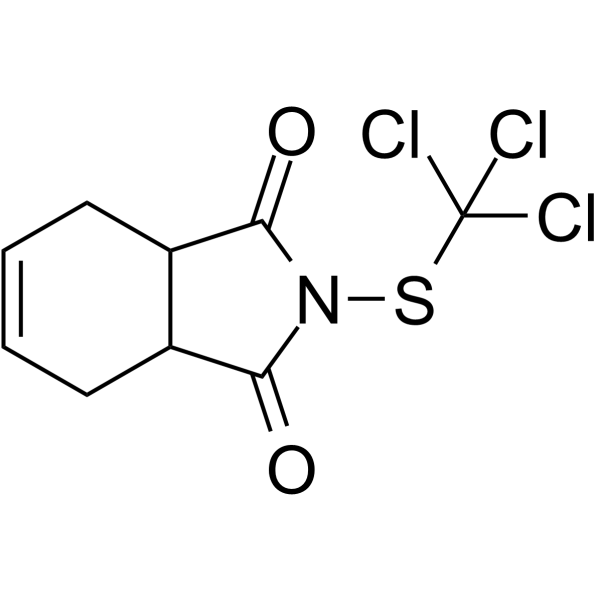
Chemical Structure
Captan
- CAS No.: 133-06-2
- Formula:C9H8Cl3NO2S
- Molecular Weight:300.59
IUPAC Name: 2-((trichloromethyl)thio)-3a,4,7,7a-tetrahydro-1H-isoindole-1,3(2H)-dione
InChIKey: LDVVMCZRFWMZSG-UHFFFAOYSA-N
SMILES: O=C1N(SC(Cl)(Cl)Cl)C(C2CC=CCC12)=O
Biological Activity: Captan is a thiol-reactive fungicide. Captan irreversibly depletes protein and non-protein thiols (including glutathione), reducing enzyme activity and fungal respiration/metabolism. Captan inhibits DNA synthesis and replication fork progression, and induces ROS accumulation, oxidative stress, inflammation, ER stress, mitochondrial dysfunction, autophagy, DNA damage, and apoptosis as well as loss of membrane integrity with necrosis. Captan is used to control fungal diseases of various fruits, vegetables, and ornamental plants[1][2][3][4].
| Cat. No. | Product Name | Purity | Description | Pricing | |||||||||||||||||||
|---|---|---|---|---|---|---|---|---|---|---|---|---|---|---|---|---|---|---|---|---|---|---|---|
|
|
Captan | 98.34% | Captan is a thiol-reactive fungicide. Captan irreversibly depletes protein and non-protein thiols (including glutathione), reducing enzyme activity and fungal respiration/metabolism. Captan inhibits DNA synthesis and replication fork progression, and induces ROS accumulation, oxidative stress, inflammation, ER stress, mitochondrial dysfunction, autophagy, DNA damage, and apoptosis as well as loss of membrane integrity with necrosis. Captan is used to control fungal diseases of various fruits, vegetables, and ornamental plants. | ||||||||||||||||||||
|
loading...
/
|
|||||||||||||||||||||||
|
|
Captan (Standard) | ≥98% | Captan (Standard) is the analytical standard of Captan (HY-B1584). This product is intended for research and analytical applications. Captan is a thiol-reactive fungicide. Captan irreversibly depletes protein and non-protein thiols (including glutathione), reducing enzyme activity and fungal respiration/metabolism. Captan inhibits DNA synthesis and replication fork progression, and induces ROS accumulation, oxidative stress, inflammation, ER stress, mitochondrial dysfunction, autophagy, DNA damage, and apoptosis as well as loss of membrane integrity with necrosis. Captan is used to control fungal diseases of various fruits, vegetables, and ornamental plants. | ||||||||||||||||||||
|
loading...
/
|
|||||||||||||||||||||||
|
|
Captan-d6 | Captan-d6 is the deuterated-labeled Captan (HY-B1584). Captan is a thiol-reactive fungicide. Captan irreversibly depletes protein and non-protein thiols (including glutathione), reducing enzyme activity and fungal respiration/metabolism. Captan inhibits DNA synthesis and replication fork progression, and induces ROS accumulation, oxidative stress, inflammation, ER stress, mitochondrial dysfunction, autophagy, DNA damage, and apoptosis as well as loss of membrane integrity with necrosis. Captan is used to control fungal diseases of various fruits, vegetables, and ornamental plants. | |||||||||||||||||||||
|
loading...
/
|
|||||||||||||||||||||||
-
Similarity Score 0.53
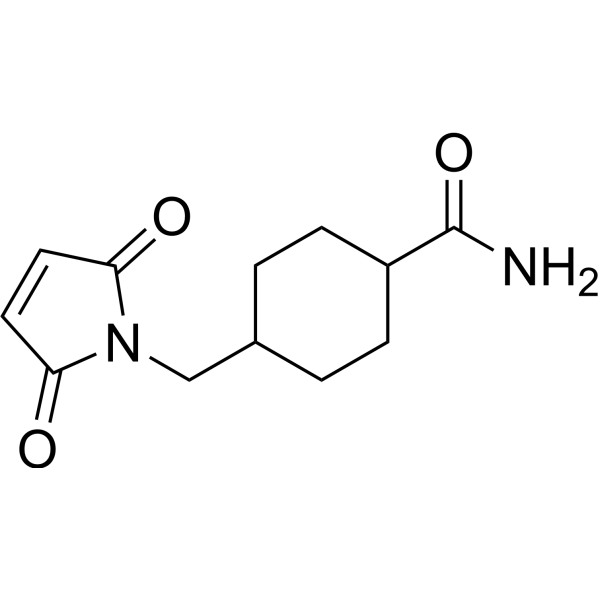 HY-132251MCC
-
Similarity Score 0.53
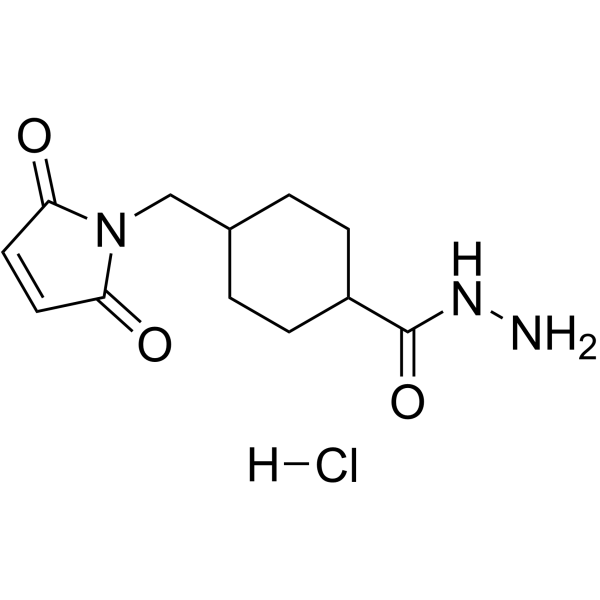 HY-133410AMal-C2-cyclohexylcarboxyl-hydrazide hydrochloride
-
Similarity Score 0.53
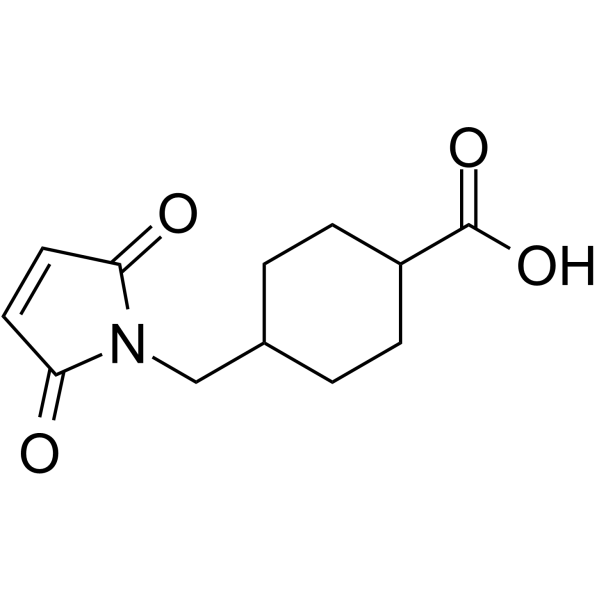 HY-42359N-(4-Carboxycyclohexylmethyl)maleimide
-
Similarity Score 0.52
 HY-W013170RMGK-264 (Standard)
-
Similarity Score 0.51
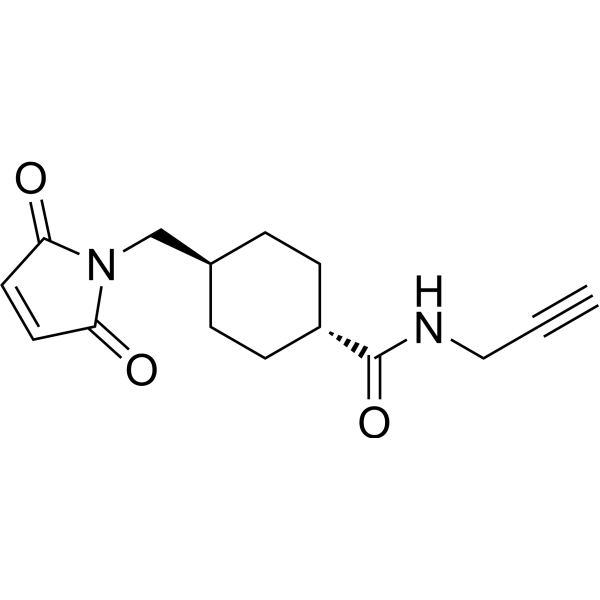 HY-151752Mal-AMCHC-N-Propargylamide
-
Similarity Score 0.51
 HY-Z8069Buspirone impurity 10
-
Similarity Score 0.51
 HY-179733CRBN ligand-191
-
Similarity Score 0.50
 HY-Z8070Buspirone impurity 11
-

Explore the MedChemAI to find more analogs


References
- [1]. Scariot FJ, et al. Necrotic and apoptotic cell death induced by Captan on Saccharomyces cerevisiae. World journal of microbiology & biotechnology. 2017 Aug;33(8):159.
- [2]. Fernandez-Vidal A, et al. Exposure to the Fungicide Captan Induces DNA Base Alterations and Replicative Stress in Mammalian Cells. Environmental and molecular mutagenesis. 2019 Apr;60(3):286-297.
- [3]. He QK, et al. Captan exposure disrupts ovarian homeostasis and affects oocytes quality via mitochondrial dysfunction induced apoptosis. Chemosphere. 2022 Jan;286(Pt 1):131625.
- [4]. Inoue T, et al. Captan-induced increase in the concentrations of intracellular Ca2+ and Zn2+ and its correlation with oxidative stress in rat thymic lymphocytes. Environ Toxicol Pharmacol. 2018 Oct;63:78-83.



