



83-86-3
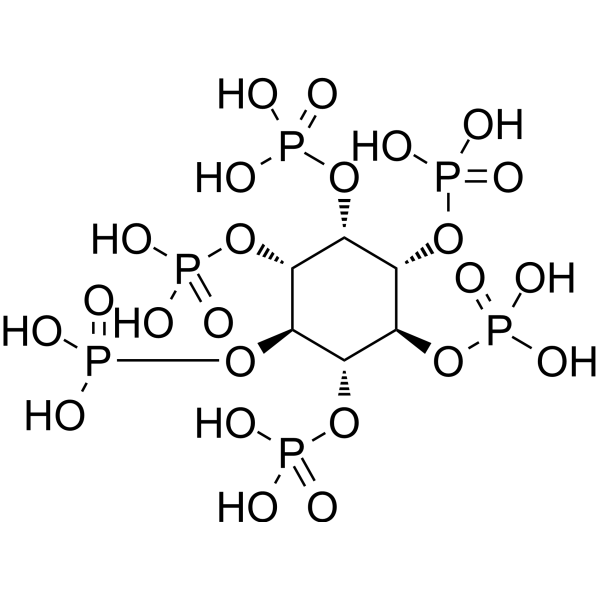
Chemical Structure
Phytic acid (50% w/w in water)
Synonym(s): Inositol hexaphosphate; SNF472 free acid
- CAS No.: 83-86-3
- Formula:C6H18O24P6
- Molecular Weight:660.04
IUPAC Name: (1R,2r,3S,4R,5s,6S)-cyclohexane-1,2,3,4,5,6-hexayl hexakis(dihydrogen phosphate)
InChIKey: IMQLKJBTEOYOSI-GPIVLXJGSA-N
SMILES: O=P(O)(O)O[C@H]([C@H]([C@H](OP(O)(O)=O)[C@H]1OP(O)(O)=O)OP(O)(O)=O)[C@H]([C@H]1OP(O)(O)=O)OP(O)(O)=O
Biological Activity:
Phytic acid (50% w/w in water) (Inositol hexaphosphate) is an orally active compound. Phytic acid can be derived from the seeds of legumes. Phytic acid (50% w/w in water) is a [PO4]3- storage depot and precursor for other inositol phosphates and pyrophosphates. Phytic acid (50% w/w in water) attenuates Aβ oligomers and upregulates autophagy protein. Phytic acid (50% w/w in water) can be used in cardiovascular disease, metabolic disease, nervous system disease and cancer research[1][2][3][4][5][6][7][8][9][10].
The product specifications provided below indicate the total amount only; they do not represent the actual content of Phytic acid.
| Cat. No. | Product Name | Purity | Description | Pricing | |||||||||||||||||||
|---|---|---|---|---|---|---|---|---|---|---|---|---|---|---|---|---|---|---|---|---|---|---|---|
|
|
Phytic acid (50% w/w in water) | 99.60% | Phytic acid (50% w/w in water) (Inositol hexaphosphate) is an orally active compound. Phytic acid can be derived from the seeds of legumes. Phytic acid (50% w/w in water) is a [PO4]3- storage depot and precursor for other inositol phosphates and pyrophosphates. Phytic acid (50% w/w in water) attenuates Aβ oligomers and upregulates autophagy protein. Phytic acid (50% w/w in water) can be used in cardiovascular disease, metabolic disease, nervous system disease and cancer research. The product specifications provided below indicate the total amount only; they do not represent the actual content of Phytic acid. |
||||||||||||||||||||
|
loading...
/
|
|||||||||||||||||||||||
-
Similarity Score 0.99
 HY-166984Phytic acid calcium
-
Similarity Score 0.86
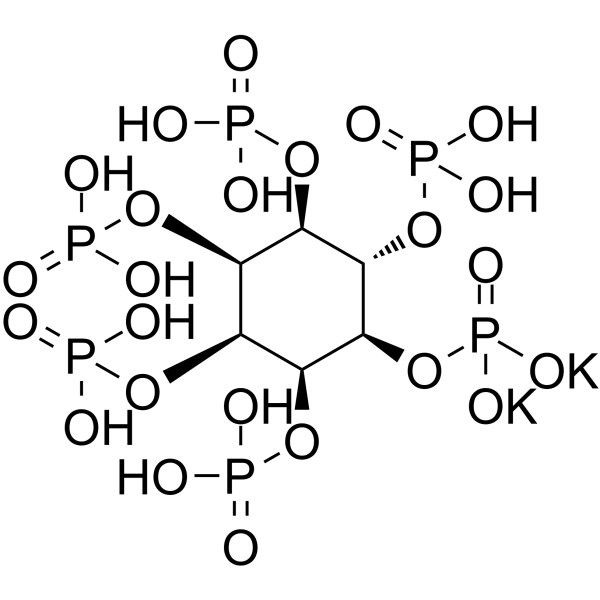 HY-W018059Phytic acid potassium
-
Similarity Score 0.77
 HY-W703190myo-Inositol 1,4,5,6-tetrakisphosphate
-
Similarity Score 0.76
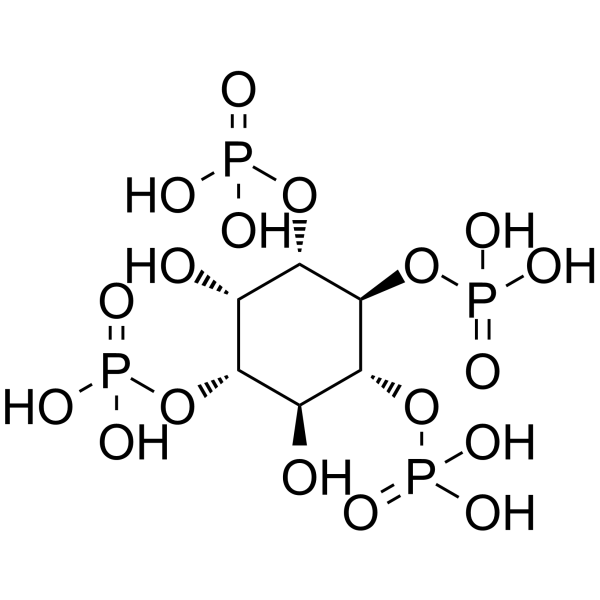 HY-W127317Inositol 1,3,4,5-tetraphosphate
-
Similarity Score 0.76
 HY-W788040Inositol 1,3,4,5-tetraphosphate tetraammonium
-
Similarity Score 0.69
 HY-105279α-Trinositol
-
Similarity Score 0.68
 HY-W790474D-myo-Inositol 1,3,4-tris-phosphate
-
Similarity Score 0.68
 HY-W790474AIP3(1,3,4) ammonium
-
Similarity Score 0.68
 HY-150135AD-myo-Inositol-1,4,5-triphosphate triammonium
-

Explore the MedChemAI to find more analogs


References
- [1]. Shears SB, et al.Assessing the omnipotence of inositol hexakisphosphate.Cell Signal. 2001 Mar;13(3):151-8. [Content Brief]
- [2]. Kim NH, et al. Phytic Acid and Sodium Chloride Show Marked Synergistic Bactericidal Effects against Nonadapted and Acid-Adapted Escherichia coli O157:H7 Strains. Appl Environ Microbiol. 2015 Dec 4;82(4):1040-1049. [Content Brief]
- [3]. Fu Q, et al. The effect of phytic acid on tight junctions in the human intestinal Caco-2 cell line and its mechanism. Eur J Pharm Sci. 2015 Dec 1;80:1-8. [Content Brief]
- [4]. Woyengo TA, et al. Effect of dietary phytic acid on performance and nutrient uptake in the small intestine of piglets. J Anim Sci. 2012 Feb;90(2):543-9. [Content Brief]
- [5]. Anekonda TS, et al. Phytic acid as a potential treatment for alzheimer's pathology: evidence from animal and in vitro models. J Alzheimers Dis. 2011;23(1):21-35. [Content Brief]
- [6]. Eberhard M, et al. Effect of phytic acid on suicidal erythrocyte death. J Agric Food Chem. 2010 Feb 10;58(3):2028-33. [Content Brief]
- [7]. Obata T, et al. Phytic acid suppresses ischemia-induced hydroxyl radical generation in rat myocardium. Eur J Pharmacol. 2016 Mar 5;774:20-4. [Content Brief]
- [8]. Xu Z, et al. Protective effects of phytic acid on CCl4‐induced liver fibrosis in mice. Journal of Food Biochemistry, 2023, 2023(1): 6634450.
- [9]. Omoruyi FO, et al. The potential benefits and adverse effects of phytic Acid supplement in streptozotocin-induced diabetic rats. Adv Pharmacol Sci. 2013;2013:172494. [Content Brief]
- [10]. Verghese M, et al. Anticarcinogenic effect of phytic acid (IP6): apoptosis as a possible mechanism of action. LWT-Food Science and Technology, 2006, 39(10): 1093-1098.



