



Elcubragistat
Based on 2 publication(s) in Google Scholar
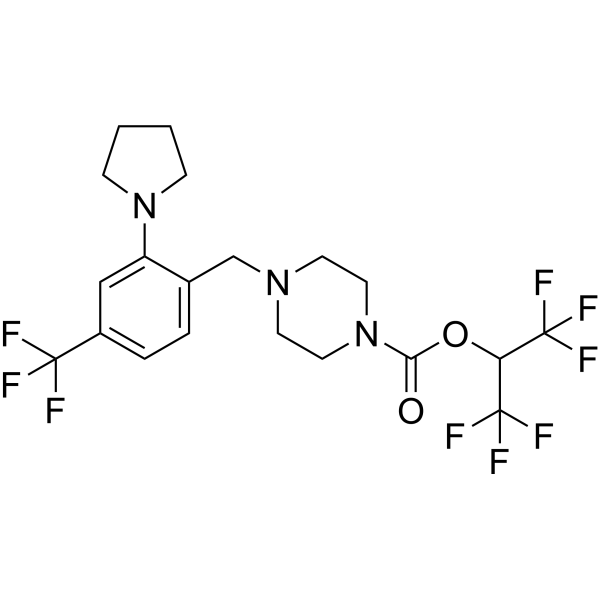
Elcubragistat (ABX-1431) is a highly effective, selective, orally active, and blood-brain barrier-permeable monoacylglycerol lipase (MAGL) inhibitor, with an IC50 value of 14 nM.
Nur für Forschungszwecke. Wir verkaufen nicht an Patienten.
- Reinheit : 99.96%
- CAS. Nr.: 1446817-84-0
- Formel: C20H22F9N3O2
- Molecular Weight:507.39
-
Speicherung:Powder -20°C, 3 years , 4°C, 2 years ; In solvent -80°C, 6 months , -20°C, 1 month

To place orders, for customer services and technical support, please contact: MedChemExpress USA
Tel: 609-228-6898 E-mail: [email protected] [email protected]


-
 Biologische Aktivität
-
Chemical Information
-
Lösungsmittel & Löslichkeit
- Reinheit & Dokumentation
- Verweise
-
 Help & FAQs


-
HY-15249
JZL 184MAGL Inhibitor -
HY-12332
JW 642MAGL Inhibitor -
HY-117474
MJN110MAGL Inhibitor -
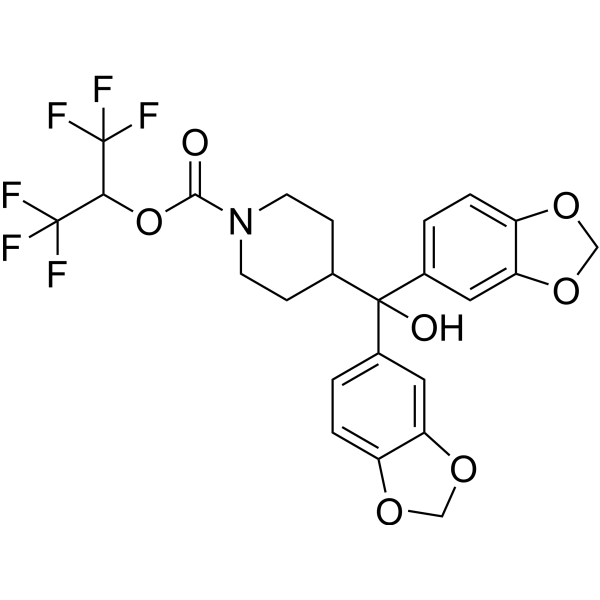
HY-18977
KML29MAGL Inhibitor -
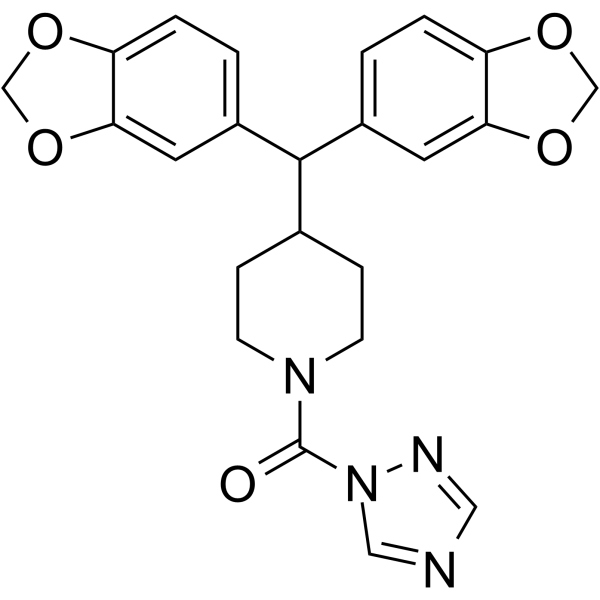
HY-108613
JJKK 048MAGL Inhibitor -
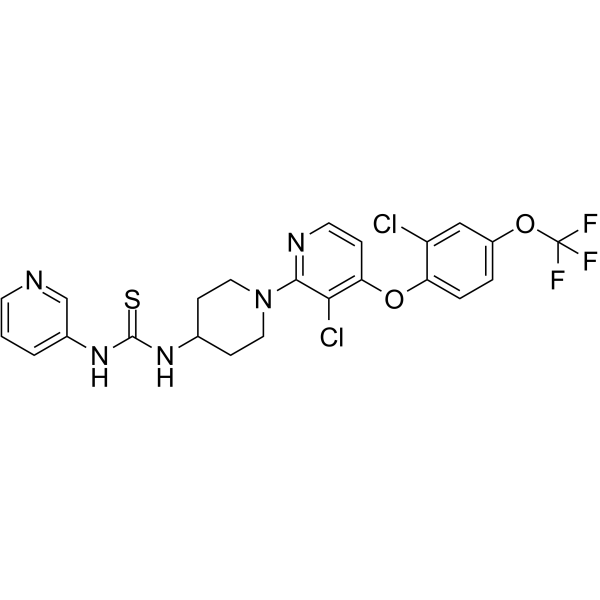
HY-114157
DO-264MAGL Inhibitor -
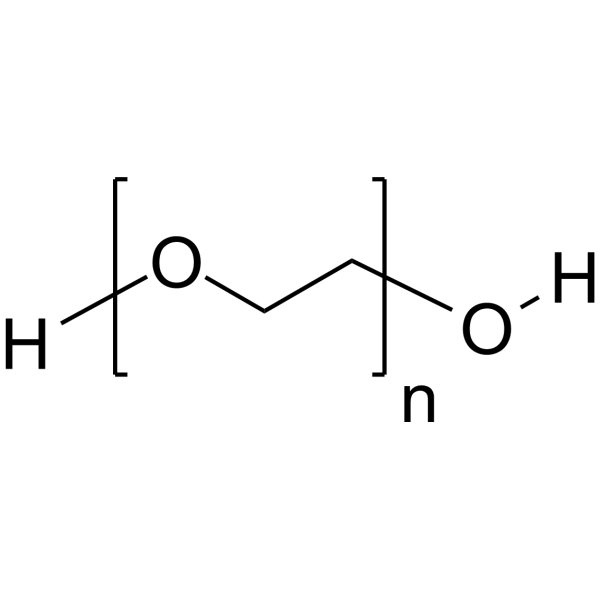
HY-Y0873
PEG300Neutral Polymer -
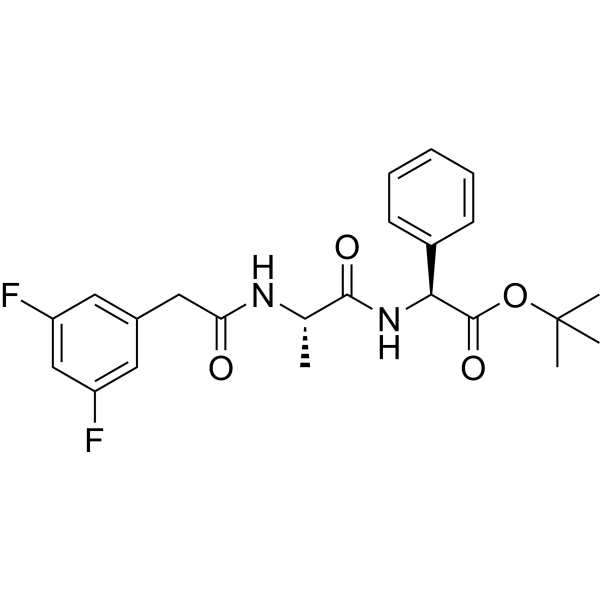
HY-13027
DAPTγ-secretase Inhibitor -
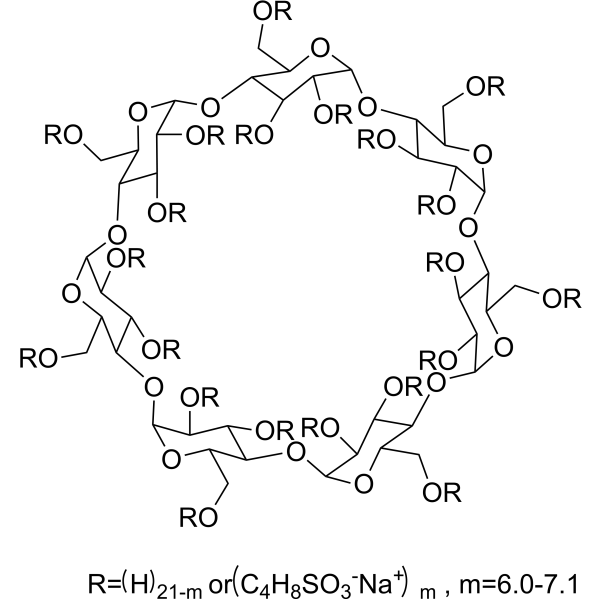
HY-17031
SBE-β-CDExcipient -
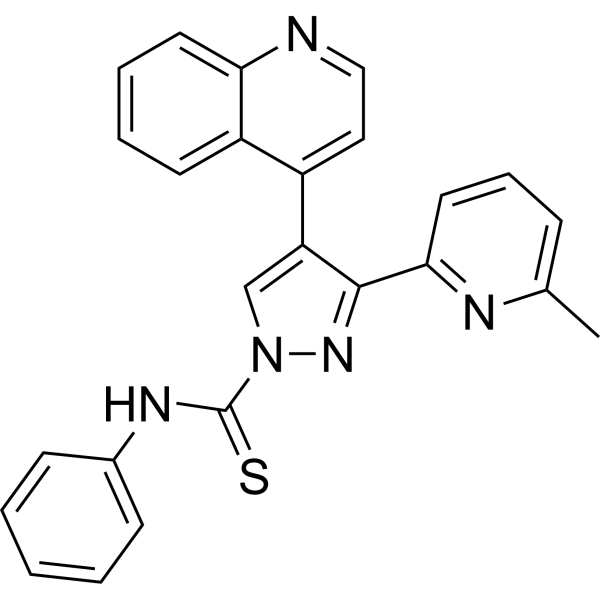
HY-10432
A 83-01ALK4/5/7 Inhibitor -
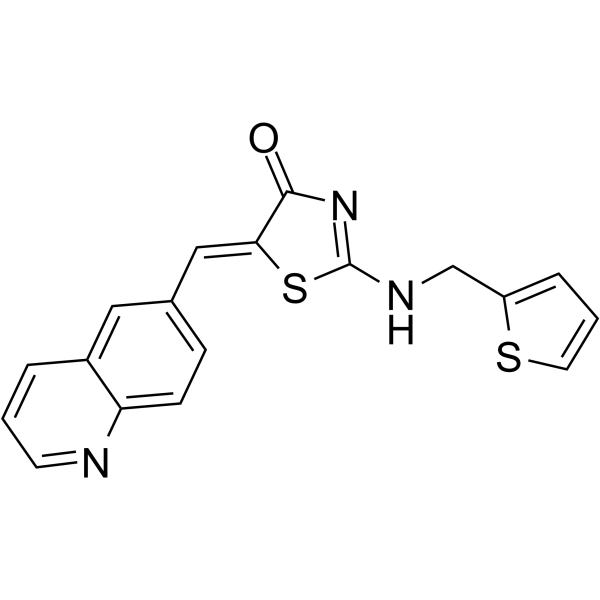
HY-12529
Ro-3306CDK1 Inhibitor -
HY-K0301
Cell Counting Kit-8
Publications Citing Use of MedChemExpress (MCE) Elcubragistat
More

Biologische Aktivität
Beschreibung
IC50 & Target
IC50: 14 nM (human MGLL)[1]
In Vitro
Elcubragistat (ABX-1431) is a potent human MGLL inhibitor (IC50=0.014 μM) with >100-fold selectivity against ABHD6 and >200-fold selectivity against PLA2G7. Elcubragistat inhibits human PC3 cells with an IC50 of 0.0022 μM. In the cell-based assay, >100-fold selectivity for MGLL over ABHD6 (IC50=0.253 μM) and PLA2G7 (IC50=494 μM) is maintained[1].
MedChemExpress (MCE) has not independently confirmed the accuracy of these methods. They are for reference only. .
In Vivo
Clinical Trial
| NCT Number | Sponsor | Condition | Start Date |
Phase

|
|---|---|---|---|---|
| NCT01329991 | Plexxikon| | 2011-05 | PHASE1 |


Chemical Information
-
CAS. Nr. 1446817-84-0
-
Appearance Solid
-
Molecular Weight 507.39
-
Formel C20H22F9N3O2
-
Color White to light yellow
-
SMILES
O=C(N1CCN(CC2=CC=C(C(F)(F)F)C=C2N3CCCC3)CC1)OC(C(F)(F)F)C(F)(F)F
-
Synonyms
ABX-1431
-
Versand
Room temperature in continental US; may vary elsewhere.
-
Speicherung
Powder -20°C 3 years 4°C 2 years In solvent -80°C 6 months -20°C 1 month


Publications (2)
-
Journal Impact Factor
-
Most Recent
-
Nat Commun
2022 Feb 25;13(1):1058. PMID: 35217685 -


Lösungsmittel & Löslichkeit
In Vitro:
DMSO : 250 mg/mL (492.72 mM; Need ultrasonic; Hygroscopic DMSO has a significant impact on the solubility of product, please use newly opened DMSO)
Please refer to the solubility information to select the appropriate solvent. Once prepared, please aliquot and store the solution to prevent product inactivation from repeated freeze-thaw cycles.
Storage method and period of stock solution: -80°C, 6 months; -20°C, 1 month. When stored at -80°C, please use it within 6 months. When stored at -20°C, please use it within 1 month.
Please refer to the solubility information to select the appropriate solvent. Once prepared, please aliquot and store the solution to prevent product inactivation from repeated freeze-thaw cycles.
Storage method and period of stock solution: -80°C, 6 months; -20°C, 1 month. When stored at -80°C, please use it within 6 months. When stored at -20°C, please use it within 1 month.
Konzentration (Stammlösung) × Volumen (Stammlösung) = Konzentration (Ziellösung) × Volumen (Ziellösung)
In Vivo:
Select the appropriate dissolution method based on your experimental animal and administration route.
- For the following dissolution methods, please ensure to first prepare a clear stock solution using an In Vitro approach and then sequentially add co-solvents:
- To ensure reliable experimental results, the clarified stock solution can be appropriately stored based on storage conditions. As for the working solution for In Vivo experiments, it is recommended to prepare freshly and use it on the same day.
- The percentages shown for the solvents indicate their volumetric ratio in the final prepared solution. If precipitation or phase separation occurs during preparation, heat and/or sonication can be used to aid dissolution.
Add each solvent one by one: 10% DMSO 40% PEG300 5% Tween-80 45% Saline
Solubility: ≥ 2.08 mg/mL (4.10 mM); Clear solution
This protocol yields a clear solution of ≥ 2.08 mg/mL (saturation unknown).
Taking 1 mL working solution as an example, add 100 μL DMSO stock solution (20.8 mg/mL) to 400 μL PEG300, and mix evenly; then add 50 μL Tween-80 and mix evenly; then add 450 μL Saline to adjust the volume to 1 mL.
Preparation of Saline: Dissolve 0.9 g sodium chloride in ddH₂O and dilute to 100 mL to obtain a clear Saline solution.
Add each solvent one by one: 10% DMSO 90% (20% SBE-β-CD in Saline)
Solubility: 2.08 mg/mL (4.10 mM); Suspended solution; Need ultrasonic
This protocol yields a suspended solution of 2.08 mg/mL. Suspended solution can be used for oral and intraperitoneal injection.
Taking 1 mL working solution as an example, add 100 μL DMSO stock solution (20.8 mg/mL) to 900 μL 20% SBE-β-CD in Saline, and mix evenly.
Preparation of 20% SBE-β-CD in Saline (4°C, storage for one week): 2 g SBE-β-CD powder is dissolved in 10 mL Saline, completely dissolve until clear.
In Vivo Dissolution Calculator
Please enter the basic information of animal experiments:
-
-
-
-
Recommended: Prepare an additional quantity of animals to account for potential losses during experiments.
Please enter your animal formula composition:
-
%DMSO +
Recommended: Keep the proportion of DMSO in working solution below 2% if your animal is weak.
-
%+
-
+%Tween-80 + +
-
%Saline +
The co-solvents required include: DMSO, . All of co-solvents are available by MedChemExpress (MCE). , Tween 80. All of co-solvents are available by MedChemExpress (MCE).
Working solution concentration: 0.22 mg/mL
Method for preparing stock solution: mg drug dissolved in μL DMSO. Stock solution concentration: mg/mL.
1. Take μL DMSO stock solution;
2. Add μL .
μL , mix evenly;
3. Then add μL Tween 80, mix evenly;
4. Then add μL
Please ensure that the stock solution in the first step is dissolved to a clear state, and add co-solvents in sequence. You can use ultrasonic heating (ultrasonic cleaner, recommended frequency 20-40 kHz), vortexing, etc. to assist dissolution.


Reinheit & Dokumentation
-
Data Sheet (274 KB)
-
SDS (393 KB)
- English - EN (393 KB)
- Français - FR (393 KB)
- Deutsch - DE (393 KB)
- Norwegian - NO (393 KB)
- Español - ES (393 KB)
- Swedish - SV (393 KB)
- Italian - IT (393 KB)
- Korean - KR (393 KB)
- Portuguese - PT (393 KB)
-
Handling Instructions (2659 KB)
Verweise


Complete Stock Solution Preparation Table
Please refer to the solubility information to select the appropriate solvent. Once prepared, please aliquot and store the solution to prevent product inactivation from repeated freeze-thaw cycles.
Storage method and period of stock solution: -80°C, 6 months; -20°C, 1 month. When stored at -80°C, please use it within 6 months. When stored at -20°C, please use it within 1 month.
| Optional Solvent | Concentration Solvent Mass | 1 mg | 5 mg | 10 mg | 25 mg |
|---|---|---|---|---|---|
| DMSO | 1 mM | 1.9709 mL | 9.8544 mL | 19.7087 mL | 49.2718 mL |
| 5 mM | 0.3942 mL | 1.9709 mL | 3.9417 mL | 9.8544 mL | |
| 10 mM | 0.1971 mL | 0.9854 mL | 1.9709 mL | 4.9272 mL | |
| 15 mM | 0.1314 mL | 0.6570 mL | 1.3139 mL | 3.2848 mL | |
| 20 mM | 0.0985 mL | 0.4927 mL | 0.9854 mL | 2.4636 mL | |
| 25 mM | 0.0788 mL | 0.3942 mL | 0.7883 mL | 1.9709 mL | |
| 30 mM | 0.0657 mL | 0.3285 mL | 0.6570 mL | 1.6424 mL | |
| 40 mM | 0.0493 mL | 0.2464 mL | 0.4927 mL | 1.2318 mL | |
| 50 mM | 0.0394 mL | 0.1971 mL | 0.3942 mL | 0.9854 mL | |
| 60 mM | 0.0328 mL | 0.1642 mL | 0.3285 mL | 0.8212 mL | |
| 80 mM | 0.0246 mL | 0.1232 mL | 0.2464 mL | 0.6159 mL | |
| 100 mM | 0.0197 mL | 0.0985 mL | 0.1971 mL | 0.4927 mL |


Elcubragistat Related Classifications
HY-117632 Related Classifications
 Powered by Bioz