



Mosunetuzumab
Based on 1 publication(s) in Google Scholar
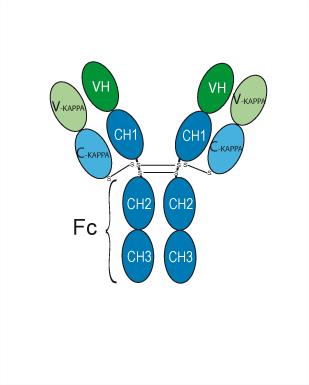
Mosunetuzumab (BTCT-4465A) is a full-length, fully humanized immunoglobulin G1 (IgG1) T-cell-dependent bispecific (TDB) antibody targeting CD20 (B cells) and CD3 (T cells). Mosunetuzumab redirects T cells to engage and eliminate malignant B cells and can be used for the research of relapsed or refractory (R/R) B-cell non-Hodgkin lymphomas (B-NHLs).
Nur für Forschungszwecke. Wir verkaufen nicht an Patienten.
- Reinheit: 98.75%
- CAS. Nr.: 1905409-39-3
- Molecular Weight:144 kDa
-
Speicherung:
Please store the product under the recommended conditions in the Certificate of Analysis.


To place orders, for customer services and technical support, please contact: MedChemExpress USA
Tel: 609-228-6898 E-mail: [email protected] [email protected]


-
 Biologische Aktivität
-
Chemical Information
- Reinheit & Dokumentation
- Verweise
-
 Help & FAQs














Publications Citing Use of MedChemExpress (MCE) Mosunetuzumab
More

Biologische Aktivität
Human IgG1 kappa
Human
CD3E & MS4A1
Mosunetuzumab has two arms. One arm binds specifically to CD3 on T-cells and the other to CD20 present on normal and neoplastic B-cells. Simultaneous binding of both arms to their respective targets facilitates T-cell-mediated killing of CD20+ B-cells[2].
MedChemExpress (MCE) has not independently confirmed the accuracy of these methods. They are for reference only.
| NCT Number | Sponsor | Condition | Start Date |
Phase

|
|---|---|---|---|---|
| NCT01329991 | Plexxikon| | 2011-05 | PHASE1 |
Unconjugated
The product can be reconstituted/diluted with sterile PBS or saline.
-
Human IgG1 kappa
ELISA, FACS, Functional assay
-
 Flow cytometric analysis of 1X10⁶ Raji cells with Mosunetuzumab (HY-P99033, red). Cells were fixed with 4% paraformaldehyde. Then stained with the primary antibody at 1/200 dilution for an hour at 4℃. Alexa Fluor 488-conjugated AffiniPure Goat Anti-Human IgG H&L (HY-P83776) was used as the secondary antibody at 1/1,000 dilution for 30 minutes at 4℃. Human IgG1 kappa (HY-P99001, blue) was used as the isotype control, cells without incubation with primary antibody were used as the unlabeled control (black).
 -
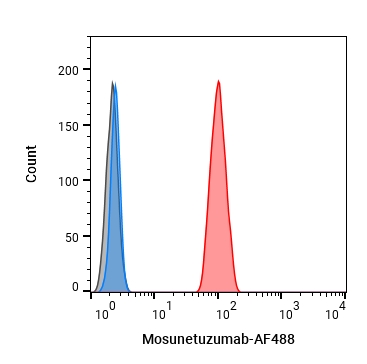 Flow cytometric analysis of 1X10⁶ Jurkat cells with Mosunetuzumab (HY-P99033, red). Cells were fixed with 4% paraformaldehyde. Then stained with the primary antibody at 1/200 dilution for an hour at 4℃. Alexa Fluor 488-conjugated AffiniPure Goat Anti-Human IgG H&L (HY-P83776) was used as the secondary antibody at 1/1,000 dilution for 30 minutes at 4℃. Human IgG1 kappa (HY-P99001, blue) was used as the isotype control, cells without incubation with primary antibody were used as the unlabeled control (black).
 -
 Immobilized CD20/MS4A1 Protein-VLP, Human (HEK293, HY-P78543) can bind Mosunetuzumab. The EC50 for this effect is 280.4 ng/mL
 -
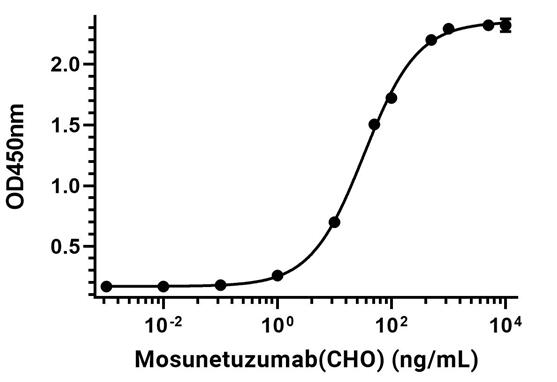 Immobilized CD3D-CD3E Heterodimer Protein, Human (HEK293, Fc, HY-P77610) can bind Mosunetuzumab. The EC50 for this effect is 33.22 ng/mL.


Chemical Information
-
CAS. Nr. 1905409-39-3
-
Appearance Liquid
-
Molecular Weight 144 kDa
-
Color Colorless to light yellow
-
SMILES
[Mosunetuzumab]
-
Synonyms
BTCT-4465A; RG-7828; RO7030816
-
Versand
Shipping with dry ice.
-
Formulation
Please refer to the lot-specific COA for specific buffer information.
-
Speicherung
Please store the product under the recommended conditions in the Certificate of Analysis.


Publications (1)
-
Journal Impact Factor
-
Most Recent
-
MAbs
Optimizing human FcRn mouse models to improve pharmacokinetic evaluation of antibody drug candidates. [Abstract]2026 Dec 31;18(1):2649990. PMID: 41878863


Reinheit & Dokumentation
-
Data Sheet (258 KB)
-
SDS (252 KB)
- English - EN (252 KB)
- Français - FR (252 KB)
- Deutsch - DE (252 KB)
- Norwegian - NO (252 KB)
- Español - ES (252 KB)
- Swedish - SV (252 KB)
- Italian - IT (252 KB)
- Korean - KR (252 KB)
- Portuguese - PT (252 KB)
-
Inhibitory Antibodies User Guide (603 KB)
Verweise
[1]. Lihua E Budde, et al. Single-Agent Mosunetuzumab Shows Durable Complete Responses in Patients With Relapsed or Refractory B-Cell Lymphomas: Phase I Dose-Escalation Study. J Clin Oncol. 2022 Feb 10;40(5):481-491. [Content Brief]
[2]. Gregory Z Ferl, et al. A Preclinical Population Pharmacokinetic Model for Anti-CD20/CD3 T-Cell-Dependent Bispecific Antibodies. Clin Transl Sci. 2018 May;11(3):296-304. [Content Brief]

Calculators
Konzentration (Stammlösung) × Volumen (Stammlösung) = Konzentration (Ziellösung) × Volumen (Ziellösung)


Mosunetuzumab Related Classifications
HY-P99033 Related Classifications
 Powered by Bioz