



Pseudouridimycin
Based on 1 publication(s) in Google Scholar
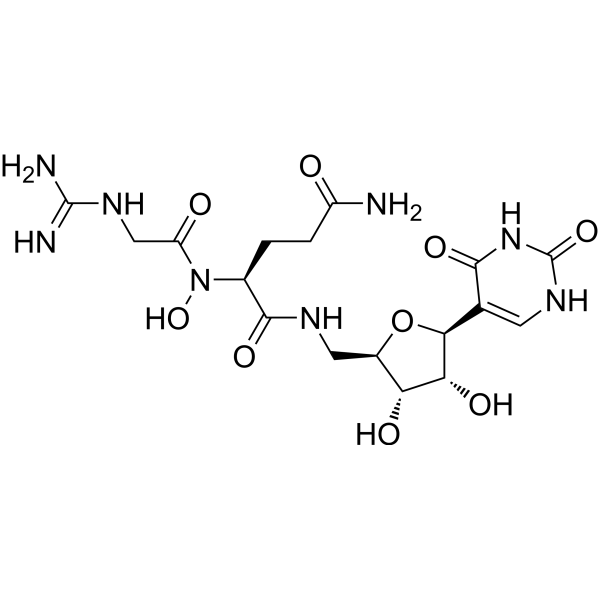
Pseudouridimycin (PUM) is an antibiotic that selectively inhibits bacterial RNA polymerase (RNAP), with an IC50 of about 0.1 μM and MICs of 4-6 μg/mL. Pseudouridimycin is a C-nucleoside analogue that's effective against both Gram-negative and Gram-positive bacteria. Pseudouridimycin inhibits bacterial growth in vitro and shows activity in a mouse model of purulent streptococcal peritonitis.
Nur für Forschungszwecke. Wir verkaufen nicht an Patienten.
- Reinheit : 96.0%
- CAS. Nr.: 1566586-52-4
- Formel: C17H26N8O9
- Molecular Weight:486.44
-
Speicherung:Powder -20°C, 3 years ; In solvent -80°C, 6 months , -20°C, 1 month

To place orders, for customer services and technical support, please contact: MedChemExpress USA
Tel: 609-228-6898 E-mail: [email protected] [email protected]


-
 Biologische Aktivität
-
Chemical Information
- Protokoll
- Reinheit & Dokumentation
- Verweise
-
 Help & FAQs


-
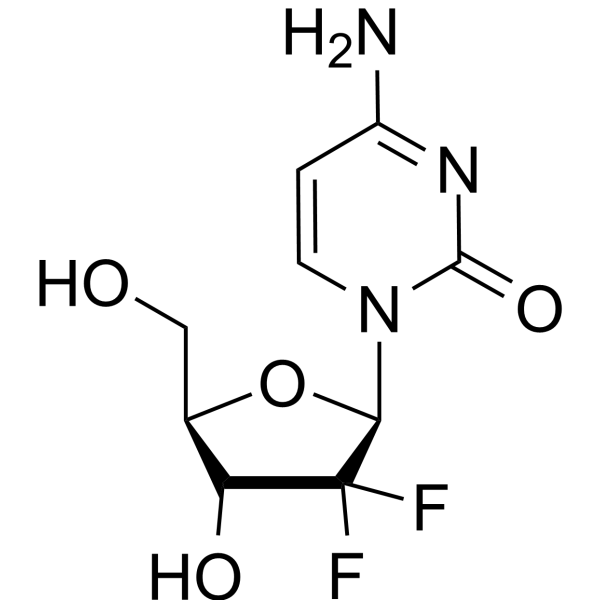
HY-17026
GemcitabineDNA Synthesis Inhibitor -
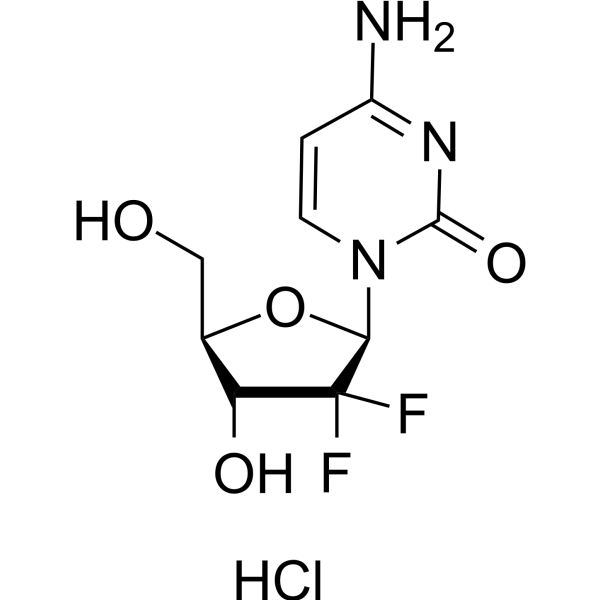
HY-B0003
Gemcitabine hydrochlorideDNA Synthesis Inhibitor -

HY-17026R
Gemcitabine (Standard)DNA Synthesis Inhibitor -
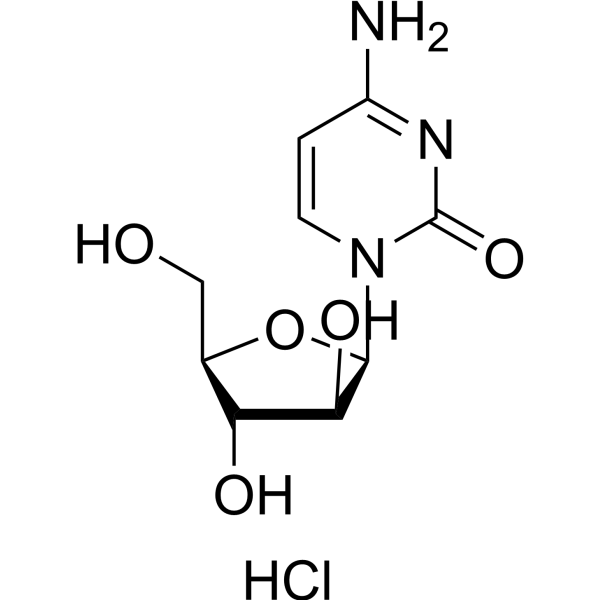
HY-13605A
Cytarabine hydrochlorideDNA Synthesis Inhibitor -
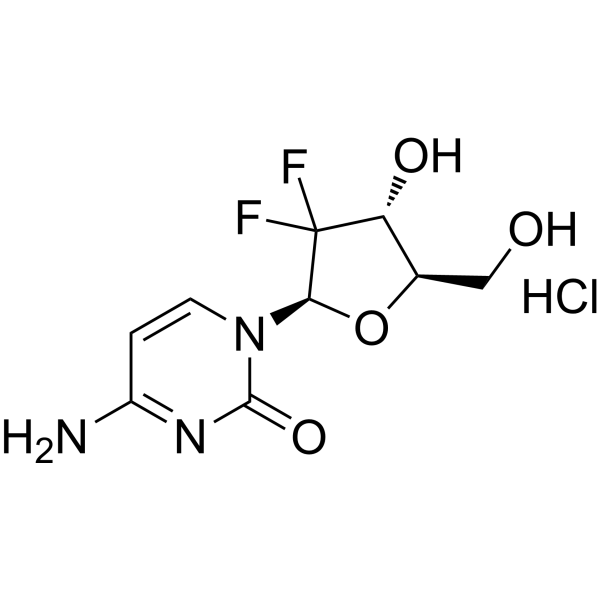
HY-B0003R
Gemcitabine hydrochloride (Standard)DNA Synthesis Inhibitor -

HY-13605AR
Cytarabine hydrochloride (Standard)DNA Synthesis Inhibitor
Publications Citing Use of MedChemExpress (MCE) Pseudouridimycin
MoreAlle Antibiotic Isoform-spezifische Produkte anzeigen
MoreAlle DNA/RNA Synthesis Isoform-spezifische Produkte anzeigen
More

Biologische Aktivität
Beschreibung
IC50 & Target
|
RNA Polymerase |
In Vitro
Pseudouridimycin (PUM) is selective because of its side chain that binds in a region that is conserved in bacterial RNA polymerases but not in humans. In vitro bactericidal activity is reported for Pseudouridimycin against drug-sensitive, drug-resistant, and multidrug-resistant Streptococcus species[1].
MedChemExpress (MCE) has not independently confirmed the accuracy of these methods. They are for reference only.
In Vivo
MedChemExpress (MCE) has not independently confirmed the accuracy of these methods. They are for reference only.
-
Animal Model:Female ICR mice (23-25 g) intraperitoneal injection of 0.5 mL saline solution (supplemented with 1% peptone) containing 4 × 10³ cfu S. pyogenes C203[3].
-
Dosage:3.2 mg/kg, 8 mg/kg, 20 mg/kg, 50 mg/kg
-
Administration:iv; 10 min after infection and again 6 h after infection
-
Result:Showed antibacterial activity in vivo.


Chemical Information
-
CAS. Nr. 1566586-52-4
-
Appearance Solid
-
Molecular Weight 486.44
-
Formel C17H26N8O9
-
Color Off-white to light yellow
-
SMILES
O=C1NC(C([C@H]2[C@@H]([C@@H]([C@@H](CNC([C@H](CCC(N)=O)N(C(CNC(N)=N)=O)O)=O)O2)O)O)=CN1)=O
-
Synonyms
PUM
-
Structure Classification
-
Initial Source
treptomyces sp
-
Versand
Room temperature in continental US; may vary elsewhere.
-
Speicherung
Powder -20°C 3 years In solvent -80°C 6 months -20°C 1 month


Publications (1)
-
Journal Impact Factor
-
Most Recent
-
ACS Omega
Pseudouridimycin-A Potent Nucleoside Inhibitor of the RNA Polymerase Beta Prime Subunit of Streptococcus pyogenes. [Abstract]2023 Feb 13;8(8):7989-8000. PMID: 36873015


Reinheit & Dokumentation
-
Data Sheet (275 KB)
-
SDS (251 KB)
- English - EN (251 KB)
- Français - FR (251 KB)
- Deutsch - DE (251 KB)
- Norwegian - NO (251 KB)
- Español - ES (251 KB)
- Swedish - SV (251 KB)
- Italian - IT (251 KB)
- Korean - KR (251 KB)
- Portuguese - PT (251 KB)
-
Handling Instructions (2659 KB)
Verweise
[1]. Rosenqvist P, et al. Characterization of C-nucleoside Antimicrobials from Streptomyces albus DSM 40763: Strepturidin is Pseudouridimycin. Sci Rep. 2019 Jun 20;9(1):8935. [Content Brief]
[2]. Kunthavai Pavundurai Chandra, et al. Pseudouridimycin-A Potent Nucleoside Inhibitor of the RNA. ACS Omega. 2023 Feb 13;8(8):7989-8000. [Content Brief]
[3]. Maffioli SI, et al. Antibacterial Nucleoside-Analog Inhibitor of Bacterial RNA Polymerase. Cell. 2017 Jun 15;169(7):1240-1248.e23. [Content Brief]

Calculators
Konzentration (Stammlösung) × Volumen (Stammlösung) = Konzentration (Ziellösung) × Volumen (Ziellösung)


Pseudouridimycin Related Classifications
HY-125650 Related Classifications
 Powered by Bioz