



RdRP-IN-4
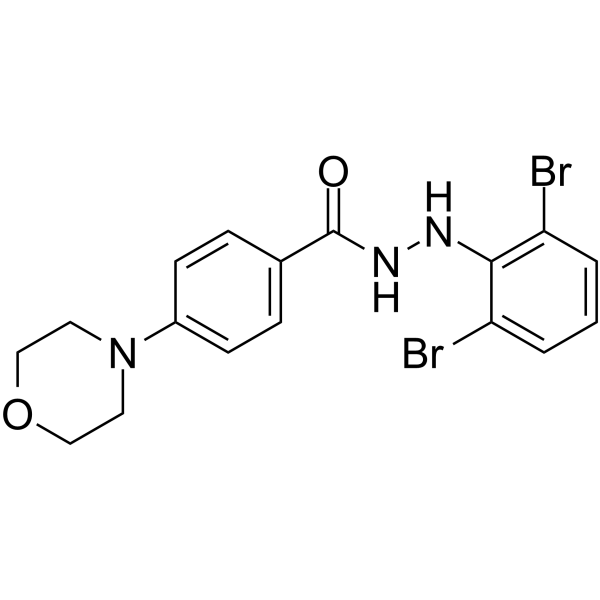
RdRP-IN-4 (compound 11q), an aryl benzoyl hydrazide analog, is an orally active influenza A virus RNA-dependent RNA polymerase (RdRp) inhibitor by interacting with the PB1 subunit. RdRP-IN-4 exhibits potent inhibitory activity against the avian H5N1 flu strain with an EC50 of 18 nM in MDCK cells. RdRP-IN-4 displays excellent potency against the the H1N1 (A/PR/8/34) Flu A strain and Flu B strain (B/Lee/1940) with EC50 values of 53 nM and 20 nM, respectively. RdRP-IN-4 significantly inhibits the expression level of viral nucleoprotein (NP) in a dose-dependent manner. RdRP-IN-4 exhibits significant antiviral activity in infected mice.
Nur für Forschungszwecke. Wir verkaufen nicht an Patienten.
- CAS. Nr.: 3035088-22-0
- Formel: C17H17Br2N3O2
- Molecular Weight:455.14
-
Speicherung:
Please store the product under the recommended conditions in the Certificate of Analysis.

To place orders, for customer services and technical support, please contact: MedChemExpress USA
Tel: 609-228-6898 E-mail: [email protected] [email protected]


-
 Biologische Aktivität
-
Chemical Information
- Protokoll
- Reinheit & Dokumentation
- Verweise
-
 Help & FAQs


Alle DNA/RNA Synthesis Isoform-spezifische Produkte anzeigen
More

Biologische Aktivität
Beschreibung
IC50 & Target
|
RNA Polymerase |
Cellular Effect
|
Cell Line

|
Type | Value | Description | References |
|---|---|---|---|---|
| MDCK | CC50 |
>100 μM
Compound: 11q
|
Cytotoxicity against dog MDCK cells assessed as reduction in cell viability incubated for 48 hrs by CCK-8 assay
Cytotoxicity against dog MDCK cells assessed as reduction in cell viability incubated for 48 hrs by CCK-8 assay
|
[PMID: 35212527] |


Chemical Information
-
CAS. Nr. 3035088-22-0
-
Molecular Weight 455.14
-
Formel C17H17Br2N3O2
-
SMILES
O=C(C1=CC=C(C=C1)N2CCOCC2)NNC3=C(C=CC=C3Br)Br
-
Versand
Room temperature in continental US; may vary elsewhere.
-
Speicherung
Please store the product under the recommended conditions in the Certificate of Analysis.

Protokoll
-
RNA extraction experimental
By lysing cells, releasing RNA, and removing impurities such as proteins and DNA, high-purity RNA products are finally obtained. The commonly used traditional method is the guanidine isothiocyanate/phenol/chloroform method (Trizol), which is suitable for a variety of animal materials including animal tissues, microorganisms, cultured cells, etc., and most plant materials.
-
Research Protocol for Infectious Diseases
Infectious-disease experiments test how pathogens interact with host barriers, innate immune receptors, inflammatory signaling, pathogen replication, and tissue injury; pattern-recognition receptors such as TLRs, RIG-I-like receptors, NOD-like receptors, and inflammasomes detect microbial molecules and activate NF-κB, interferon, and cytokine responses. The central hypothesis is that infection severity reflects the balance between pathogen burden and host response: protective inflammation restricts pathogen growth, whereas excessive or mislocalized inflammation contributes to tissue damage and disease phenotype. Unresolved questions include which host pathways are protective versus pathogenic, why some infection models fail to translate to human disease, and which combined readouts best predict clinically relevant infection outcomes.


Reinheit & Dokumentation
Verweise

Calculators
Konzentration (Stammlösung) × Volumen (Stammlösung) = Konzentration (Ziellösung) × Volumen (Ziellösung)


RdRP-IN-4 Related Classifications
HY-144668 Related Classifications
 Powered by Bioz