



Coronaridine
Based on 1 publication(s) in Google Scholar
Coronaridine, an iboga type alkaloid, inhibits the wnt signaling pathway by decreasing β-catenin expression.
Nos produits utilisent uniquement pour la recherche. Nous ne vendons pas aux patients.
- Pureté : 99.23%
- CAS No.: 467-77-6
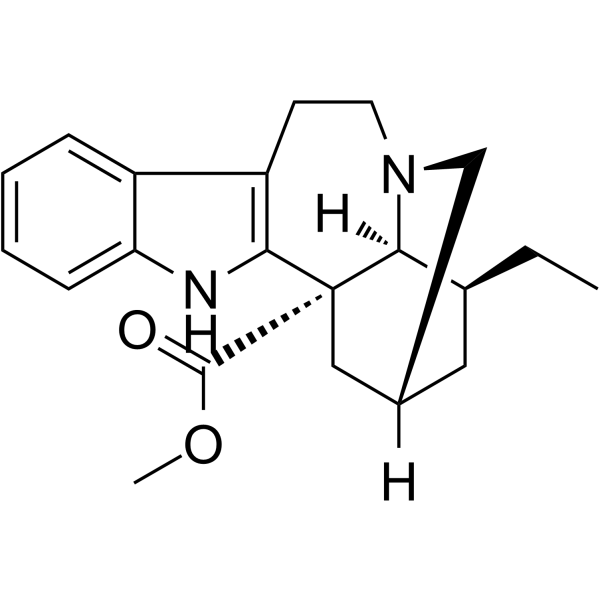
- Formule: C21H26N2O2
- Masse moléculaire:338.44
-
Stockage:
4°C, protect from light
* In solvent : -80°C, 6 months; -20°C, 1 month (protect from light)

To place orders, for customer services and technical support, please contact: MedChemExpress USA
Tel: 609-228-6898 E-mail: [email protected] [email protected]


-
 Activité biologique
-
Chemical Information
-
Solvant et solubilité
- Protocole
- Pureté et documentation
- Références
-
 Help & FAQs


Publications Citing Use of MedChemExpress (MCE) Coronaridine
More

Activité biologique
Description
Cellular Effect
|
Cell Line

|
Type | Value | Description | References |
|---|---|---|---|---|
| A-431 | ED50 |
19.1 μg/mL
Compound: 1
|
Cytotoxicity against human A431 cells by SRB assay
Cytotoxicity against human A431 cells by SRB assay
|
[PMID: 7853002] |
| BC1 cell line | ED50 |
7.5 μg/mL
Compound: 1
|
Cytotoxicity against human BC1 cells by SRB assay
Cytotoxicity against human BC1 cells by SRB assay
|
[PMID: 7853002] |
| Col2 | ED50 |
>20 μg/mL
Compound: 1
|
Cytotoxicity against human Col2 cells by SRB assay
Cytotoxicity against human Col2 cells by SRB assay
|
[PMID: 7853002] |
| DLD-1 | IC50 |
24.4 μM
Compound: 3
|
Cytotoxicity against Wnt-dependent human DLD1 cells assessed as cell viability after 24 hrs by fluorescence assay
Cytotoxicity against Wnt-dependent human DLD1 cells assessed as cell viability after 24 hrs by fluorescence assay
|
[PMID: 26231157] |
| HCT-116 | IC50 |
11.6 μM
Compound: 3
|
Cytotoxicity against Wnt-dependent human HCT116 cells assessed as cell viability after 24 hrs by fluorescence assay
Cytotoxicity against Wnt-dependent human HCT116 cells assessed as cell viability after 24 hrs by fluorescence assay
|
[PMID: 26231157] |
| HEK293 | IC50 |
31.7 μM
Compound: 3
|
Cytotoxicity against HEK293 cells assessed as cell viability after 24 hrs by fluorescence assay
Cytotoxicity against HEK293 cells assessed as cell viability after 24 hrs by fluorescence assay
|
[PMID: 26231157] |
| HEK-293T | IC50 |
>40 μM
Compound: 3
|
Cytotoxicity against HEK293T cells assessed as cell viability after 24 hrs by fluorescence assay
Cytotoxicity against HEK293T cells assessed as cell viability after 24 hrs by fluorescence assay
|
[PMID: 26231157] |
| HeLa | EC50 |
>40 μM
Compound: 20
|
Inhibition of lysosomal acidification in human HeLa cells incubated for 3 hrs by LysoTracker Red DND-99 staining based array scan method
Inhibition of lysosomal acidification in human HeLa cells incubated for 3 hrs by LysoTracker Red DND-99 staining based array scan method
|
[PMID: 32356659] |
| HT | ED50 |
>20 μg/mL
Compound: 1
|
Cytotoxicity against human HT cells by SRB assay
Cytotoxicity against human HT cells by SRB assay
|
[PMID: 7853002] |
| KB | ED50 |
13.6 μg/mL
Compound: 1
|
Cytotoxicity against human KB cells by SRB assay
Cytotoxicity against human KB cells by SRB assay
|
[PMID: 7853002] |
| KB-V1 | ED50 |
1.9 μg/mL
Compound: 1
|
Cytotoxicity against human drug-resistant KBV1 cells by SRB assay in presence of vinblastine
Cytotoxicity against human drug-resistant KBV1 cells by SRB assay in presence of vinblastine
|
[PMID: 7853002] |
| KB-V1 | ED50 |
11.2 μg/mL
Compound: 1
|
Cytotoxicity against human drug-resistant KBV1 cells by SRB assay in absence of vinblastine
Cytotoxicity against human drug-resistant KBV1 cells by SRB assay in absence of vinblastine
|
[PMID: 7853002] |
| LNCaP | ED50 |
10.7 μg/mL
Compound: 1
|
Cytotoxicity against human LNCAP cells by SRB assay
Cytotoxicity against human LNCAP cells by SRB assay
|
[PMID: 7853002] |
| Lu1 | ED50 |
10.9 μg/mL
Compound: 1
|
Cytotoxicity against human Lu1 cells by SRB assay
Cytotoxicity against human Lu1 cells by SRB assay
|
[PMID: 7853002] |
| P388 | ED50 |
3.8 μg/mL
Compound: 1
|
Cytotoxicity against mouse P388 cells after 48 hrs by SRB assay
Cytotoxicity against mouse P388 cells after 48 hrs by SRB assay
|
[PMID: 7853002] |
| RAW264.7 | IC50 |
25.5 μM
Compound: 10
|
Anti-inflammatory activity in mouse RAW264.7 cells assessed as LPS-stimulated inhibition of nitric oxide production incubated simultaneously with LPS for 24 hrs by Griess reagent based assay
Anti-inflammatory activity in mouse RAW264.7 cells assessed as LPS-stimulated inhibition of nitric oxide production incubated simultaneously with LPS for 24 hrs by Griess reagent based assay
|
[PMID: 26024020] |
| RKO | IC50 |
>40 μM
Compound: 3
|
Cytotoxicity against Wnt-independent human RKO cells assessed as cell viability after 24 hrs by fluorescence assay
Cytotoxicity against Wnt-independent human RKO cells assessed as cell viability after 24 hrs by fluorescence assay
|
[PMID: 26231157] |
| SK-MEL-2 | ED50 |
>20 μg/mL
Compound: 1
|
Cytotoxicity against human SK-MEL-2 cells by SRB assay
Cytotoxicity against human SK-MEL-2 cells by SRB assay
|
[PMID: 7853002] |
| SW480 | IC50 |
10.4 μM
Compound: 3
|
Cytotoxicity against Wnt-dependent human SW480 cells assessed as cell viability after 24 hrs by fluorescence assay
Cytotoxicity against Wnt-dependent human SW480 cells assessed as cell viability after 24 hrs by fluorescence assay
|
[PMID: 26231157] |
| U-373MG ATCC | ED50 |
12 μg/mL
Compound: 1
|
Cytotoxicity against human U373 cells by SRB assay
Cytotoxicity against human U373 cells by SRB assay
|
[PMID: 7853002] |
| ZR-75-1 | ED50 |
>20 μg/mL
Compound: 1
|
Cytotoxicity against human ZR-75-1 cells by SRB assay
Cytotoxicity against human ZR-75-1 cells by SRB assay
|
[PMID: 7853002] |
In Vitro
Coronaridine (0-40 μM; 24 hours) is against non-cancer cells with IC50 values >40 μM. It agaisnt wnt-dependent cells with IC50 values of 10.4, 11.6 and 24.4 μM for SW480, HCT116 and DLD1cells, respectively[1].Coronaridine (0-40 μM; 24 hours) inhibits β-catenin expression, but the protein levels of p-β--catenin at Ser33, Ser37, and Thr41 and p-β-catenin at Ser 45 [p-b-catenin (S45)] are unchanged[1].In whole-cell patch clamp recordings,Catharanthine (1-300 μM) are respectively co-applied with GABA at concentrations corresponding to the EC30 value for each receptor subtype. Both congeners potentiated different GABAARs in a concentration-dependent manner[2].At higher concentrations, however, Catharanthine starts to inhibit GABA-activated currents due to the reduced amplitude and rebound current, where the threshold concentration depended on the receptor subtype (e.g., > 30 μM for hα1β2; > 100 μM for hα1β2γ2 and hα2β2γ2). The PAM activity of Catharanthine's are depended on the receptor subtype: hα1β2 (4.6±0.8 μM), >hα2β2γ2 (12.6±3.8 μM), hα1β2γ2 (14.4 ± 4.6 μM)[2].
MedChemExpress (MCE) has not independently confirmed the accuracy of these methods. They are for reference only. Further protocols information, click here.


Chemical Information
-
CAS No. 467-77-6
-
Appearance Solid
-
Masse moléculaire 338.44
-
Formule C21H26N2O2
-
Color White to off-white
-
SMILES
COC([C@]12[C@@]3([H])[N@@](CCC4=C2NC5=CC=CC=C45)C[C@@](C[C@@H]3CC)([H])C1)=O
-
Structure Classification
-
Livraison
Room temperature in continental US; may vary elsewhere.
-
Stockage
4°C, protect from light
* In solvent : -80°C, 6 months; -20°C, 1 month (protect from light)


Publications (1)
-
Journal Impact Factor
-
Most Recent


Solvant et solubilité
In Vitro:
DMSO : 50 mg/mL (147.74 mM; Need ultrasonic; Hygroscopic DMSO has a significant impact on the solubility of product, please use newly opened DMSO)
Please refer to the solubility information to select the appropriate solvent. Once prepared, please aliquot and store the solution to prevent product inactivation from repeated freeze-thaw cycles.
Storage method and period of stock solution: -80°C, 6 months; -20°C, 1 month (protect from light). When stored at -80°C, please use it within 6 months. When stored at -20°C, please use it within 1 month.
Please refer to the solubility information to select the appropriate solvent. Once prepared, please aliquot and store the solution to prevent product inactivation from repeated freeze-thaw cycles.
Storage method and period of stock solution: -80°C, 6 months; -20°C, 1 month (protect from light). When stored at -80°C, please use it within 6 months. When stored at -20°C, please use it within 1 month.
Concentration (start) × Volume (start) = Concentration (final) × Volume (final)
In Vivo:
Select the appropriate dissolution method based on your experimental animal and administration route.
- For the following dissolution methods, please ensure to first prepare a clear stock solution using an In Vitro approach and then sequentially add co-solvents:
- To ensure reliable experimental results, the clarified stock solution can be appropriately stored based on storage conditions. As for the working solution for In Vivo experiments, it is recommended to prepare freshly and use it on the same day.
- The percentages shown for the solvents indicate their volumetric ratio in the final prepared solution. If precipitation or phase separation occurs during preparation, heat and/or sonication can be used to aid dissolution.
In Vivo Dissolution Calculator
Please enter the basic information of animal experiments:
-
-
-
-
Recommended: Prepare an additional quantity of animals to account for potential losses during experiments.
Please enter your animal formula composition:
-
%DMSO +
Recommended: Keep the proportion of DMSO in working solution below 2% if your animal is weak.
-
%+
-
+%Tween-80 + +
-
%Saline +
The co-solvents required include: DMSO, . All of co-solvents are available by MedChemExpress (MCE). , Tween 80. All of co-solvents are available by MedChemExpress (MCE).
Working solution concentration: 0.22 mg/mL
Method for preparing stock solution: mg drug dissolved in μL DMSO. Stock solution concentration: mg/mL. * In solvent : -80°C, 6 months; -20°C, 1 month (protect from light)
1. Take μL DMSO stock solution;
2. Add μL .
μL , mix evenly;
3. Then add μL Tween 80, mix evenly;
4. Then add μL
Please ensure that the stock solution in the first step is dissolved to a clear state, and add co-solvents in sequence. You can use ultrasonic heating (ultrasonic cleaner, recommended frequency 20-40 kHz), vortexing, etc. to assist dissolution.

Protocole
-
RNA extraction experimental
By lysing cells, releasing RNA, and removing impurities such as proteins and DNA, high-purity RNA products are finally obtained. The commonly used traditional method is the guanidine isothiocyanate/phenol/chloroform method (Trizol), which is suitable for a variety of animal materials including animal tissues, microorganisms, cultured cells, etc., and most plant materials.


Pureté et documentation
-
Fiche technique (279 KB)
-
SDS (251 KB)
- English - EN (251 KB)
- Français - FR (251 KB)
- Deutsch - DE (251 KB)
- Norwegian - NO (251 KB)
- Español - ES (251 KB)
- Swedish - SV (251 KB)
- Italian - IT (251 KB)
- Korean - KR (251 KB)
- Portuguese - PT (251 KB)
-
Instruction de manipulation (2659 KB)
Références
[1]. Kensuke Ohishi, et al. Coronaridine, an iboga type alkaloid from Tabernaemontana divaricata, inhibits the Wnt signaling pathway by decreasing β-catenin mRNA expression. Bioorg Med Chem Lett. 2015 Sep 15;25(18):3937-40. [Content Brief]
[2]. Hugo R Arias, et al. Coronaridine congeners potentiate GABA A receptors and induce sedative activity in mice in a benzodiazepine-insensitive manner. Prog Neuropsychopharmacol Biol Psychiatry. 2020 Jul 13;101:109930 [Content Brief]


Complete Stock Solution Preparation Table
Please refer to the solubility information to select the appropriate solvent. Once prepared, please aliquot and store the solution to prevent product inactivation from repeated freeze-thaw cycles.
Storage method and period of stock solution: -80°C, 6 months; -20°C, 1 month (protect from light). When stored at -80°C, please use it within 6 months. When stored at -20°C, please use it within 1 month.
| Optional Solvent | Concentration Solvent Mass | 1 mg | 5 mg | 10 mg | 25 mg |
|---|---|---|---|---|---|
| DMSO | 1 mM | 2.9547 mL | 14.7737 mL | 29.5473 mL | 73.8683 mL |
| 5 mM | 0.5909 mL | 2.9547 mL | 5.9095 mL | 14.7737 mL | |
| 10 mM | 0.2955 mL | 1.4774 mL | 2.9547 mL | 7.3868 mL | |
| 15 mM | 0.1970 mL | 0.9849 mL | 1.9698 mL | 4.9246 mL | |
| 20 mM | 0.1477 mL | 0.7387 mL | 1.4774 mL | 3.6934 mL | |
| 25 mM | 0.1182 mL | 0.5909 mL | 1.1819 mL | 2.9547 mL | |
| 30 mM | 0.0985 mL | 0.4925 mL | 0.9849 mL | 2.4623 mL | |
| 40 mM | 0.0739 mL | 0.3693 mL | 0.7387 mL | 1.8467 mL | |
| 50 mM | 0.0591 mL | 0.2955 mL | 0.5909 mL | 1.4774 mL | |
| 60 mM | 0.0492 mL | 0.2462 mL | 0.4925 mL | 1.2311 mL | |
| 80 mM | 0.0369 mL | 0.1847 mL | 0.3693 mL | 0.9234 mL | |
| 100 mM | 0.0295 mL | 0.1477 mL | 0.2955 mL | 0.7387 mL |


Coronaridine Related Classifications
HY-121118 Related Classifications
 Powered by Bioz