



SU0268
Based on 5 publication(s) in Google Scholar
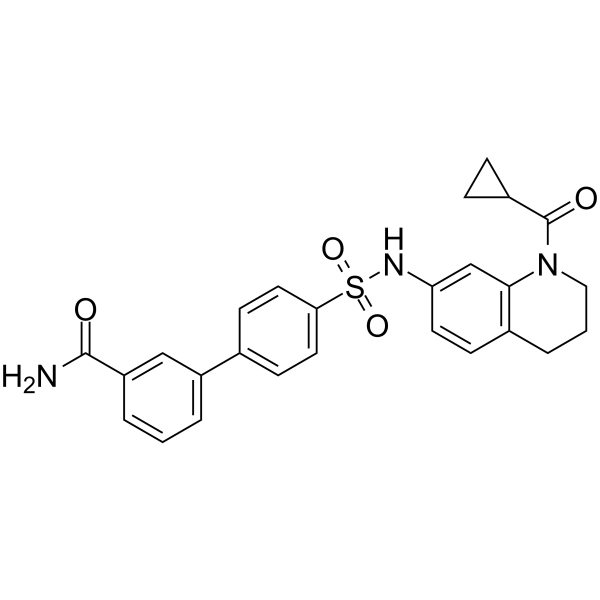
SU0268 is a potent and specific inhibitor of 8-Oxoguanine DNA glycosylase 1 (OGG1). SU0268 regulates inflammatory responses during Pseudomonas aeruginosa infection.
Nos produits utilisent uniquement pour la recherche. Nous ne vendons pas aux patients.
- Pureté : 99.96%
- CAS No.: 2210228-45-6
- Formule: C26H25N3O4S
- Masse moléculaire:475.56
-
Stockage:Powder -20°C, 3 years , 4°C, 2 years ; In solvent -80°C, 6 months , -20°C, 1 month

To place orders, for customer services and technical support, please contact: MedChemExpress USA
Tel: 609-228-6898 E-mail: [email protected] [email protected]


-
 Activité biologique
-
Chemical Information
-
Solvant et solubilité
- Protocole
- Pureté et documentation
- Références
-
 Help & FAQs




Publications Citing Use of MedChemExpress (MCE) SU0268
More

Activité biologique
Description
In Vitro
MTH1-depleted cells are less sensitive to the OGG1-specific inhibitor, SU0268 (5-10 μM), than their control shGFP counterparts[1].
SU0268/IACS-4759 (5-20 μM, 48h) co-treated cells are more viable than the correspondingly-treated IACS-4759- or SU0268-treated cells[1].
SU0268 does not bind DNA and thus interacts with OGG1 specifically rather than its substrate[2].
SU0268 induces the release of type I IFN by the mitochondrial DNA-cGAS-STING-IRF3-IFN-β axis, which decreases bacterial loads and halts disease progression[3].
MedChemExpress (MCE) has not independently confirmed the accuracy of these methods. They are for reference only. Further protocols information, click here.
-
Cell Line:A549 shGFP and shMTH1 (2000 cells per well).
-
Concentration:0.1 μM, 0.5 μM, 1 μM, 2.5 μM, 5 μM, 7.5 μM, 10 μM.
-
Incubation Time:24 or 48 h.
-
Result:The shGFP cells were more susceptible to OGG1 inhibition via increasing SU0268 doses than the shMTH1 cells, especially at the 48 time-point.
In Vivo
MedChemExpress (MCE) has not independently confirmed the accuracy of these methods. They are for reference only.
-
Animal Model:Anesthetized C57BL/6N mice[3].
-
Dosage:10 mg/kg.
-
Administration:Intranasally treated.
-
Result:Significantly inhibits inflammatory responses and mitigates P. aeruginosa infection.


Chemical Information
-
CAS No. 2210228-45-6
-
Appearance Solid
-
Masse moléculaire 475.56
-
Formule C26H25N3O4S
-
Color White to off-white
-
SMILES
O=C(C1=CC(C2=CC=C(S(=O)(NC3=CC4=C(C=C3)CCCN4C(C5CC5)=O)=O)C=C2)=CC=C1)N
-
Livraison
Room temperature in continental US; may vary elsewhere.
-
Stockage
Powder -20°C 3 years 4°C 2 years In solvent -80°C 6 months -20°C 1 month


Publications (5)
-
Journal Impact Factor
-
Most Recent


Solvant et solubilité
In Vitro:
DMSO : 100 mg/mL (210.28 mM; Need ultrasonic; Hygroscopic DMSO has a significant impact on the solubility of product, please use newly opened DMSO)
Please refer to the solubility information to select the appropriate solvent. Once prepared, please aliquot and store the solution to prevent product inactivation from repeated freeze-thaw cycles.
Storage method and period of stock solution: -80°C, 6 months; -20°C, 1 month. When stored at -80°C, please use it within 6 months. When stored at -20°C, please use it within 1 month.
Please refer to the solubility information to select the appropriate solvent. Once prepared, please aliquot and store the solution to prevent product inactivation from repeated freeze-thaw cycles.
Storage method and period of stock solution: -80°C, 6 months; -20°C, 1 month. When stored at -80°C, please use it within 6 months. When stored at -20°C, please use it within 1 month.
Concentration (start) × Volume (start) = Concentration (final) × Volume (final)
In Vivo:
Select the appropriate dissolution method based on your experimental animal and administration route.
- For the following dissolution methods, please ensure to first prepare a clear stock solution using an In Vitro approach and then sequentially add co-solvents:
- To ensure reliable experimental results, the clarified stock solution can be appropriately stored based on storage conditions. As for the working solution for In Vivo experiments, it is recommended to prepare freshly and use it on the same day.
- The percentages shown for the solvents indicate their volumetric ratio in the final prepared solution. If precipitation or phase separation occurs during preparation, heat and/or sonication can be used to aid dissolution.
Add each solvent one by one: 10% DMSO 40% PEG300 5% Tween-80 45% Saline
Solubility: ≥ 2.5 mg/mL (5.26 mM); Clear solution
This protocol yields a clear solution of ≥ 2.5 mg/mL (saturation unknown).
Taking 1 mL working solution as an example, add 100 μL DMSO stock solution (25.0 mg/mL) to 400 μL PEG300, and mix evenly; then add 50 μL Tween-80 and mix evenly; then add 450 μL Saline to adjust the volume to 1 mL.
Preparation of Saline: Dissolve 0.9 g sodium chloride in ddH₂O and dilute to 100 mL to obtain a clear Saline solution.
Add each solvent one by one: 10% DMSO 90% (20% SBE-β-CD in Saline)
Solubility: ≥ 2.5 mg/mL (5.26 mM); Clear solution
This protocol yields a clear solution of ≥ 2.5 mg/mL (saturation unknown).
Taking 1 mL working solution as an example, add 100 μL DMSO stock solution (25.0 mg/mL) to 900 μL 20% SBE-β-CD in Saline, and mix evenly.
Preparation of 20% SBE-β-CD in Saline (4°C, storage for one week): 2 g SBE-β-CD powder is dissolved in 10 mL Saline, completely dissolve until clear.
In Vivo Dissolution Calculator
Please enter the basic information of animal experiments:
-
-
-
-
Recommended: Prepare an additional quantity of animals to account for potential losses during experiments.
Please enter your animal formula composition:
-
%DMSO +
Recommended: Keep the proportion of DMSO in working solution below 2% if your animal is weak.
-
%+
-
+%Tween-80 + +
-
%Saline +
The co-solvents required include: DMSO, . All of co-solvents are available by MedChemExpress (MCE). , Tween 80. All of co-solvents are available by MedChemExpress (MCE).
Working solution concentration: 0.22 mg/mL
Method for preparing stock solution: mg drug dissolved in μL DMSO. Stock solution concentration: mg/mL.
1. Take μL DMSO stock solution;
2. Add μL .
μL , mix evenly;
3. Then add μL Tween 80, mix evenly;
4. Then add μL
Please ensure that the stock solution in the first step is dissolved to a clear state, and add co-solvents in sequence. You can use ultrasonic heating (ultrasonic cleaner, recommended frequency 20-40 kHz), vortexing, etc. to assist dissolution.

Protocole
-
Research Protocol for Infectious Diseases
Infectious-disease experiments test how pathogens interact with host barriers, innate immune receptors, inflammatory signaling, pathogen replication, and tissue injury; pattern-recognition receptors such as TLRs, RIG-I-like receptors, NOD-like receptors, and inflammasomes detect microbial molecules and activate NF-κB, interferon, and cytokine responses. The central hypothesis is that infection severity reflects the balance between pathogen burden and host response: protective inflammation restricts pathogen growth, whereas excessive or mislocalized inflammation contributes to tissue damage and disease phenotype. Unresolved questions include which host pathways are protective versus pathogenic, why some infection models fail to translate to human disease, and which combined readouts best predict clinically relevant infection outcomes.


Pureté et documentation
-
Fiche technique (276 KB)
-
SDS (393 KB)
- English - EN (393 KB)
- Français - FR (393 KB)
- Deutsch - DE (393 KB)
- Norwegian - NO (393 KB)
- Español - ES (393 KB)
- Swedish - SV (393 KB)
- Italian - IT (393 KB)
- Korean - KR (393 KB)
- Portuguese - PT (393 KB)
-
Instruction de manipulation (2659 KB)
Références
[1]. Ling Zhang, et al. OGG1 co-inhibition antagonizes the tumor-inhibitory effects of targeting MTH1. Redox Biol. 2021 Apr;40:101848. [Content Brief]
[2]. Yu-Ki Tahara, et al. Potent and Selective Inhibitors of 8-Oxoguanine DNA Glycosylase. J Am Chem Soc. 2018 Feb 14;140(6):2105-2114. [Content Brief]
[3]. Shugang Qin, et al. Small-Molecule Inhibitor of 8-Oxoguanine DNA Glycosylase 1 Regulates Inflammatory Responses during Pseudomonas aeruginosa Infection. J Immunol. 2020 Oct 15;205(8):2231-2242. [Content Brief]


Complete Stock Solution Preparation Table
Please refer to the solubility information to select the appropriate solvent. Once prepared, please aliquot and store the solution to prevent product inactivation from repeated freeze-thaw cycles.
Storage method and period of stock solution: -80°C, 6 months; -20°C, 1 month. When stored at -80°C, please use it within 6 months. When stored at -20°C, please use it within 1 month.
| Optional Solvent | Concentration Solvent Mass | 1 mg | 5 mg | 10 mg | 25 mg |
|---|---|---|---|---|---|
| DMSO | 1 mM | 2.1028 mL | 10.5139 mL | 21.0278 mL | 52.5696 mL |
| 5 mM | 0.4206 mL | 2.1028 mL | 4.2056 mL | 10.5139 mL | |
| 10 mM | 0.2103 mL | 1.0514 mL | 2.1028 mL | 5.2570 mL | |
| 15 mM | 0.1402 mL | 0.7009 mL | 1.4019 mL | 3.5046 mL | |
| 20 mM | 0.1051 mL | 0.5257 mL | 1.0514 mL | 2.6285 mL | |
| 25 mM | 0.0841 mL | 0.4206 mL | 0.8411 mL | 2.1028 mL | |
| 30 mM | 0.0701 mL | 0.3505 mL | 0.7009 mL | 1.7523 mL | |
| 40 mM | 0.0526 mL | 0.2628 mL | 0.5257 mL | 1.3142 mL | |
| 50 mM | 0.0421 mL | 0.2103 mL | 0.4206 mL | 1.0514 mL | |
| 60 mM | 0.0350 mL | 0.1752 mL | 0.3505 mL | 0.8762 mL | |
| 80 mM | 0.0263 mL | 0.1314 mL | 0.2628 mL | 0.6571 mL | |
| 100 mM | 0.0210 mL | 0.1051 mL | 0.2103 mL | 0.5257 mL |


SU0268 Related Classifications
HY-139056 Related Classifications
 Powered by Bioz