



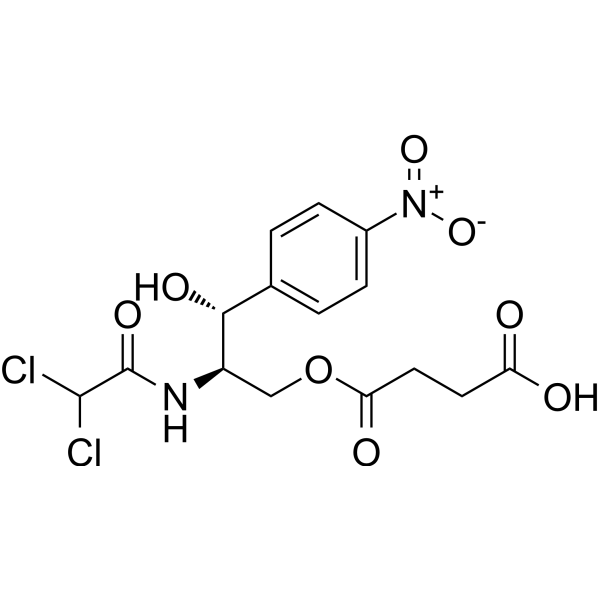
Chloramphenicol succinate
Based on 3 publication(s) in Google Scholar
Chloramphenicol succinate is a prodrug of Chloramphenicol (HY-B0239), acting as a P2Y14R inhibitor with an IC50 of 1.585 nM. Chloramphenicol succinate serves as a competitive substrate and inhibitor of succinate dehydrogenase (SDH), which may account for its toxicity. Chloramphenicol succinate exerts a significant inhibitory effect on colitis. Chloramphenicol succinate can be used in research related to myelosuppression, gray baby syndrome, aplastic anemia, bacterial meningitis and inflammatory bowel disease.
For research use only. We do not sell to patients.
- CAS No.: 3544-94-3
- Formula: C15H16Cl2N2O8
- Molecular Weight:423.20
-
Storage:
Please store the product under the recommended conditions in the Certificate of Analysis.

To place orders, for customer services and technical support, please contact: MedChemExpress USA
Tel: 609-228-6898 E-mail: [email protected] [email protected]


-
 Biological Activity
-
Chemical Information
- Protocols
- Purity & Documentation
- References
-
 Help & FAQs


Publications Citing Use of MedChemExpress (MCE) Chloramphenicol succinate
MoreAll P2Y Receptor Isoforms
More

Biological Activity
Description
In Vitro
Chloramphenicol succinate (50 μM; 3-24 h) is slowly oxidized to Chloramphenicol by cultured human bone marrow monocytes within 24 h[1].
Chloramphenicol succinate (50-100 μM; 30-60 min) is oxidized to Chloramphenicol by mitochondria isolated from human liver, rat liver and rat kidney within 60 min[1].
Chloramphenicol succinate is hydrolyzed by esterases present in the liver, kidney and lung of humans and animals, but not by blood esterases[2].
Chloramphenicol succinate ((0.01-100 μM; 24 h) exhibits only extremely low cytotoxicity against HT-29 cells when incubated at concentrations up to 100 μM for 24 h[3].
MedChemExpress (MCE) has not independently confirmed the accuracy of these methods. They are for reference only. Further protocols information, click here.
In Vivo
MedChemExpress (MCE) has not independently confirmed the accuracy of these methods. They are for reference only.
-
Animal Model:C57BL/6 J (male, 7-8-week-old, DSS-induced colitis)[3]
-
Dosage:50 μM; 100 μM
-
Administration:rectal; daily; 7 days
-
Result:Significantly attenuated DSS-induced colitis symptoms.
Reduced weight loss.
Lowered Disease Activity Index (DAI) scores.
Prevented colon shortening.
Mitigated colon tissue damage and inflammatory cell infiltration.
Enhanced gut barrier integrity via increased expression of tight junction proteins (Claudin-1, Occludin, ZO-1).


Chemical Information
-
CAS No. 3544-94-3
-
Molecular Weight 423.20
-
Formula C15H16Cl2N2O8
-
SMILES
O=C(OC[C@@H](NC(C(Cl)Cl)=O)[C@H](O)C1=CC=C([N+]([O-])=O)C=C1)CCC(O)=O
-
Structure Classification
-
Initial Source
Streptomyces venequelae
-
Shipping
Room temperature in continental US; may vary elsewhere.
-
Storage
Please store the product under the recommended conditions in the Certificate of Analysis.


Publications (3)
-
Journal Impact Factor
-
Most Recent
-
Acta Pharmacol Sin
Esflurbiprofen exerts a fast-onset antidepressant effect by blocking SERT-nNOS interaction. [Abstract]2025 Oct 9. PMID: 41068287 -
Molecules
Seeking Correlation Among Porin Permeabilities and Minimum Inhibitory Concentrations Through Machine Learning: A Promising Route to the Essential Molecular Descriptors. [Abstract]2025 Mar 9;30(6):1224. PMID: 40142001 -
Anim Dis
Pasteurella multocida capsular: lipopolysaccharide types D:L6 and A:L3 remain to be the main epidemic genotypes of pigs in China. [Abstract]2021;1(1):26. PMID: 34778886

Protocols
-
Cell Cytotoxicity Assay
Cytotoxicity assays are usually based on the assessment of cell membrane damage, which can also be indirectly detected by measuring cell viability. Detection methods include MTT assay, CKK-8 assay, LDH assay and ATP assay, etc.
-
DSS-Induced Colitis
Dextran sulfate sodium (DSS)-induced colitis is generated by administering DSS in mouse drinking water, producing epithelial injury, barrier disruption, weight loss, diarrhea, fecal blood, colon shortening, histologic mucosal damage, and inflammatory mediator changes; the model is mainly used to study acute or chronic intestinal inflammation resembling selected features of ulcerative colitis. DSS injury is interpreted through clinical and tissue readouts rather than a single molecular endpoint: daily body weight, stool consistency, and bleeding are combined into a disease activity index, while colon length, histology, cytokines, myeloperoxidase activity, intestinal permeability, and tight-junction markers provide complementary measures of inflammation and barrier damage.
-
TNBS-Induced Colitis
TNBS-induced colitis is produced by intrarectal delivery of 2,4,6-trinitrobenzene sulfonic acid in ethanol, where ethanol disrupts the mucosal barrier and TNBS haptenates colonic proteins, generating immune-mediated colonic inflammation with weight loss, diarrhea, ulceration, transmural injury, inflammatory-cell infiltration, and cytokine responses. The model is used as an experimental intestinal inflammation model with Crohn’s disease–like features, especially when Th1-type responses, IL-12–dependent inflammation, chronic relapsing inflammation, or fibrosis-related endpoints are studied.


Purity & Documentation
References
[1]. Ambekar CS, et al. Chloramphenicol succinate, a competitive substrate and inhibitor of succinate dehydrogenase: possible reason for its toxicity. Toxicol In Vitro. 2004;18(4):441-447. [Content Brief]
[2]. Ambrose PJ, et al. Clinical pharmacokinetics of chloramphenicol and chloramphenicol succinate. Clin Pharmacokinet. 1984;9(3):222-238. [Content Brief]
[3]. Tian S, et al. Computational discovery and repurposing of chloramphenicol succinate as a potent P2Y14 receptor antagonist for inflammatory bowel disease therapy. J Adv Res. Published online August 22, 2025. [Content Brief]

Calculators
Concentration (start) × Volume (start) = Concentration (final) × Volume (final)


Chloramphenicol succinate Related Classifications
HY-N7114 Related Classifications
 Powered by Bioz