



Cinnamtannin B-1

Based on 1 Customer Validation
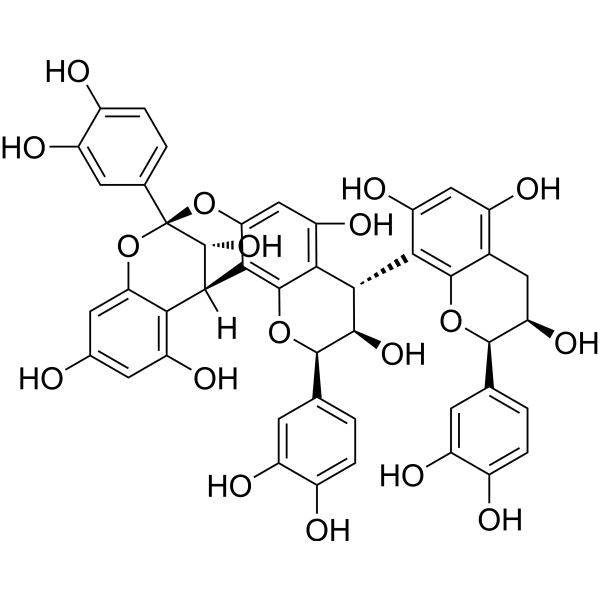
Cinnamtannin B-1 is a anthocyanidin. Cinnamtannin B-1 inhibits the osteoclast formation by inhibiting NF-kB signaling pathway and ROS generation. Cinnamtannin B-1 exhibits antioxidant, anti-inflammatory, antitumor and anti-platelet aggregation activities. Cinnamtannin B-1 is orally active.
For research use only. We do not sell to patients.
- Purity : 99.16%
- CAS No.: 88082-60-4
- Formula: C45H36O18
- Molecular Weight:864.76
-
Storage:
4°C, protect from light
* In solvent : -80°C, 6 months; -20°C, 1 month (protect from light)

To place orders, for customer services and technical support, please contact: MedChemExpress USA
Tel: 609-228-6898 E-mail: [email protected] [email protected]


-
 Biological Activity
-
Chemical Information
-
Solvent & Solubility
- Protocols
- Purity & Documentation
- References
-
 Help & FAQs





Biological Activity
Description
Cellular Effect
|
Cell Line

|
Type | Value | Description | References |
|---|---|---|---|---|
| A549 | ED50 |
>10 μg/mL
Compound: 54
|
Cytotoxicity against human A549 cells by tetrazolium salt-based colorimetric assay
Cytotoxicity against human A549 cells by tetrazolium salt-based colorimetric assay
|
[PMID: 1431932] |
| HCT-8 | ED50 |
>10 μg/mL
Compound: 54
|
Cytotoxicity against human HCT8 cells by tetrazolium salt-based colorimetric assay
Cytotoxicity against human HCT8 cells by tetrazolium salt-based colorimetric assay
|
[PMID: 1431932] |
| KB | ED50 |
>10 μg/mL
Compound: 54
|
Cytotoxicity against human KB cells by tetrazolium salt-based colorimetric assay
Cytotoxicity against human KB cells by tetrazolium salt-based colorimetric assay
|
[PMID: 1431932] |
| TE-671 | ED50 |
>10 μg/mL
Compound: 54
|
Cytotoxicity against human TE671 cells by tetrazolium salt-based colorimetric assay
Cytotoxicity against human TE671 cells by tetrazolium salt-based colorimetric assay
|
[PMID: 1431932] |
In Vitro
Cinnamtannin B-1 (0-100 μM, 1-5 days) downregulates osteoclast differentiation-related gene expressions (such as Ctsk, Mmp9, Acp5, ATP6V0d2, and NFATc1), reduces the protein expression of NFATc1 and c-Fos, inhibits RANKL-induced osteoclast formation and bone resorption function in mouse bone marrow macrophages[1].
Cinnamtannin B-1 (0-100 μM, 1-3 days) inhibits the viability of cancer cells DLD-1, COLO 201 and HCT-116 (IC50s are 32 μM, 35 μM and 58.8 μM, respectively), arrests the cell cycle at G2/M phase, and induces apoptosis in DLD-1 and COLO 201[2].
MedChemExpress (MCE) has not independently confirmed the accuracy of these methods. They are for reference only. Further protocols information, click here.
-
Cell Line:DLD-1, COLO 201 and HCT-116
-
Concentration:0-100 μM
-
Incubation Time:24-72 h
-
Result:Inhibited the cell viability.
-
Cell Line:mouse bone marrow macrophage
-
Concentration:0-10 μM
-
Incubation Time:4 h
-
Result:Downregulated the expression of NFATc1 and c-Fos.
In Vivo
MedChemExpress (MCE) has not independently confirmed the accuracy of these methods. They are for reference only.
-
Animal Model:OVX-induced osteoporosis in C57BL/6 mice[1]
-
Dosage:20 mg/kg
-
Administration:ig, 5 times a week for 5 weeks
-
Result:Increased the bone density, increased the bone volume fraction (BV/TV), the number of trabeculae (Tb.N) and the thickness of trabeculae (Tb.Th), decreased the trabecular separation (Tb.Sp).


Chemical Information
-
CAS No. 88082-60-4
-
Appearance Solid
-
Molecular Weight 864.76
-
Formula C45H36O18
-
Color White to pink
-
SMILES
O[C@H]1[C@@H](C2=CC=C(O)C(O)=C2)OC3=C4C(O[C@]5(C6=CC=C(O)C(O)=C6)OC7=CC(O)=CC(O)=C7[C@@]4([H])[C@H]5O)=CC(O)=C3[C@@H]1C8=C9C(C[C@@H](O)[C@@H](C%10=CC=C(O)C(O)=C%10)O9)=C(O)C=C8O
-
Structure Classification
-
Initial Source
-
Shipping
Room temperature in continental US; may vary elsewhere.
-
Storage
4°C, protect from light
* In solvent : -80°C, 6 months; -20°C, 1 month (protect from light)


Solvent & Solubility
In Vitro:
DMSO : 100 mg/mL (115.64 mM; Need ultrasonic; Hygroscopic DMSO has a significant impact on the solubility of product, please use newly opened DMSO)
Please refer to the solubility information to select the appropriate solvent. Once prepared, please aliquot and store the solution to prevent product inactivation from repeated freeze-thaw cycles.
Storage method and period of stock solution: -80°C, 6 months; -20°C, 1 month (protect from light). When stored at -80°C, please use it within 6 months. When stored at -20°C, please use it within 1 month.
Please refer to the solubility information to select the appropriate solvent. Once prepared, please aliquot and store the solution to prevent product inactivation from repeated freeze-thaw cycles.
Storage method and period of stock solution: -80°C, 6 months; -20°C, 1 month (protect from light). When stored at -80°C, please use it within 6 months. When stored at -20°C, please use it within 1 month.
Concentration (start) × Volume (start) = Concentration (final) × Volume (final)

Protocols
-
ROS/oxidative-stress fluorescent staining
ROS/oxidative-stress fluorescent staining uses cell-permeant fluorogenic probes that become fluorescent after oxidation inside cells or tissues; commonly used examples include DCFH-DA/DCFDA for broad cellular oxidant detection, DHE for superoxide-related signal detection, MitoSOX for mitochondrial superoxide-related signal detection, and CellROX probes for oxidative-stress-associated fluorescence readouts. The assay detects probe oxidation rather than a single ROS species unless the probe and analysis method have been chemically validated for that species. DCFH-DA enters cells, is deacetylated by intracellular esterases to DCFH, and produces fluorescent DCF after oxidation, so the readout is used as an operational measure of total cellular oxidative stress rather than a species-specific ROS measurement. DHE and MitoSOX can report superoxide-related oxidation, but red fluorescence alone can include non-specific ethidium-like oxidation products; HPLC or optimized spectral approaches are
-
Research Protocol for Inflammation-related Diseases
The NLRP3 inflammasome is a cytosolic innate immune signaling platform that integrates priming signals and danger-signal activation to promote caspase-1 activation, maturation of IL-1β and IL-18, and gasdermin D-mediated pyroptotic cell death. The core experimental logic is to determine whether inflammatory disease phenotypes are driven by increased NLRP3 expression, ASC-containing inflammasome assembly, caspase-1 cleavage, GSDMD cleavage, and extracellular release of IL-1β/IL-18 rather than by nonspecific cell injury alone. The pathway is strongly linked to inflammation-related disease phenotypes because monosodium urate crystals activate NALP3/NLRP3 inflammasome signaling in gout-like crystal inflammation, cholesterol crystals activate NLRP3 inflammasomes in atherogenesis models, and DSS-induced intestinal inflammation has been reported to involve NLRP3 inflammasome activity. However, experimental colitis studies also show context-dependent protective effects of NLRP3 inflammasome co
-
Osteoclast differentiation from monocyte/macrophage precursors
Osteoclast differentiation is an in vitro induction assay in which monocyte/macrophage-lineage precursors are exposed to macrophage colony-stimulating factor (M-CSF) and receptor activator of NF-κB ligand (RANKL), generating multinucleated osteoclasts that are commonly identified by tartrate-resistant acid phosphatase (TRAP) staining and functionally confirmed by resorption pits on dentin, bone, or mineralized substrates. M-CSF supports survival and expansion of osteoclast precursors, while RANKL binding to RANK drives osteoclast commitment, fusion, maturation, and resorptive function; osteoprotegerin inhibits this pathway by binding RANKL and preventing RANK activation. The main readouts are the number of TRAP-positive multinucleated cells, formation of F-actin rings, and resorbed surface area; TRAP-positive multinucleated cells indicate osteoclast differentiation, whereas pit formation on dentin, bone, or mineralized coating indicates functional bone-resorbing activity.


Purity & Documentation
-
Data Sheet (284 KB)
-
SDS (252 KB)
- English - EN (252 KB)
- Français - FR (252 KB)
- Deutsch - DE (252 KB)
- Norwegian - NO (252 KB)
- Español - ES (252 KB)
- Swedish - SV (252 KB)
- Italian - IT (252 KB)
- Korean - KR (252 KB)
- Portuguese - PT (252 KB)
-
Handling Instructions (2659 KB)
References
[1]. Meng Li, et al. Cinnamtannin B-1 Prevents Ovariectomy-Induced Osteoporosis via Attenuating Osteoclastogenesis and ROS Generation. Front Pharmacol. 2020 Jul 10;11:1023. [Content Brief]
[2]. Patrick P Carriere, et al. Cinnamtannin B-1 inhibits cell survival molecules and induces apoptosis in colon cancer.Int J Oncol. 2018 Oct;53(4):1442-1454. [Content Brief]
[3]. Fujita K, et al., Cinnamtannin B-1 Promotes Migration of Mesenchymal Stem Cells and Accelerates Wound Healing in Mice. PLoS One. 2015 Dec 11;10(12):e0144166. [Content Brief]


Complete Stock Solution Preparation Table
Please refer to the solubility information to select the appropriate solvent. Once prepared, please aliquot and store the solution to prevent product inactivation from repeated freeze-thaw cycles.
Storage method and period of stock solution: -80°C, 6 months; -20°C, 1 month (protect from light). When stored at -80°C, please use it within 6 months. When stored at -20°C, please use it within 1 month.
| Optional Solvent | Concentration Solvent Mass | 1 mg | 5 mg | 10 mg | 25 mg |
|---|---|---|---|---|---|
| DMSO | 1 mM | 1.1564 mL | 5.7820 mL | 11.5639 mL | 28.9098 mL |
| 5 mM | 0.2313 mL | 1.1564 mL | 2.3128 mL | 5.7820 mL | |
| 10 mM | 0.1156 mL | 0.5782 mL | 1.1564 mL | 2.8910 mL | |
| 15 mM | 0.0771 mL | 0.3855 mL | 0.7709 mL | 1.9273 mL | |
| 20 mM | 0.0578 mL | 0.2891 mL | 0.5782 mL | 1.4455 mL | |
| 25 mM | 0.0463 mL | 0.2313 mL | 0.4626 mL | 1.1564 mL | |
| 30 mM | 0.0385 mL | 0.1927 mL | 0.3855 mL | 0.9637 mL | |
| 40 mM | 0.0289 mL | 0.1445 mL | 0.2891 mL | 0.7227 mL | |
| 50 mM | 0.0231 mL | 0.1156 mL | 0.2313 mL | 0.5782 mL | |
| 60 mM | 0.0193 mL | 0.0964 mL | 0.1927 mL | 0.4818 mL | |
| 80 mM | 0.0145 mL | 0.0723 mL | 0.1445 mL | 0.3614 mL | |
| 100 mM | 0.0116 mL | 0.0578 mL | 0.1156 mL | 0.2891 mL |


Cinnamtannin B-1 Related Classifications
HY-130237 Related Classifications
 Powered by Bioz