



Cloprostenol

Based on 1 Customer Validation
Cloprostenol is a prostaglandin F-2α (PGF2α (HY-12956)) analogue. Cloprostenol induces luteolysis in marmoset monkeys. Cloprostenol can be used for the research of open-cervix pyometra.
For research use only. We do not sell to patients.
- Purity : 99.73%
- CAS No.: 40665-92-7
- Formula: C22H29ClO6
- Molecular Weight:424.92
-
Storage:
Store at room temperature 3 years.
In solvent -80°C, 2 years , -20°C, 1 year


To place orders, for customer services and technical support, please contact: MedChemExpress USA
Tel: 609-228-6898 E-mail: [email protected] [email protected]


-
 Biological Activity
-
Chemical Information
- Purity & Documentation
- References
-
 Help & FAQs


-
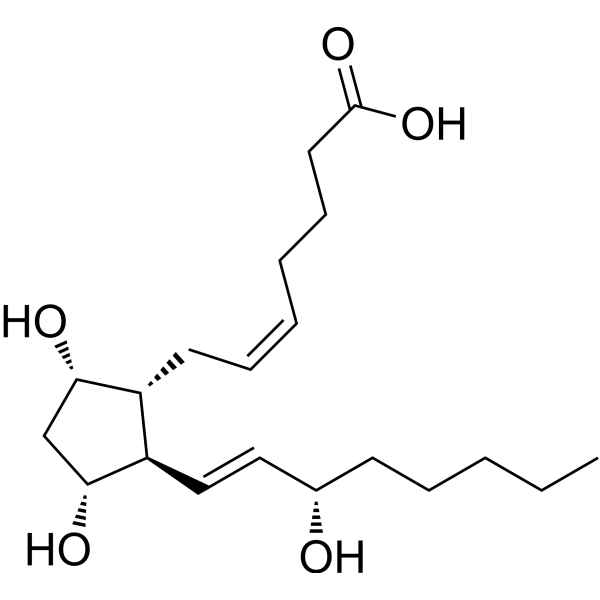
HY-12956
DinoprostFP Receptor Agonist -
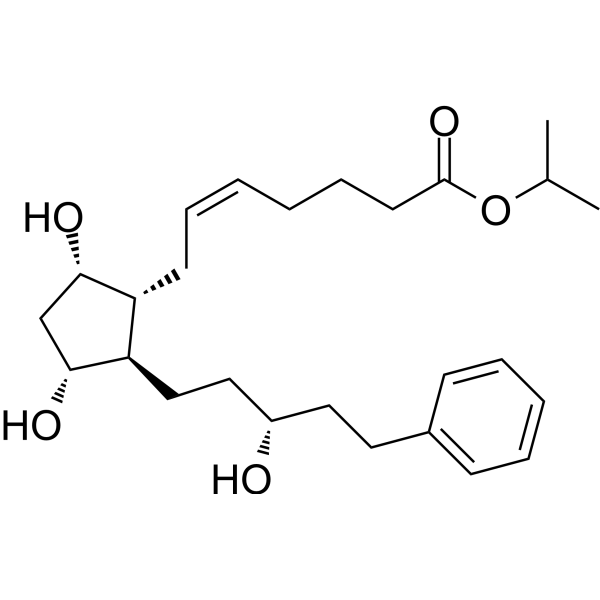
HY-B0577
LatanoprostProstaglandin Receptor Agonist -
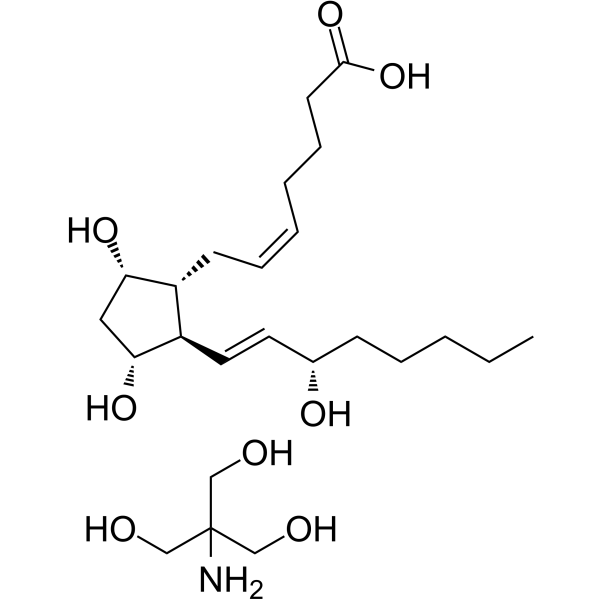
HY-12956A
Dinoprost tromethamine saltFP Receptor Agonist -
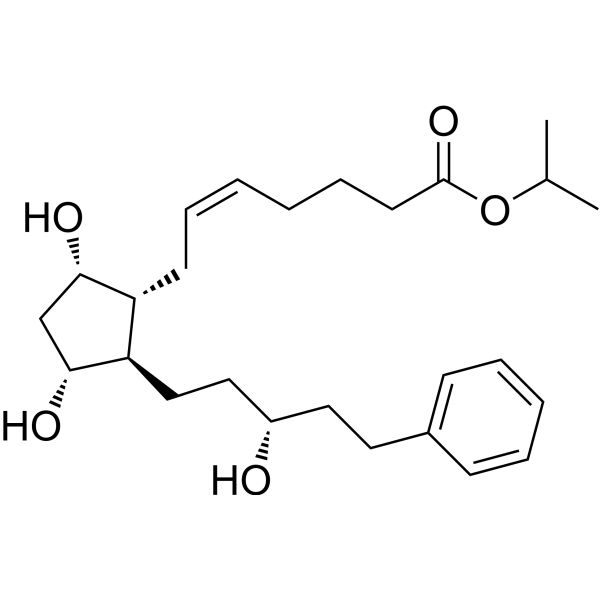
HY-B0577R
Latanoprost (Standard) -

HY-12956R
Dinoprost (Standard)FP Receptor Agonist -

HY-12956AR
Dinoprost tromethamine salt (Standard)FP Receptor Agonist


Biological Activity
Description
In Vivo
MedChemExpress (MCE) has not independently confirmed the accuracy of these methods. They are for reference only.
-
Animal Model:Adult Female Common marmoset monkeys (250-510 g, regular ovarian cycles)[1]
-
Dosage:0.5 μg
-
Administration:i.m.; single injection
-
Result:Failed to induce luteolysis in animals treated on Days 6 or 7 of the ovarian cycle, with progesterone concentrations remaining elevated until at least Day 15-16 post-injection.
Induced luteolysis in 3/5 animals treated on Day 8.
Induced luteolysis in 1/2 animals treated on Day 9.
Induced complete, irreversible luteolysis within 24 hours in all 23 animals treated between Days 10 and 17, with progesterone falling to <10 ng/mL and remaining at this level until the day after post-treatment ovulation.
Resulted in a mean interval from injection to ovulation of 10.7 days for treatments between Days 8 and 17 where permanent luteolysis occurred, with no significant difference between mid-luteal and late luteal phase treatments, or between females paired with vasectomized versus intact males.
Produced post-treatment ovarian cycles with a normal mean length of 27.6 days and luteal phase of 18.7 days in 7 animals monitored.
-
Animal Model:Adult Female Common marmoset monkeys (range 250-510 g, pregnant between Days 19 and 43)[1]
-
Dosage:0.5 μg
-
Administration:i.m.; single injection
-
Result:Induced complete luteolysis within 24 hours in all 7 pregnant animals, with progesterone falling to <10 ng/mL and remaining at this level until the day after post-treatment ovulation.
Resulted in a mean interval from injection to ovulation of 10.9 days.
Produced 23 morphologically normal embryos out of 24 collected 6-9 days post-treatment from 11 animals, with 1 degenerate morula.


Chemical Information
-
CAS No. 40665-92-7
-
Appearance Solid
-
Molecular Weight 424.92
-
Formula C22H29ClO6
-
Color White to off-white
-
SMILES
OC(CCC/C=C\C[C@H]1[C@@H]([C@@H](O)C[C@H]1O)/C=C/[C@H](O)COC2=CC(Cl)=CC=C2)=O
-
Shipping
Room temperature in continental US; may vary elsewhere.
-
Storage
Store at room temperature 3 years
In solvent -80°C 2 years -20°C 1 year


Purity & Documentation
-
Data Sheet (268 KB)
-
SDS (393 KB)
- English - EN (393 KB)
- Français - FR (393 KB)
- Deutsch - DE (393 KB)
- Norwegian - NO (393 KB)
- Español - ES (393 KB)
- Swedish - SV (393 KB)
- Italian - IT (393 KB)
- Korean - KR (393 KB)
- Portuguese - PT (393 KB)
-
Handling Instructions (2659 KB)
References

Calculators
Concentration (start) × Volume (start) = Concentration (final) × Volume (final)


Cloprostenol Related Classifications
HY-121314 Related Classifications
 Powered by Bioz