



CXL-1020
Based on 1 publication(s) in Google Scholar
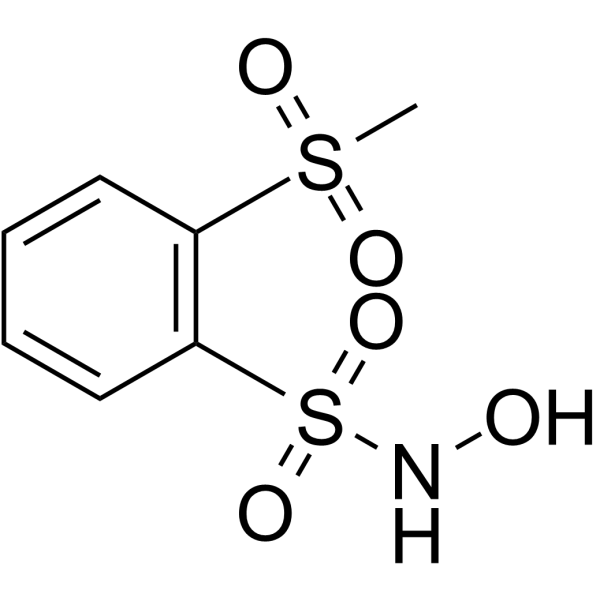
CXL-1020 is a hydroxylamine-based nitroxyl (HNO) donor. CXL-1020 improves cardiac inotropy/lusitropy and Ca2+ cycling in rats with abnormal relaxation. CXL-1020 induces vasorelaxation and improves cardiac function in canine models. CXL-1020 has been used to research systolic heart failure and stable heart failure.
Nos produits utilisent uniquement pour la recherche. Nous ne vendons pas aux patients.
- CAS No.: 950834-06-7
- Formule: C7H9NO5S2
- Masse moléculaire:251.28
-
Stockage:Powder -20°C, 3 years , 4°C, 2 years ; In solvent -80°C, 6 months , -20°C, 1 month

To place orders, for customer services and technical support, please contact: MedChemExpress USA
Tel: 609-228-6898 E-mail: [email protected] [email protected]


-
 Activité biologique
-
Chemical Information
- Protocole
- Pureté et documentation
- Références
-
 Help & FAQs


Publications Citing Use of MedChemExpress (MCE) CXL-1020
MoreVoir tous les produits spécifiques à Isoform Calcium Channel
More

Activité biologique
Description
IC50 & Target
[1]|
L-type calcium channel |
In Vivo
CXL-1020 (3 and 10 mg/kg/min; 4-hour intravenous infusion) improves left ventricular systolic and diastolic function in dogs with advanced heart failure[2].
MedChemExpress (MCE) has not independently confirmed the accuracy of these methods. They are for reference only.
-
Animal Model:Adult male Sprague-Dawley rats (250-350 g; induced cardiac dysfunction by isoproterenol)[1]
-
Dosage:100 μg/kg/min
-
Administration:For 30 min
-
Result:Improved hemodynamics and cardiac function in normal rats, and enhanced both diastolic and systolic performance in cardiac dysfunction mice.
-
Animal Model:Dogs (coronary microembolization-induced heart failure)[2] 3 and 10 mg/kg/min
-
Dosage:3 and 10 mg/kg/min
-
Administration:4-hour intravenous infusion
-
Result:Decreased systolic aortic pressure (AoP) modestly; significantly increased EF and deceleration time of early mitral inflow velocity (DT) and significantly lowered left ventricular (LV) end-systolic volume (ESV), LV end-diastolic pressure (EDP) and end-diastolic wall stress (EDWS) in a dose-dependent manner.
Essai clinique
| NCT Number | Sponsor | Condition | Start Date |
Phase

|
|---|---|---|---|---|
| NCT01329991 | 2011-05 | PHASE1 |


Chemical Information
-
CAS No. 950834-06-7
-
Appearance Solid
-
Masse moléculaire 251.28
-
Formule C7H9NO5S2
-
Color White to off-white
-
SMILES
CS(=O)(C1=C(S(=O)(NO)=O)C=CC=C1)=O
-
Livraison
Room temperature in continental US; may vary elsewhere.
-
Stockage
Powder -20°C 3 years 4°C 2 years In solvent -80°C 6 months -20°C 1 month


Publications (1)
-
Journal Impact Factor
-
Most Recent
-
PLoS One
Nitroxyl protects H9C2 cells from H/R-induced damage and inhibits autophagy via PI3K/Akt/mTOR pathway. [Abstract]2025 Jan 29;20(1):e0314500. PMID: 39879163


Pureté et documentation
-
Fiche technique (279 KB)
-
SDS (251 KB)
- English - EN (251 KB)
- Français - FR (251 KB)
- Deutsch - DE (251 KB)
- Norwegian - NO (251 KB)
- Español - ES (251 KB)
- Swedish - SV (251 KB)
- Italian - IT (251 KB)
- Korean - KR (251 KB)
- Portuguese - PT (251 KB)
-
Instruction de manipulation (2659 KB)
Références

Calculators
Concentration (start) × Volume (start) = Concentration (final) × Volume (final)


CXL-1020 Related Classifications
HY-147384 Related Classifications
 Powered by Bioz