



Cyhalofop-butyl

Based on 1 Customer Validation
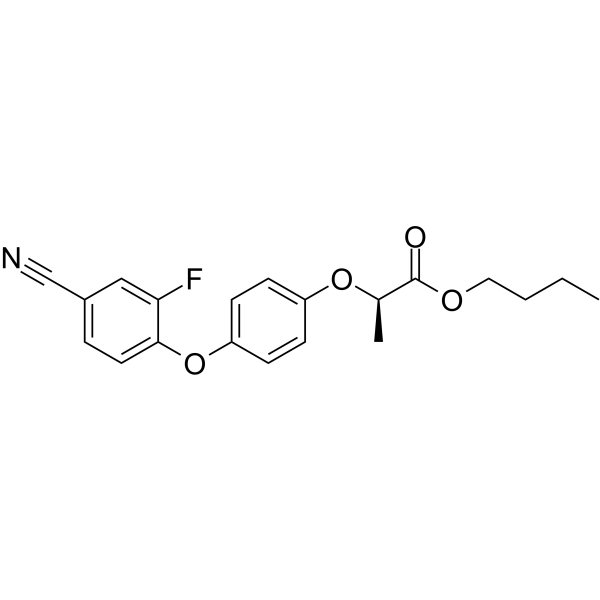
Cyhalofop-butyl is a post-emergenceherbicide that targets and inhibits ACCase. After entering the plant body, Cyhalofop-butyl rapidly degrades into the active cyhalofop-acid, which exhibits herbicidal activity against barnyardgrass and Leptochloa chinensis in paddy fields. Cyhalofop-butyl is also an environmental pollutant with acute lethal toxicity to zebrafish. Cyhalofop-butyl can be used in research on the development of agricultural herbicides.
For research use only. We do not sell to patients.
- Purity : 98.68%
- CAS No.: 122008-85-9
- Formula: C20H20FNO4
- Molecular Weight:357.38
-
Storage:
4°C, protect from light
* In solvent : -80°C, 6 months; -20°C, 1 month (protect from light)

To place orders, for customer services and technical support, please contact: MedChemExpress USA
Tel: 609-228-6898 E-mail: [email protected] [email protected]


-
 Biological Activity
-
Chemical Information
-
Solvent & Solubility
- Purity & Documentation
- References
-
 Help & FAQs


-

HY-B0861R
Cyhalofop-butyl (Standard)Reference Standard -
HY-B2007
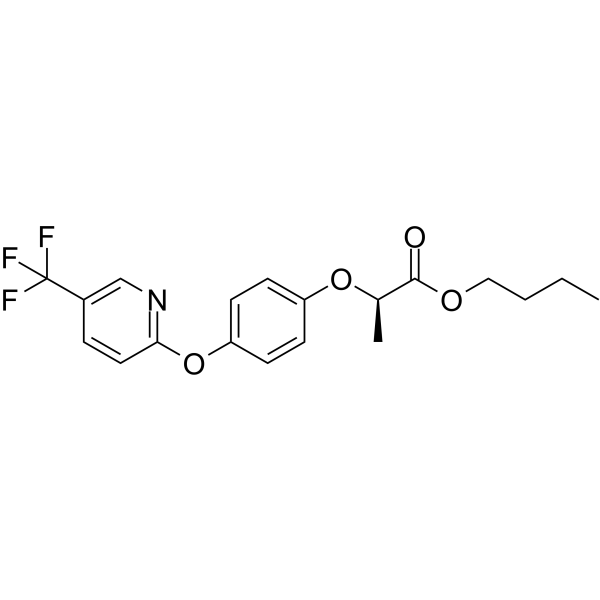
Fluazifop-P-butylACCase Inhibitor -
HY-111223
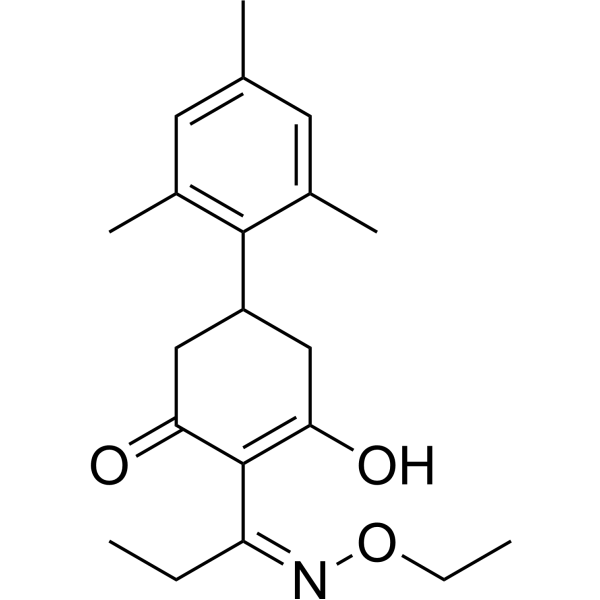
TralkoxydimHerbicide -
HY-B1950
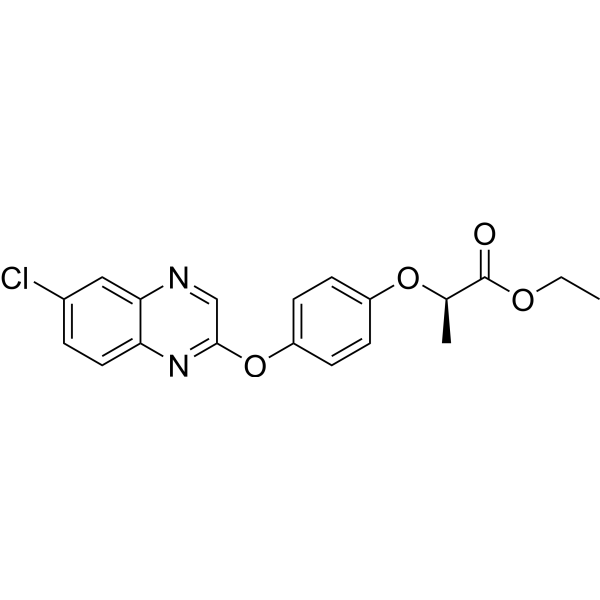
Quizalofop-p-ethylHerbicide -

HY-136380
Clodinafop-propargylHerbicide -

HY-B1950R
Quizalofop-p-ethyl (Standard)Herbicide -

HY-B2007R
Fluazifop-P-butyl (Standard)Standard -

HY-136380R
Clodinafop-propargyl (Standard)Herbicide -

HY-111223R
Tralkoxydim (Standard)Reference Standard


Biological Activity
Description
In Vitro
MedChemExpress (MCE) has not independently confirmed the accuracy of these methods. They are for reference only.
-
Cell Line:Leptochloa chinensis JS1-9
-
Concentration:1/16 ×, 1/4 ×, 1 ×, 4 ×, 16 ×, and 64 × the recommended dose
-
Incubation Time:2 weeks
-
Result:Reduced the fresh weight of susceptible JS1 in whole-plant Leptochloa chinensis experiments, with a GR50 of 5.9 g a.i. ha−1, whereas the GR50 values of resistant JS3, JS4, JS6, JS7, and JS8 are 158.7, 626.5, 726.0, 393.5, and 216.5 g a.i. ha−1, respectively.
In Vivo
Cyhalofop-butyl (0.33-1.00 mg/L; exposure in reconstituted water; solution renewed every 24 h; 96-h exposure) has a significant acute lethal toxic effect in zebrafish larvae at 12 h post-hatching, with sensitivity higher than that of the embryo and adult stages[1].
Cyhalofop-butyl (0.50-2.29 mg/L; exposure in reconstituted water; solutions renewed every 24 h; 96 h exposure) has acute lethal toxic effects in zebrafish larvae at 72 h post-hatching[1].
Cyhalofop-butyl (2.00-6.10 mg/L; exposed in dechlorinated tap water; static exposure observation; 96 h exposure) has lethal toxic effects in 6-month-old adult zebrafish[1].
Cyhalofop-butyl (0.32-1.25 mg/L; exposure in reconstituted water; solution renewed every 24 h; application for up to 13 days until complete yolk sac absorption) inhibits spontaneous movement, reduces hatching rate, decreases body length of surviving larvae, and induces short-term developmental toxicity including pericardial edema, yolk sac edema, and tail and spinal malformations in zebrafish embryos and yolk sac-stage larvae[1].
Cyhalofop-butyl (0.1-10 mg/kg; daily exposure; 28 consecutive days) exerts immunotoxicological suppressive effects in mammalian models, affecting immune cell migration in lung bronchoalveolar lavage fluid[3].
MedChemExpress (MCE) has not independently confirmed the accuracy of these methods. They are for reference only.
-
Animal Model:wild-type AB strain zebrafish embryos, 12 h post-hatching larvae, 72 h post-hatching larvae, and adult fish (Danio rerio) ()[1]
-
Dosage:embryos: 0.25, 0.50, 1.00, 2.00, 4.00, and 8.00 mg/L; 12h larvae: 0.33, 0.40,0.51, 0.64, 0.80, and 1.00 mg/L; 72h larvae: 0.50, 0.75,1.03, 1.51, and 2.29 mg/L; adults: 2.00, 2.50, 3.90, 4.88, and 6.10 mg/L
-
Administration:via waterborne exposure, with test solutions renewed daily (except static for adults) for 96 consecutive h
-
Result:Caused acute lethality across different life stages of zebrafish, with 96-h LC50 values of 2.03, 0.58, 1.42, and 3.49 mg/L for embryos, 12h larvae, 72h larvae, and adult fish, respectively.
Exhibited obvious stage-specificity, with early life stages (especially 12h post-hatching larvae) being more sensitive than adult fish.
-
Animal Model:wild-type AB zebrafish embryo and sac-fry stages (Danio rerio)[1]
-
Dosage:0.32, 0.40, 0.51, 0.64, 0.80, 1.00, 1.25 mg/L
-
Administration:waterborne exposure, with test solutions renewed daily, exposed for up to 13 days until the yolk sac was completely absorbed
-
Result:Increased embryo-larval cumulative mortality in a dose- and time-dependent manner, with significant lethal effects at concentrations of 0.80 mg/L and higher.
Significantly inhibited the spontaneous movement of embryos at 24 hpf (LOEC was 1.00 mg/L) and the hatching rate at 72 hpf (LOEC was 1.00 mg/L).
Significantly shortened the average body length of surviving larvae (at 1.25 mg/L).
Induced various teratogenic effects, including pericardial edema, yolk sac edema, tail deformation, and spine deformation.


Chemical Information
-
CAS No. 122008-85-9
-
Appearance Solid
-
Molecular Weight 357.38
-
Formula C20H20FNO4
-
Color White to off-white
-
SMILES
C[C@@H](OC1=CC=C(OC2=CC=C(C#N)C=C2F)C=C1)C(OCCCC)=O
-
Shipping
Room temperature in continental US; may vary elsewhere.
-
Storage
4°C, protect from light
* In solvent : -80°C, 6 months; -20°C, 1 month (protect from light)


Solvent & Solubility
In Vitro:
DMSO : 250 mg/mL (699.54 mM; Need ultrasonic; Hygroscopic DMSO has a significant impact on the solubility of product, please use newly opened DMSO)
Please refer to the solubility information to select the appropriate solvent. Once prepared, please aliquot and store the solution to prevent product inactivation from repeated freeze-thaw cycles.
Storage method and period of stock solution: -80°C, 6 months; -20°C, 1 month (protect from light). When stored at -80°C, please use it within 6 months. When stored at -20°C, please use it within 1 month.
Concentration (start) × Volume (start) = Concentration (final) × Volume (final)
In Vivo Dissolution Calculator
Please enter the basic information of animal experiments:
-
-
-
-
Recommended: Prepare an additional quantity of animals to account for potential losses during experiments.
Working solution concentration: 0.22 mg/mL


Purity & Documentation


References

Complete Stock Solution Preparation Table
Please refer to the solubility information to select the appropriate solvent. Once prepared, please aliquot and store the solution to prevent product inactivation from repeated freeze-thaw cycles.
Storage method and period of stock solution: -80°C, 6 months; -20°C, 1 month (protect from light). When stored at -80°C, please use it within 6 months. When stored at -20°C, please use it within 1 month.
| Optional Solvent | Concentration Solvent Mass | 1 mg | 5 mg | 10 mg | 25 mg |
|---|---|---|---|---|---|
| DMSO | 1 mM | 2.7981 mL | 13.9907 mL | 27.9814 mL | 69.9535 mL |
| 5 mM | 0.5596 mL | 2.7981 mL | 5.5963 mL | 13.9907 mL | |
| 10 mM | 0.2798 mL | 1.3991 mL | 2.7981 mL | 6.9954 mL | |
| 15 mM | 0.1865 mL | 0.9327 mL | 1.8654 mL | 4.6636 mL | |
| 20 mM | 0.1399 mL | 0.6995 mL | 1.3991 mL | 3.4977 mL | |
| 25 mM | 0.1119 mL | 0.5596 mL | 1.1193 mL | 2.7981 mL | |
| 30 mM | 0.0933 mL | 0.4664 mL | 0.9327 mL | 2.3318 mL | |
| 40 mM | 0.0700 mL | 0.3498 mL | 0.6995 mL | 1.7488 mL | |
| 50 mM | 0.0560 mL | 0.2798 mL | 0.5596 mL | 1.3991 mL | |
| 60 mM | 0.0466 mL | 0.2332 mL | 0.4664 mL | 1.1659 mL | |
| 80 mM | 0.0350 mL | 0.1749 mL | 0.3498 mL | 0.8744 mL | |
| 100 mM | 0.0280 mL | 0.1399 mL | 0.2798 mL | 0.6995 mL |


Cyhalofop-butyl Related Classifications
HY-B0861 Related Classifications
 Powered by Bioz
Keywords
- Cyhalofop-butyl
- 122008-85-9
- Herbicide
- Acetyl-CoA Carboxylase
- Environmental Pollutants
- ACC
- Acetyl Coenzyme A Carboxylase
- Environmental Contaminants
- ACCase
- ACCase target-site mutations
- Leptochloa chinensis
- acetyl-coenzyme A carboxylase
- barnyard grass
- embryo-larval developmental toxicity
- grass weeds
- immunotoxicity
- non-target-site mechanisms
- zebrafish
- Inhibitor
- inhibitor
- inhibit