



Gastroesophageal Reflux Disease
-
Gastroesophageal Reflux Disease (11)

- 1
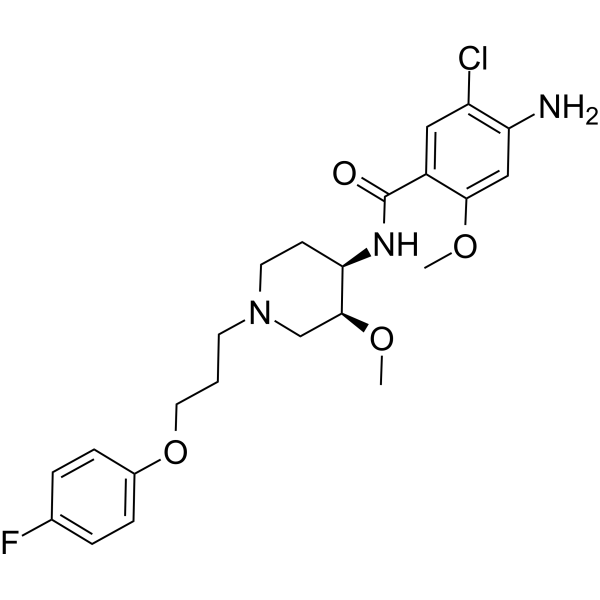
- Formula: C23H29ClFN3O4
- Molecular Weight: 465.95
Cisapride (R 51619) is an orally active, selective 5-HT4 receptor agonist with an EC50 of 140 nM. Cisapride also acts as an hERG potassium channel blocker with an IC50 of 9.4 nM. Cisapride exerts gastrointestinal prokinetic effects by activating 5-HT4 receptors, but it also blocks the hERG potassium channel responsible for the repolarization phase of cardiac action potentials, delaying repolarization and thus prolonging the action potential duration. Cisapride can be used in research related to gastrointestinal dysfunction, gastroesophageal reflux disease, functional dyspepsia, chronic gastritis, gastroparesis, ulcerative colitis and necrotizing enterocolitis.
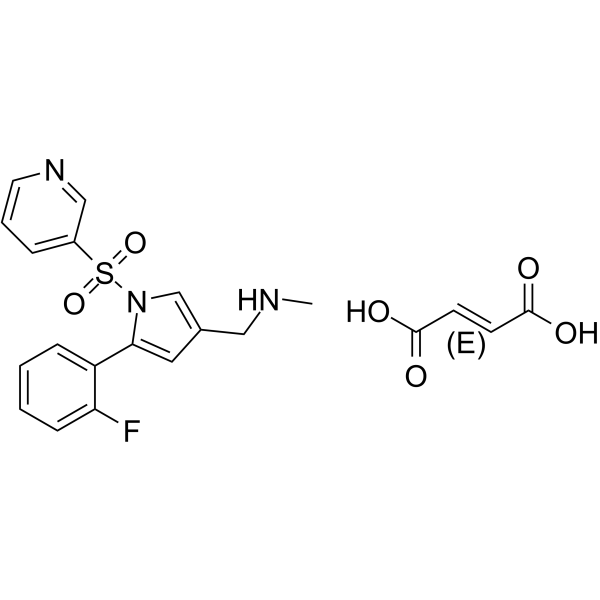
- Formula: C21H20FN3O6S
- Molecular Weight: 461.46
Vonoprazan Fumarate (TAK-438), a proton pump inhibitor (PPI), is a potent and orally active potassium-competitive acid blocker (P-CAB), with antisecretory activity. Vonoprazan Fumarate inhibits H+,K+-ATPase activity in porcine gastric microsomes with an IC50 of 19 nM at pH 6.5. Vonoprazan Fumarate is developed for the research of acid-related diseases, such as gastroesophageal reflux disease and peptic ulcer disease.

- Formula: C22H26N4O.xC6H8O7
- Molecular Weight: 362.47 (free base)
Zastaprazan (JP-1366) citrate is a Proton pump inhibitor and potent potassium-competitive acid blocker. Zastaprazan citrate can be used in the research of gastrointestinal inflammatory diseases or gastric acid-related diseases such as gastroesophageal reflux disease.
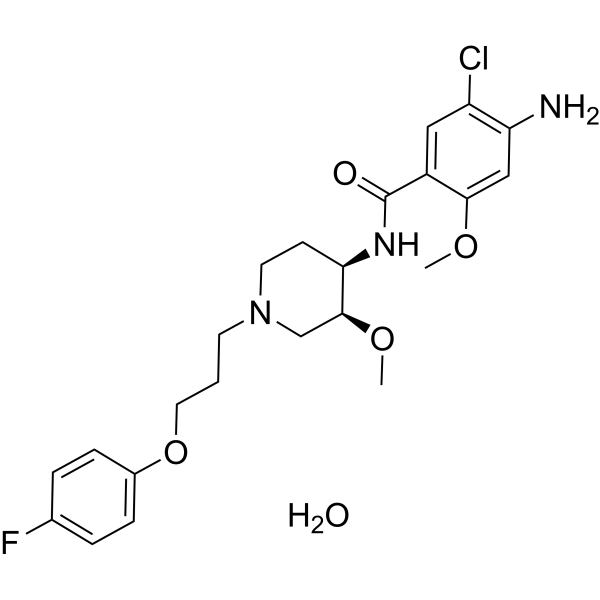
- Formula: C23H31ClFN3O5
- Molecular Weight: 483.96
Cisapride (R 51619) monohydrate is an orally active, selective 5-HT4 receptor agonist with an EC50 of 140 nM. Cisapride monohydrate also acts as an hERG potassium channel blocker with an IC50 of 9.4 nM. Cisapride monohydrate exerts gastrointestinal prokinetic effects by activating 5-HT4 receptors, but it also blocks the hERG potassium channel responsible for the repolarization phase of cardiac action potentials, delaying repolarization and thus prolonging the action potential duration. Cisapride monohydrate can be used in research related to gastrointestinal dysfunction, gastroesophageal reflux disease, functional dyspepsia, chronic gastritis, gastroparesis, ulcerative colitis and necrotizing enterocolitis.

- Formula: C22H26N3NaO4S
- Molecular Weight: 451.51
Azeloprazole sodium is an orally active proton pump inhibitor. Azeloprazole sodium irreversibly binds to and blocks the proton pump (H+/K+-ATPase) on parietal cells, thereby inhibiting gastric acid secretion. Azeloprazole sodium is primarily metabolized by the CYP3A4 enzyme, and its pharmacokinetics and acid-suppressive effects are independent of CYP2C19 activity. Azeloprazole sodium can be used for research on acid-related diseases such as reflux esophagitis and gastroesophageal reflux disease.

- Formula: C23H23D6ClFN3O4
- Molecular Weight: 471.98
Cisapride-d6 (R51619-d6) is the deuterated-labeled Cisapride (HY-14149). Cisapride (R 51619) is an orally active, selective 5-HT4 receptor agonist with an EC50 of 140 nM. Cisapride also acts as an hERG potassium channel blocker with an IC50 of 9.4 nM. Cisapride exerts gastrointestinal prokinetic effects by activating 5-HT4 receptors, but it also blocks the hERG potassium channel responsible for the repolarization phase of cardiac action potentials, delaying repolarization and thus prolonging the action potential duration. Cisapride can be used in research related to gastrointestinal dysfunction, gastroesophageal reflux disease, functional dyspepsia, chronic gastritis, gastroparesis, ulcerative colitis and necrotizing enterocolitis.

- Formula: C2213CH26D3ClFN3O4
- Molecular Weight: 469.96
Cisapride-13C,d3 (R 51619-13C,d3) is the deuterated, 13C-labeled Cisapride (HY-14149). Cisapride (R 51619) is an orally active, selective 5-HT4 receptor agonist with an EC50 of 140 nM. Cisapride also acts as an hERG potassium channel blocker with an IC50 of 9.4 nM. Cisapride exerts gastrointestinal prokinetic effects by activating 5-HT4 receptors, but it also blocks the hERG potassium channel responsible for the repolarization phase of cardiac action potentials, delaying repolarization and thus prolonging the action potential duration. Cisapride can be used in research related to gastrointestinal dysfunction, gastroesophageal reflux disease, functional dyspepsia, chronic gastritis, gastroparesis, ulcerative colitis and necrotizing enterocolitis.

- Formula: C25H28N2O5S2
- Molecular Weight: 500.63
ONO-8539 is an orally active prostanoid EP1 receptor antagonist with competitive, insurmountable binding and slow receptor dissociation for long-duration inhibition. ONO-8539 modulates afferent nerve function related to bladder activity, inhibits detrusor overactivity-related contractions, decreases nonvoiding contractions and voiding duration, and increases uroflow rate with ATP (HY-B2176)-induced detrusor overactivity. ONO-8539 attenuates acid-induced heartburn symptoms, extends time to first heartburn sensation, and prevents primary hypersensitivity after distal esophageal acidification. ONO-8539 can be used for the research of overactive bladder and gastroesophageal reflux disease.

- Formula: C22H27N3O4S
- Molecular Weight: 429.53
Azeloprazole is an orally active proton pump inhibitor. Azeloprazole irreversibly binds to and blocks the proton pump (H+/K+-ATPase) on parietal cells, thereby inhibiting gastric acid secretion. Azeloprazole is primarily metabolized by the CYP3A4 enzyme, and its pharmacokinetics and acid-suppressive effects are independent of CYP2C19 activity. Azeloprazole can be used for research on acid-related diseases such as reflux esophagitis and gastroesophageal reflux disease.

- Formula: C22H27KN3O4S
- Molecular Weight: 468.63
Azeloprazole potassium is an orally active proton pump inhibitor. Azeloprazole potassium irreversibly binds to and blocks the proton pump (H+/K+-ATPase) on parietal cells, thereby inhibiting gastric acid secretion. Azeloprazole potassium is primarily metabolized by the CYP3A4 enzyme, and its pharmacokinetics and acid-suppressive effects are independent of CYP2C19 activity. Azeloprazole potassium can be used for research on acid-related diseases such as reflux esophagitis and gastroesophageal reflux disease.

- Formula: C23H29ClFN3O4
- Molecular Weight: 465.95
Cisapride (R 51619) (Standard) is the analytical standard of Cisapride (HY-14149). This product is intended for research and analytical applications. Cisapride (R 51619) is an orally active, selective 5-HT4 receptor agonist with an EC50 of 140 nM. Cisapride also acts as an hERG potassium channel blocker with an IC50 of 9.4 nM. Cisapride exerts gastrointestinal prokinetic effects by activating 5-HT4 receptors, but it also blocks the hERG potassium channel responsible for the repolarization phase of cardiac action potentials, delaying repolarization and thus prolonging the action potential duration. Cisapride can be used in research related to gastrointestinal dysfunction, gastroesophageal reflux disease, functional dyspepsia, chronic gastritis, gastroparesis, ulcerative colitis and necrotizing enterocolitis.
- 1



