



BSJ-4-116
Based on 4 publication(s) in Google Scholar
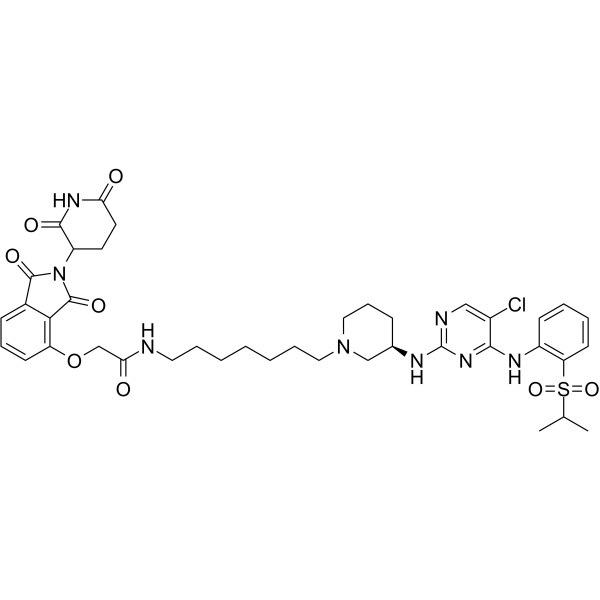
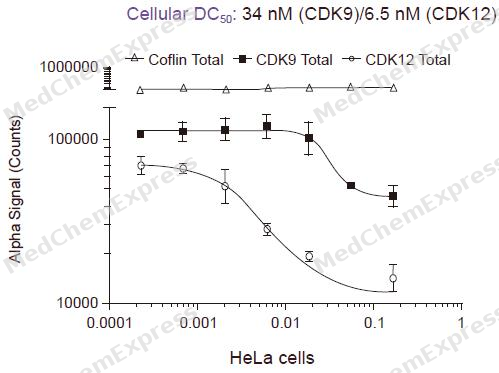
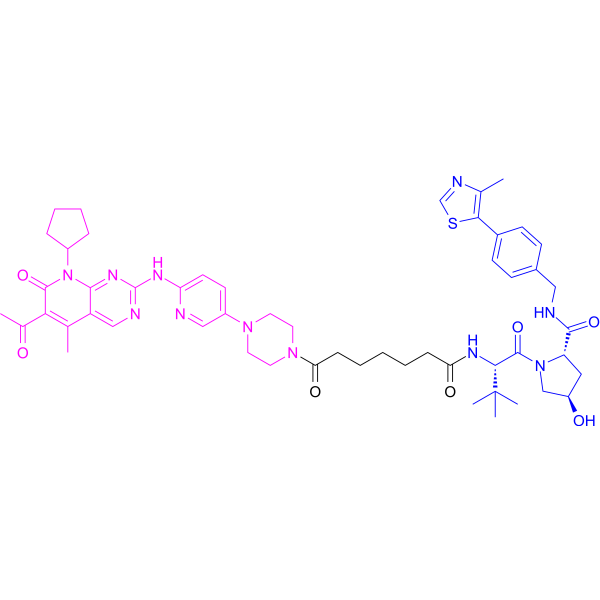
BSJ-4-116 is a PROTAC connected by ligands for Cereblon and CDK. BSJ-4-116 is a highly potent and selective CDK12 degrader (PROTAC) with an IC50 of 6 nM. BSJ-4-116 downregulates DDR genes through a premature termination of transcription, primarily through increasing poly(adenylation). BSJ-4-116 exhibits potent antiproliferative effects, alone and in combination with the poly(ADP-ribose) polymerase inhibitor Olaparib (HY-10162).
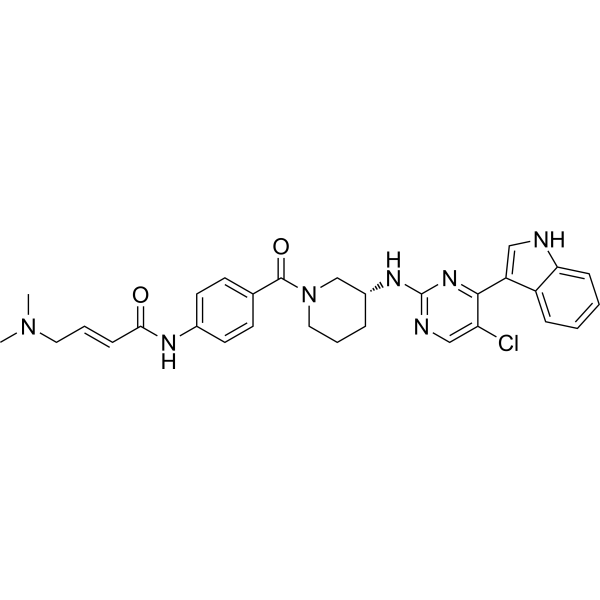
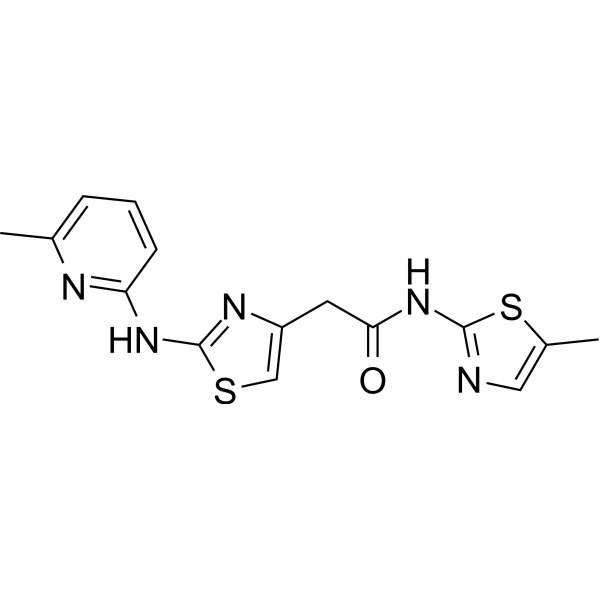
(Pink: CDK12 ligand (HY-150948); Blue: Cereblon ligand (HY-41547); Black: linker).
For research use only. We do not sell to patients.
- Purity: 99.87%
- CAS No.: 2519823-34-6
- Formula: C40H49ClN8O8S
- Molecular Weight:837.38
-
Storage:Powder -20°C, 3 years , 4°C, 2 years ; In solvent -80°C, 6 months , -20°C, 1 month

To place orders, for customer services and technical support, please contact: MedChemExpress USA
Tel: 609-228-6898 E-mail: [email protected] [email protected]


-
 Biological Activity
-
Chemical Information
-
Solvent & Solubility
- Purity & Documentation
- References
-
 Help & FAQs


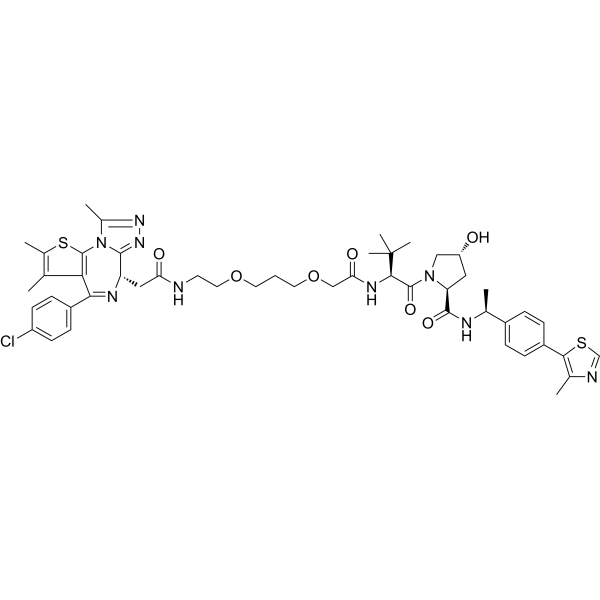
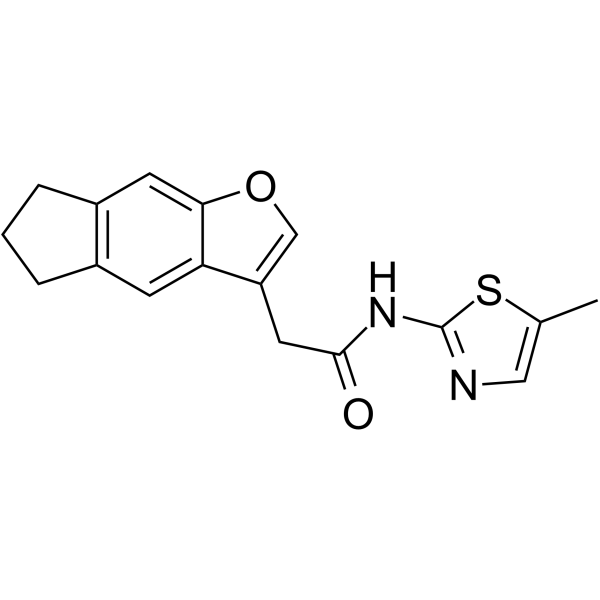
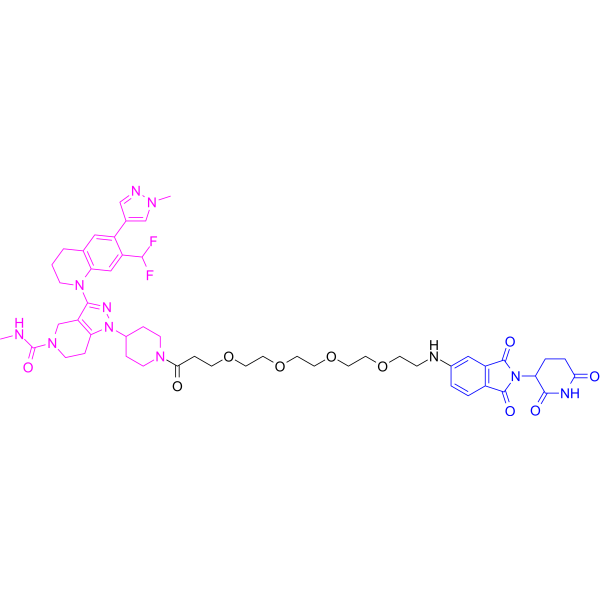
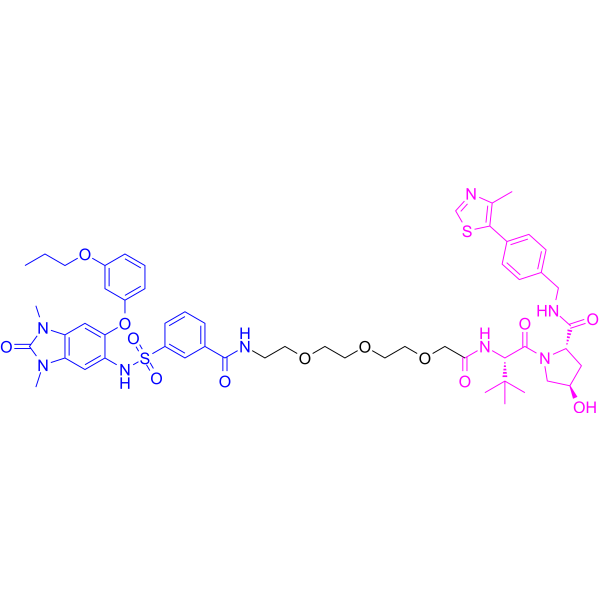
Publications Citing Use of MedChemExpress (MCE) BSJ-4-116
More Customer Validation & Images

-
RT-PCR

-
Cell Proliferation/Viability Assay

-
IF

-
Bio/Physico-chemical Assay

-
Bio/Physico-chemical Assay

All PROTACs Isoforms
More

Biological Activity
|
CDK12 6 nM (IC50) |
Cereblon |
BSJ-4-116 (10-10000 nM; 72 hours) exhibits potent antiproliferative effects in Kelly CDK12C1039F[1].
BSJ-4-116 (50 nM; 6-24 hours) decreases the level of CDK12 protein, regardless of the mutational status of the cell line[1].
BSJ-4-116 inhibits the growth of T-ALL cells (Jurkat and MOLT-4 cells) and sensitizes them to PARP inhibition[1].
BSJ-4-116 regulates DDR genes via poly(adenylation). BSJ-4-116 overcomes CDK12C1039F mutation. BSJ-4-116 represents the first example of resistance to a bivalent degrader molecule that is a consequence of an acquired point mutation in the target protein[1].
MedChemExpress (MCE) has not independently confirmed the accuracy of these methods. They are for reference only.
-
Cell Line:Parental Kelly and CDK12C1039F cells
-
Concentration:10-10000 nM
-
Incubation Time:72 hours
-
Result:Antiproliferative activity of BSJ-4-116 is independent of the mutational status, and the degrader compounds exhibited improved GR50 (growth rate inhibition) values in Kelly CDK12C1039F cells compared with the parental cell line.
-
Cell Line:Parental and CDK12C1039F (KellyCDK12CF)-expressing Kelly cells
-
Concentration:50 nM
-
Incubation Time:6-24 hours
-
Result:Led to the same level of CDK12 protein level decrease, regardless of the mutational status of the cell line.


Chemical Information
-
CAS No. 2519823-34-6
-
Appearance Solid
-
Molecular Weight 837.38
-
Formula C40H49ClN8O8S
-
Color White to off-white
-
SMILES
O=C1C2=C(OCC(NCCCCCCCN3C[C@@H](CCC3)NC4=NC=C(Cl)C(NC5=C(C=CC=C5)S(C(C)C)(=O)=O)=N4)=O)C=CC=C2C(N1C6C(NC(CC6)=O)=O)=O
-
Shipping
Room temperature in continental US; may vary elsewhere.
-
Storage
Powder -20°C 3 years 4°C 2 years In solvent -80°C 6 months -20°C 1 month


Publications (4)
-
Journal Impact Factor
-
Most Recent
-
Nat Commun
Transcriptional and epigenetic rewiring by the NUP98::KDM5A fusion oncoprotein directly activates CDK12. [Abstract]2025 May 19;16(1):4656. PMID: 40389480
BSJ-4-116 purchased from MedChemExpress. Usage Cited in: Nat Commun. 2025 May 19;16(1):4656. [Abstract]
RNA-seq data of dTAG-NUP98::KDM5A cells treated with BSJ-4-116 (100 nM, 4h) compared to DMSO showing log2(FC) values of selected DNA damage repair genes.
BSJ-4-116 purchased from MedChemExpress. Usage Cited in: Nat Commun. 2025 May 19;16(1):4656. [Abstract]
Viability assay of primary human NUP98-rearranged AML cells, healthy donor BM MNC and CD34+ progenitors treated with indicated concentrations of BSJ-4-116 (0.1 nM-10 μM) for 3 days.
BSJ-4-116 purchased from MedChemExpress. Usage Cited in: Nat Commun. 2025 May 19;16(1):4656. [Abstract]
Representative images of γH2A.X immunofluorescence staining of dTAG-GFPNUP98::KDM5A cells treated with BSJ-4-116 (100 nM, 4h).
-
J Cell Mol Med
2026 Apr;30(7):e71101. PMID: 41896195 -
-
bioRxiv
2025 Nov 3:2025.11.02.685764. PMID: 41279360
BSJ-4-116 purchased from MedChemExpress. Usage Cited in: bioRxiv. 2025 Nov 3:2025.11.02.685764. [Abstract]
Scatterplot of median gRNA enrichment (log2 fold-change) in the presence of BSJ-4-116 relative to DMSO-treated control. Each dot represents a gRNA, filtered to exclude gRNAs below 10% sensor editing and with a base mean count ≤ 100. Hits labelled with FDR < 0.1 & LFC ≥ 2. ABE screen results shown in purple; CBE in blue. Regions shaded blue indicate ATP binding site residues.
BSJ-4-116 purchased from MedChemExpress. Usage Cited in: bioRxiv. 2025 Nov 3:2025.11.02.685764. [Abstract]
Visualization of the top resistance variants in BSJ-4–116- and HQ461-treated cell pools. Maximum likelihood estimate of sensor editing rate shown as amino acid logo plot.


Solvent & Solubility
DMSO : 100 mg/mL (119.42 mM; Need ultrasonic; Hygroscopic DMSO has a significant impact on the solubility of product, please use newly opened DMSO)
Please refer to the solubility information to select the appropriate solvent. Once prepared, please aliquot and store the solution to prevent product inactivation from repeated freeze-thaw cycles.
Storage method and period of stock solution: -80°C, 6 months; -20°C, 1 month. When stored at -80°C, please use it within 6 months. When stored at -20°C, please use it within 1 month.
Please refer to the solubility information to select the appropriate solvent. Once prepared, please aliquot and store the solution to prevent product inactivation from repeated freeze-thaw cycles.
Storage method and period of stock solution: -80°C, 6 months; -20°C, 1 month. When stored at -80°C, please use it within 6 months. When stored at -20°C, please use it within 1 month.
Concentration (start) × Volume (start) = Concentration (final) × Volume (final)
Select the appropriate dissolution method based on your experimental animal and administration route.
- For the following dissolution methods, please ensure to first prepare a clear stock solution using an In Vitro approach and then sequentially add co-solvents:
- To ensure reliable experimental results, the clarified stock solution can be appropriately stored based on storage conditions. As for the working solution for In Vivo experiments, it is recommended to prepare freshly and use it on the same day.
- The percentages shown for the solvents indicate their volumetric ratio in the final prepared solution. If precipitation or phase separation occurs during preparation, heat and/or sonication can be used to aid dissolution.
Add each solvent one by one: 10% DMSO 40% PEG300 5% Tween-80 45% Saline
Solubility: ≥ 2.08 mg/mL (2.48 mM); Clear solution
This protocol yields a clear solution of ≥ 2.08 mg/mL (saturation unknown).
Taking 1 mL working solution as an example, add 100 μL DMSO stock solution (20.8 mg/mL) to 400 μL PEG300, and mix evenly; then add 50 μL Tween-80 and mix evenly; then add 450 μL Saline to adjust the volume to 1 mL.
Preparation of Saline: Dissolve 0.9 g sodium chloride in ddH₂O and dilute to 100 mL to obtain a clear Saline solution.
Please enter the basic information of animal experiments:
-
-
-
-
Recommended: Prepare an additional quantity of animals to account for potential losses during experiments.
Please enter your animal formula composition:
-
%DMSO +
Recommended: Keep the proportion of DMSO in working solution below 2% if your animal is weak.
-
%+
-
+%Tween-80 + +
-
%Saline +
The co-solvents required include: DMSO, . All of co-solvents are available by MedChemExpress (MCE). , Tween 80. All of co-solvents are available by MedChemExpress (MCE).
Working solution concentration: 0.22 mg/mL
Method for preparing stock solution: mg drug dissolved in μL DMSO. Stock solution concentration: mg/mL.
1. Take μL DMSO stock solution;
2. Add μL .
μL , mix evenly;
3. Then add μL Tween 80, mix evenly;
4. Then add μL
Please ensure that the stock solution in the first step is dissolved to a clear state, and add co-solvents in sequence. You can use ultrasonic heating (ultrasonic cleaner, recommended frequency 20-40 kHz), vortexing, etc. to assist dissolution.


Purity & Documentation
-
Data Sheet (272 KB)
-
SDS (396 KB)
- English - EN (396 KB)
- Français - FR (396 KB)
- Deutsch - DE (396 KB)
- Norwegian - NO (396 KB)
- Español - ES (396 KB)
- Swedish - SV (396 KB)
- Italian - IT (396 KB)
- Korean - KR (396 KB)
- Portuguese - PT (396 KB)
-
Handling Instructions (2659 KB)
References


Complete Stock Solution Preparation Table
Please refer to the solubility information to select the appropriate solvent. Once prepared, please aliquot and store the solution to prevent product inactivation from repeated freeze-thaw cycles.
Storage method and period of stock solution: -80°C, 6 months; -20°C, 1 month. When stored at -80°C, please use it within 6 months. When stored at -20°C, please use it within 1 month.
| Optional Solvent | Concentration Solvent Mass | 1 mg | 5 mg | 10 mg | 25 mg |
|---|---|---|---|---|---|
| DMSO | 1 mM | 1.1942 mL | 5.9710 mL | 11.9420 mL | 29.8550 mL |
| 5 mM | 0.2388 mL | 1.1942 mL | 2.3884 mL | 5.9710 mL | |
| 10 mM | 0.1194 mL | 0.5971 mL | 1.1942 mL | 2.9855 mL | |
| 15 mM | 0.0796 mL | 0.3981 mL | 0.7961 mL | 1.9903 mL | |
| 20 mM | 0.0597 mL | 0.2986 mL | 0.5971 mL | 1.4928 mL | |
| 25 mM | 0.0478 mL | 0.2388 mL | 0.4777 mL | 1.1942 mL | |
| 30 mM | 0.0398 mL | 0.1990 mL | 0.3981 mL | 0.9952 mL | |
| 40 mM | 0.0299 mL | 0.1493 mL | 0.2986 mL | 0.7464 mL | |
| 50 mM | 0.0239 mL | 0.1194 mL | 0.2388 mL | 0.5971 mL | |
| 60 mM | 0.0199 mL | 0.0995 mL | 0.1990 mL | 0.4976 mL | |
| 80 mM | 0.0149 mL | 0.0746 mL | 0.1493 mL | 0.3732 mL | |
| 100 mM | 0.0119 mL | 0.0597 mL | 0.1194 mL | 0.2986 mL |


BSJ-4-116 Related Classifications
HY-139039 Related Classifications
 Powered by Bioz