



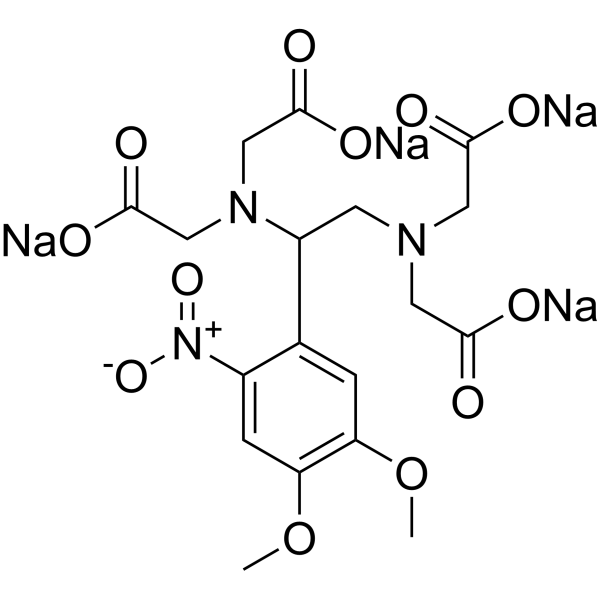
DM-Nitrophen tertasodium

Based on 1 Customer Validation
DM-Nitrophen tertasodium is a photolabile caged calcium compound that acts as a calcium releaser. DM-Nitrophen tertasodium binds Ca2+ with high affinity and Mg2+ with considerable affinity before photolysis. DM-Nitrophen tertasodium releases Ca2+ into the cytosol upon ultraviolet light irradiation. DM-Nitrophen tertasodium induces calcium concentration pulses, triggers cytosolic calcium transients, promotes calcium-dependent exocytosis. DM-Nitrophen tertasodium can be used for the research of calcium-dependent cellular processes.
For research use only. We do not sell to patients.
- Purity : 90.0%
- CAS No.: 291517-40-3
- Formula: C18H19N3Na4O12
- Molecular Weight:561.32
-
Storage:
-20°C, sealed storage, away from moisture and light
* In solvent : -80°C, 6 months; -20°C, 1 month (sealed storage, away from moisture and light)

To place orders, for customer services and technical support, please contact: MedChemExpress USA
Tel: 609-228-6898 E-mail: [email protected] [email protected]


-
 Biological Activity
-
Chemical Information
- Purity & Documentation
- References
-
 Help & FAQs




Biological Activity
Description
In Vitro
DM-Nitrophen tertasodium forms biphasically decaying aci-nitro intermediates and releases calcium ions efficiently upon laser photolysis, with calcium release rate being pH-dependent (minimum at physiological pH) and capable of rapidly generating transient free calcium pulses that quickly reach a steady state[1].
DM-Nitrophen tertasodium induces obvious intracellular calcium elevation and promotes exocytosis after UV flash photolysis in cultured rat pituitary melanotrophs, and barely affects the calcium dissociation constant of Fura-2[2].
DM-Nitrophen tertasodium activates typical transient Ca2+-dependent Cl- currents consistent with voltage-triggered counterparts in rat DRG neurons after flash photolysis, and can reactivate such currents during decay phase to confirm current deactivation instead of inactivation[3].
DM-Nitrophen tertasodium only elicits weak current responses under depolarized holding potentials and exerts no influence on the inactivation process of voltage-gated Ca2+ currents in target neurons[3].
MedChemExpress (MCE) has not independently confirmed the accuracy of these methods. They are for reference only.


Chemical Information
-
CAS No. 291517-40-3
-
Appearance Solid
-
Molecular Weight 561.32
-
Formula C18H19N3Na4O12
-
Color Light yellow to brown
-
SMILES
O=C(CN(CC(N(CC(O[Na])=O)CC(O[Na])=O)C1=CC(OC)=C(C=C1[N+]([O-])=O)OC)CC(O[Na])=O)O[Na]
-
Shipping
Room temperature in continental US; may vary elsewhere.
-
Storage
-20°C, sealed storage, away from moisture and light
* In solvent : -80°C, 6 months; -20°C, 1 month (sealed storage, away from moisture and light)


Purity & Documentation
-
Data Sheet (278 KB)
-
SDS (393 KB)
- English - EN (393 KB)
- Français - FR (393 KB)
- Deutsch - DE (393 KB)
- Norwegian - NO (393 KB)
- Español - ES (393 KB)
- Swedish - SV (393 KB)
- Italian - IT (393 KB)
- Korean - KR (393 KB)
- Portuguese - PT (393 KB)
-
Handling Instructions (2659 KB)
References
[1]. Ellis-Davies GC, et al. Laser photolysis of caged calcium: rates of calcium release by nitrophenyl-EGTA and DM-nitrophen. Biophys J. 1996 Feb;70(2):1006-16. [Content Brief]
[2]. Parsons TD, et al. Millisecond studies of calcium-dependent exocytosis in pituitary melanotrophs: comparison of the photolabile calcium chelators nitrophenyl-EGTA and DM-nitrophen. Cell Calcium. 1996;19(3):185-192. [Content Brief]
[3]. Currie KP, et al. Activation of Ca(2+)-dependent Cl- currents in cultured rat sensory neurones by flash photolysis of DM-nitrophen. J Physiol. 1995;482 ( Pt 2)(Pt 2):291-307. [Content Brief]

Calculators
Concentration (start) × Volume (start) = Concentration (final) × Volume (final)


DM-Nitrophen tertasodium Related Classifications
HY-126789A Related Classifications
 Powered by Bioz