



Durvalumab (anti-PD-L1)
Based on 7 publication(s) in Google Scholar
Durvalumab (anti-PD-L1)(MEDI 4736) is a human anti-PD-L1 protein monoclonal antibody. Durvalumab (anti-PD-L1) completely blocks PD-L1 binding to PD-1 and CD80, IC 50 are 0.1 and 0.04 nM respectively, has anti-tumor activity.
For research use only. We do not sell to patients.
- Purity : 99.0%
- CAS No.: 1428935-60-7
- Molecular Weight:146.32 kDa
-
Storage:
Please store the product under the recommended conditions in the Certificate of Analysis.


To place orders, for customer services and technical support, please contact: MedChemExpress USA
Tel: 609-228-6898 E-mail: [email protected] [email protected]


-
 Biological Activity
-
Chemical Information
- Purity & Documentation
- References
-
 Help & FAQs


-

HY-P9904
AtezolizumabAnti-PD-L1 Antibody -

HY-P9902
PembrolizumabPD-1 Inhibitor -
HY-P9903
NivolumabPD-1 Inhibitor -
HY-108730A
Avelumab (anti-PD-L1)anti-PD-L1 Antibody Inhibitor -

HY-P9919
DurvalumabPD-L1 Blocking Antibody -

HY-P99203
CemiplimabPD-1 Inhibitor -

HY-P99345
DostarlimabAnti-PD-1 mAb -

HY-P99675
IvonescimabPD-1/VEGF Bispecific Antibody -

HY-P99833
CosibelimabAnti-PD-L1 Antibody -

HY-108730
AvelumabAnti-PD-L1 Antibody -

HY-P99001
Human IgG1 kappa, Isotype ControlIgG1κ Isotype Control -

HY-P9971
CamrelizumabPD-1 Neutralizing Antibody
Publications Citing Use of MedChemExpress (MCE) Durvalumab (anti-PD-L1)
More Customer Validation & Images

-
Bio/Physico-chemical Assay
-
Bio/Physico-chemical Assay
-
In Vivo Efficacy Study
-
In Vivo Efficacy Study
-
Histological Imaging/Staining


Biological Activity
Description
Isotype
Human IgG1 (L234F/L235E/P331S) kappa
Recommend Isotype Controls
Species Reactivity
Human
IC50 & Target
B7-H1/PD-L1/CD274
In Vitro
In Vivo
MedChemExpress (MCE) has not independently confirmed the accuracy of these methods. They are for reference only.
-
Animal Model:HPAC/A375 xenograft mouse model[1]
-
Dosage:0.01, 0.1, 1, 5 mg/kg; twice a week; three weeks
-
Administration:Intraperitoneal injection (i.p.)
-
Result:Inhibited tumor growth of HPAC, A375 and had no effect on tumor xenografts in the absence of T cells.
Gene ID
Accession
Conjugated
Unconjugated
Reconsititution
The product can be reconstituted/diluted with sterile PBS or saline.
Format
-
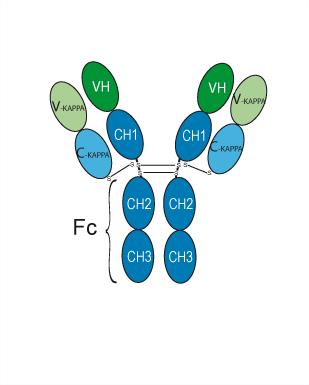
Human IgG1 kappa
Application
ELISA, FACS, Functional assay
Verified Bioactivity


Chemical Information
-
CAS No. 1428935-60-7
-
Appearance Liquid
-
Molecular Weight 146.32 kDa
-
Color Colorless to light yellow
-
SMILES
[Durvalumab (anti-PD-L1)]
-
Synonyms
MEDI 4736 (anti-PD-L1)
-
Shipping
Shipping with dry ice.
-
Formulation
Please refer to the lot-specific COA for specific buffer information.
-
Storage
Please store the product under the recommended conditions in the Certificate of Analysis.


Publications (7)
-
Journal Impact Factor
-
Most Recent
-
Cancer Discov
Pharmacologic Suppression of B7-H4 Glycosylation Restores Antitumor Immunity in Immune-Cold Breast Cancers. [Abstract]2020 Dec;10(12):1872-1893. PMID: 32938586
Durvalumab (anti-PD-L1) purchased from MedChemExpress. Usage Cited in: Cancer Discov. 2020 Dec;10(12):1872-1893. [Abstract]
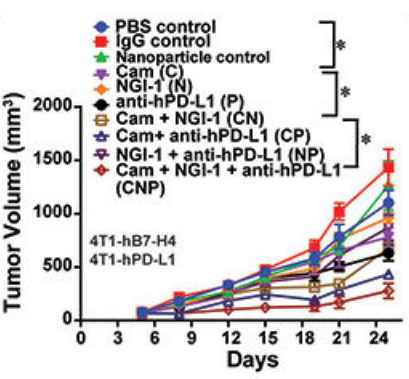
4T1-hPD-L, where the basal mouse PD-L1 was knocked out followed by adding back human PD-L1 gene, and 4T1-hB7-H4 cells were orthotopically injected into the left fourth mammary fat pad and allow to grow around 100 mm3, followed by injection of Cam (25 mg/kg, i.p.) for 4 times, NGI-1 nanoparticle (10 mg/kg, i.v.) as well as PD-L1 antibody Durvalumab (5 mg/kg, i.p.) for 3 times. The tumor growth was monitored twice per week. n=8 mice per group.
Durvalumab (anti-PD-L1) purchased from MedChemExpress. Usage Cited in: Cancer Discov. 2020 Dec;10(12):1872-1893. [Abstract]
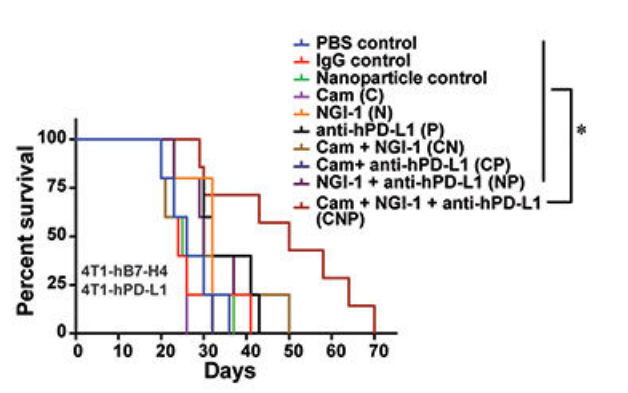
Survival curve of the mice of the combination of Cam, NGI-1 nanoparticle and Durvalumab (5 mg/kg, i.p., 3 times). n=8 mice per group.
Durvalumab (anti-PD-L1) purchased from MedChemExpress. Usage Cited in: Cancer Discov. 2020 Dec;10(12):1872-1893. [Abstract]
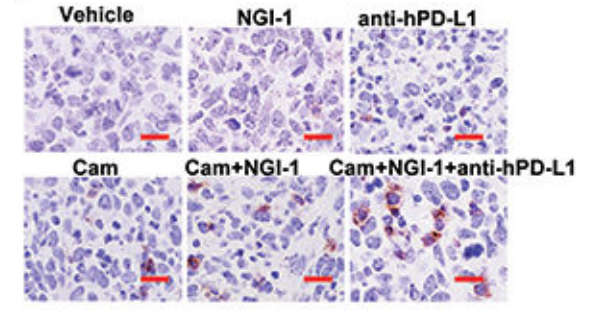
4T1-hPD-L, where the basal mouse PD-L1 was knocked out followed by adding back human PD-L1 gene, and 4T1-hB7-H4 cells were orthotopically injected into the left fourth mammary fat pad and allow to grow around 100 mm3, followed by injection of Cam (25 mg/kg, i.p.) for 4 times, NGI-1 nanoparticle (10 mg/kg, i.v.) as well as PD-L1 antibody Durvalumab (5 mg/kg, i.p.) for 3 times. Tumor tissues were subjected to the immunohistochemically staining with anti-CD8 antibody.
-
-
Cell Rep
PD-L1 promotes myofibroblastic activation of hepatic stellate cells by distinct mechanisms selective for TGF-β receptor I versus II. [Abstract]2022 Feb 8;38(6):110349. PMID: 35139382 -
Biochem Genet
Cuproptosis-Related Gene FDX1 Induces Malignant Progression and Immune Suppression in Triple-Negative Breast Cancer. [Abstract]2025 Sep 5. PMID: 40911146 -
-
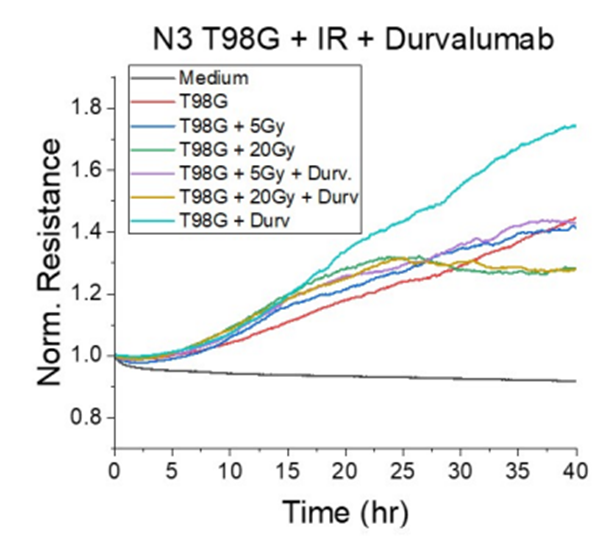
Durvalumab (anti-PD-L1) purchased from MedChemExpress. Usage Cited in: Preprints. 10 May 2022.
Migration-focused results of ECIS tests on T98G and U87 glioblastoma cells treated with Radiation and Durvalumab. Representative plot of normalized resistance in the first 40 hours posttreatment for T98G.
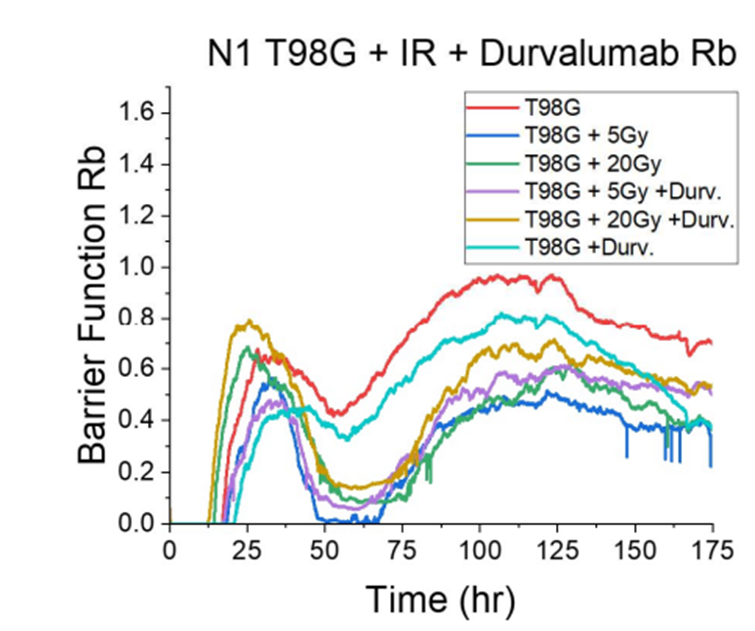
Durvalumab (anti-PD-L1) purchased from MedChemExpress. Usage Cited in: Preprints. 10 May 2022.
Barrier function-focused results of ECIS tests on T98G glioblastoma cells treated with radiation and durvalumab. Representative plot of the barrier function Rb posttreatment for T98G shown.
-


Purity & Documentation
-
Data Sheet (261 KB)
-
SDS (252 KB)
- English - EN (252 KB)
- Français - FR (252 KB)
- Deutsch - DE (252 KB)
- Norwegian - NO (252 KB)
- Español - ES (252 KB)
- Swedish - SV (252 KB)
- Italian - IT (252 KB)
- Korean - KR (252 KB)
- Portuguese - PT (252 KB)
-
Inhibitory Antibodies User Guide (603 KB)
References
[1]. Stewart R, et al. Identification and Characterization of MEDI4736, an Antagonistic Anti-PD-L1 Monoclonal Antibody. Cancer Immunol Res. 2015 Sep;3(9):1052-62. [Content Brief]
[2]. Faiena I, et al. Durvalumab: an investigational anti-PD-L1 monoclonal antibody for the treatment of urothelial carcinoma. Drug Des Devel Ther. 2018 Jan 23;12:209-215. [Content Brief]

Calculators
Concentration (start) × Volume (start) = Concentration (final) × Volume (final)


Durvalumab (anti-PD-L1) Related Classifications
HY-P9919A Related Classifications
 Powered by Bioz