



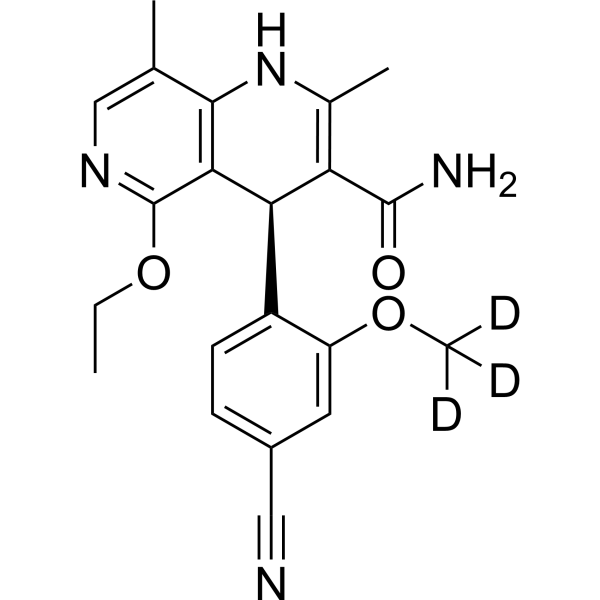
Finerenone-d3

Based on 1 Customer Validation
Finerenone-d3 is the deuterium labeled finerenone (HY-111372). Finerenone is a third-generation, selective, and orally available nonsteroidal mineralocorticoid receptor (MR) antagonist (IC50=18 nM). Finerenone displays excellent selectivity versus glucocorticoid receptor (GR), androgen receptor (AR), and progesterone receptor (>500-fold). Finerenone has the potential for cardiorenal diseases research, such as type 2 diabetes mellitus and chronic kidney disease.
For research use only. We do not sell to patients.
- Purity : 97.12%
- CAS No.: 2917530-37-9
- Formula: C21H19D3N4O3
- Molecular Weight:381.44
-
Storage:Powder -20°C, 3 years , 4°C, 2 years ; In solvent -80°C, 6 months , -20°C, 1 month

To place orders, for customer services and technical support, please contact: MedChemExpress USA
Tel: 609-228-6898 E-mail: [email protected] [email protected]


-
 Biological Activity
-
Chemical Information
-
Solvent & Solubility
- Protocols
- Purity & Documentation
- References
-
 Help & FAQs




Biological Activity
Description
Application
1. This compound can be used as a tracer
2. This compound can be used as an internal standard for quantitative analysis by NMR, GC-MS, or LC-MS.


Chemical Information
-
CAS No. 2917530-37-9
-
Unlabeled CAS 1050477-31-0
-
Appearance Solid
-
Molecular Weight 381.44
-
Formula C21H19D3N4O3
-
SMILES
O=C(C1=C(C)NC2=C(C(OCC)=NC=C2C)[C@@H]1C3=CC=C(C#N)C=C3OC([2H])([2H])[2H])N
-
Synonyms
BAY 94-8862-d3
-
Shipping
Room temperature in continental US; may vary elsewhere.
-
Storage
Powder -20°C 3 years 4°C 2 years In solvent -80°C 6 months -20°C 1 month


Solvent & Solubility
In Vitro:
DMSO : 100 mg/mL (262.16 mM; ultrasonic and warming and heat to 60°C; Hygroscopic DMSO has a significant impact on the solubility of product, please use newly opened DMSO)
Please refer to the solubility information to select the appropriate solvent. Once prepared, please aliquot and store the solution to prevent product inactivation from repeated freeze-thaw cycles.
Storage method and period of stock solution: -80°C, 6 months; -20°C, 1 month. When stored at -80°C, please use it within 6 months. When stored at -20°C, please use it within 1 month.
Please refer to the solubility information to select the appropriate solvent. Once prepared, please aliquot and store the solution to prevent product inactivation from repeated freeze-thaw cycles.
Storage method and period of stock solution: -80°C, 6 months; -20°C, 1 month. When stored at -80°C, please use it within 6 months. When stored at -20°C, please use it within 1 month.
Concentration (start) × Volume (start) = Concentration (final) × Volume (final)


Purity & Documentation
-
Data Sheet (276 KB)
-
SDS (393 KB)
- English - EN (393 KB)
- Français - FR (393 KB)
- Deutsch - DE (393 KB)
- Norwegian - NO (393 KB)
- Español - ES (393 KB)
- Swedish - SV (393 KB)
- Italian - IT (393 KB)
- Korean - KR (393 KB)
- Portuguese - PT (393 KB)
-
Handling Instructions (2659 KB)
References
[1]. Bärfacker L, et al. Discovery of BAY 94-8862: a nonsteroidal antagonist of the mineralocorticoid receptor for the treatment of cardiorenal diseases. ChemMedChem. 2012;7(8):1385-1403. [Content Brief]
[2]. González-Blázquez R, et al. Finerenone Attenuates Endothelial Dysfunction and Albuminuria in a Chronic Kidney Disease Model by a Reduction in Oxidative Stress. Front Pharmacol. 2018;9:1131. Published 2018 Oct 9. [Content Brief]


Complete Stock Solution Preparation Table
Please refer to the solubility information to select the appropriate solvent. Once prepared, please aliquot and store the solution to prevent product inactivation from repeated freeze-thaw cycles.
Storage method and period of stock solution: -80°C, 6 months; -20°C, 1 month. When stored at -80°C, please use it within 6 months. When stored at -20°C, please use it within 1 month.
| Optional Solvent | Concentration Solvent Mass | 1 mg | 5 mg | 10 mg | 25 mg |
|---|---|---|---|---|---|
| DMSO | 1 mM | 2.6216 mL | 13.1082 mL | 26.2164 mL | 65.5411 mL |
| 5 mM | 0.5243 mL | 2.6216 mL | 5.2433 mL | 13.1082 mL | |
| 10 mM | 0.2622 mL | 1.3108 mL | 2.6216 mL | 6.5541 mL | |
| 15 mM | 0.1748 mL | 0.8739 mL | 1.7478 mL | 4.3694 mL | |
| 20 mM | 0.1311 mL | 0.6554 mL | 1.3108 mL | 3.2771 mL | |
| 25 mM | 0.1049 mL | 0.5243 mL | 1.0487 mL | 2.6216 mL | |
| 30 mM | 0.0874 mL | 0.4369 mL | 0.8739 mL | 2.1847 mL | |
| 40 mM | 0.0655 mL | 0.3277 mL | 0.6554 mL | 1.6385 mL | |
| 50 mM | 0.0524 mL | 0.2622 mL | 0.5243 mL | 1.3108 mL | |
| 60 mM | 0.0437 mL | 0.2185 mL | 0.4369 mL | 1.0924 mL | |
| 80 mM | 0.0328 mL | 0.1639 mL | 0.3277 mL | 0.8193 mL | |
| 100 mM | 0.0262 mL | 0.1311 mL | 0.2622 mL | 0.6554 mL |


Finerenone-d3 Related Classifications
HY-111372S Related Classifications
 Powered by Bioz