



Tryptone
Based on 1 publication(s) in Google Scholar
Tryptone is a peptide-rich bacterial culture medium component that can regulate bacterial cell surface proteins and biofilm-related genes. Tryptone promotes the expression and assembly of bacterial adhesion proteins (such as LapA and LapF) by providing peptide substances as structural factors, enhancing cell surface hydrophobicity and intercellular adhesion, thereby stabilizing the biofilm matrix and supporting the maturation and maintenance of bacterial biofilms. The peptide mixture contained in Tryptone can specifically regulate the transcription of bacterial adhesion-related genes (such as activating LapA and inhibiting LapF), affecting the synthesis and localization of biofilm structural proteins.
For research use only. We do not sell to patients.
- CAS No.: 73049-73-7
-
Storage:
Store at room temperature 3 years.
In solvent -80°C, 2 years , -20°C, 1 year


To place orders, for customer services and technical support, please contact: MedChemExpress USA
Tel: 609-228-6898 E-mail: [email protected] [email protected]


-
 Biological Activity
-
Chemical Information
-
Solvent & Solubility
- Protocols
- Purity & Documentation
- References
-
 Help & FAQs


-

HY-153126
Yeast extractYeast Extract -

HY-W134423
Agar, microbiology tested, for cell culture (powder)Biochemical Assay Reagents -
HY-150278
Peptone from caseinCasein Hydrolysis -
HY-B1174
BekanamycinAminoglycoside Antibiotic -
HY-K1031
Agarose -
HY-18569
3-Indoleacetic acidPlant Growth Regulator -
HY-B0167
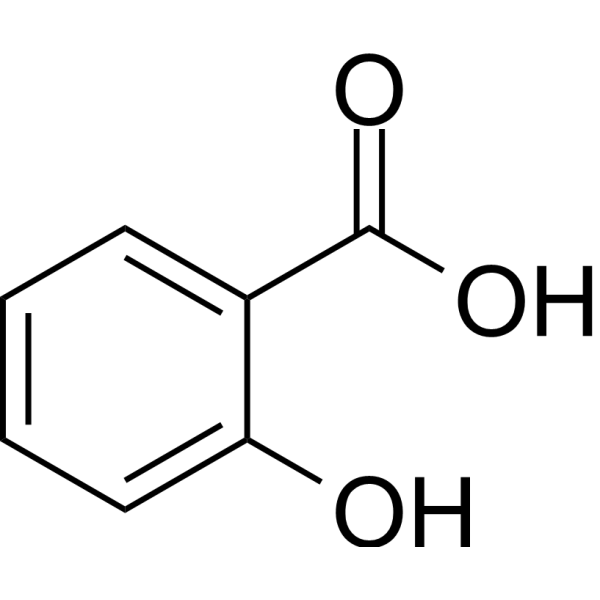
Salicylic acidCOX-2 Inhibitor -
HY-N0160
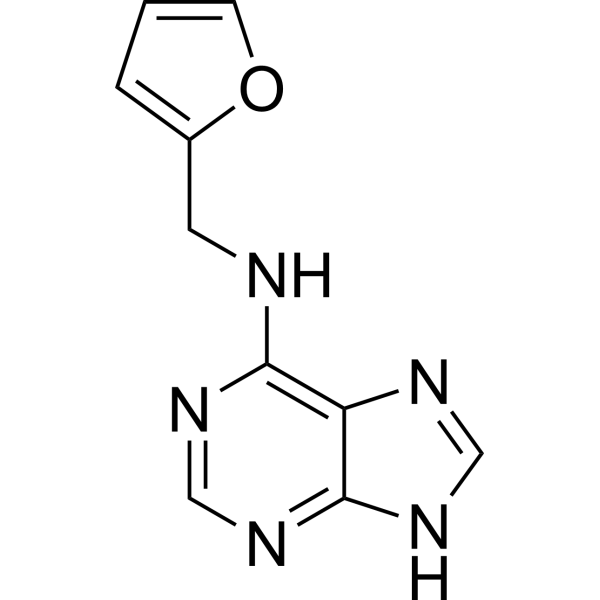
KinetinPlant Hormone -

HY-18569B
3-Indoleacetic acid,suitable for plant cell culturePlant Growth-Promoting Hormone -

HY-18569R
3-Indoleacetic acid (standard)Reference Standard -

HY-W134423A
Agar, microbiology tested, for cell culture (granular)Microbial Culture Medium Component -

HY-W134423B
Agar, meets USP testing specificationsCell Growth Support
Publications Citing Use of MedChemExpress (MCE) Tryptone
More

Biological Activity
Description
In Vitro
Tryptone (10 g/L; 10 min; 37°C) significantly improved the capture efficiency of T4 phage conjugated magnetic particles for Escherichia coli, and this effect was temperature-dependent[1].
In the Pseudomonas biofilm formation experiment, Tryptone (10 g/L; 24 h) promoted the formation of mature biofilms of wild-type and Fis-overexpressing strains of Pseudomonas putida, increasing the amount of biofilm by 1.3-2.9 times compared with the M9 medium group without Tryptone, and was related to peptide-mediated cell surface protein regulation[2].
MedChemExpress (MCE) has not independently confirmed the accuracy of these methods. They are for reference only.
-
Cell Line:Escherichia coli (ATCC 11303)
-
Concentration:10 g/L (added to Luria-Bertani medium or phosphate buffer)
-
Incubation Time:10 min at 37°C
-
Result:Increased the capture efficiency of T4 bacteriophage-conjugated Fe3O4 magnetic particles, with viable bacterial counts in the supernatant decreasing by 70% compared to Tryptone-free conditions.
Bacterial capture was temperature-dependent, with no significant effect observed at 4°C. Flow cytometry and plate counting assays showed that Tryptone facilitated irreversible binding between T4 bacteriophage and E. coli surface receptors, enhancing magnetic particle-mediated isolation of bacteria.
-
Cell Line:Pseudomonas putida strains PSm (wild type) and F15 (fis-overexpression)
-
Concentration:10 g/L (supplemented to M9-0.2CAA medium)
-
Incubation Time:24 h
-
Result:Increased biofilm formation measured by crystal violet staining, with wild-type PSm showing a 1.3-fold increase and F15 strain exhibiting a 2.9-fold increase compared to Tryptone-free M9 medium.
qPCR analysis revealed upregulated expression of adhesion genes lapA and downregulated lapF in F15 cells, while Western blot confirmed enhanced Fis protein levels in Tryptone-supplemented cultures.
Biofilm matrix stability was assessed via protease K treatment, showing reduced dispersion in Tryptone-containing media, indicating polypeptide-mediated reinforcement of extracellular matrix structure.


Chemical Information
-
CAS No. 73049-73-7
-
Appearance Solid
-
Color Off-white to light yellow
-
SMILES
[Tryptone]
-
Shipping
Room temperature in continental US; may vary elsewhere.
-
Storage
Store at room temperature 3 years
In solvent -80°C 2 years -20°C 1 year


Publications (1)
-
Journal Impact Factor
-
Most Recent


Solvent & Solubility
In Vitro:
H2O : 100 mg/mL (Need ultrasonic)


Purity & Documentation
-
Data Sheet (272 KB)
-
SDS (394 KB)
- English - EN (394 KB)
- Français - FR (394 KB)
- Deutsch - DE (394 KB)
- Norwegian - NO (394 KB)
- Español - ES (394 KB)
- Swedish - SV (394 KB)
- Italian - IT (394 KB)
- Korean - KR (394 KB)
- Portuguese - PT (394 KB)
-
Handling Instructions (2659 KB)
References
[1]. Liana AE, et al. T4 bacteriophage conjugated magnetic particles for E. coli capturing: Influence of bacteriophage loading, temperature and tryptone. Colloids Surf B Biointerfaces. 2017 Mar 1;151:47-57. [Content Brief]
[2]. Puhm M, et al. Tryptone in Growth Media Enhances Pseudomonas putida Biofilm. Microorganisms. 2022 Mar 14;10(3):618. [Content Brief]

Calculators
Concentration (start) × Volume (start) = Concentration (final) × Volume (final)


Tryptone Related Classifications
HY-W133898 Related Classifications
 Powered by Bioz