



Fulvestrant-d3

Based on 1 Customer Validation
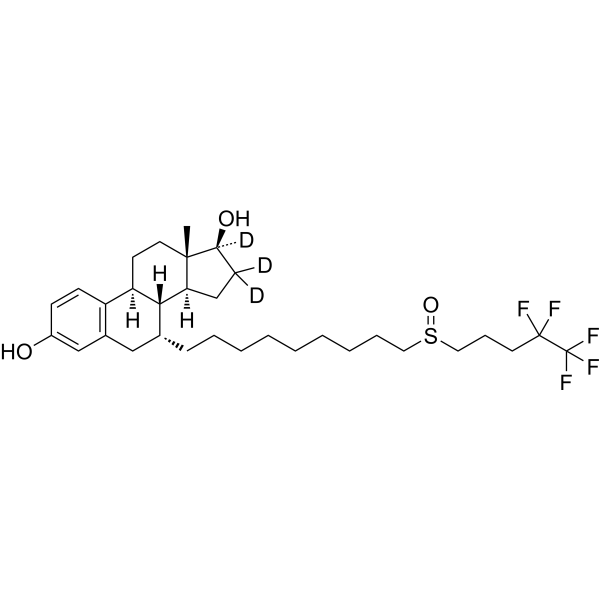
Fulvestrant-d3 is the deuterium labeled Fulvestrant. Fulvestrant (ICI 182780) is a pure antiestrogen and a potent estrogen receptor (ER) antagonist with an IC50 of 9.4 nM. Fulvestrant is also a GPR30 agonist. Fulvestrant effectively inhibits the growth of ER-positive MCF-7 cells with an IC50 of 0.29 nM. Fulvestrant also induces autophagy and has antitumor efficacy.
Nos produits utilisent uniquement pour la recherche. Nous ne vendons pas aux patients.
- Pureté : 97.47%
- Formule: C32H44D3F5O3S
- Masse moléculaire:609.79
-
Stockage:Powder -20°C, 3 years , 4°C, 2 years ; In solvent -80°C, 6 months , -20°C, 1 month

To place orders, for customer services and technical support, please contact: MedChemExpress USA
Tel: 609-228-6898 E-mail: [email protected] [email protected]


-
 Activité biologique
-
Chemical Information
-
Solvant et solubilité
- Protocole
- Pureté et documentation
- Références
-
 Help & FAQs




Activité biologique
Description
In Vitro
Stable heavy isotopes of hydrogen, carbon, and other elements have been incorporated into drug molecules, largely as tracers for quantitation during the drug development process. Deuteration has gained attention because of its potential to affect the pharmacokinetic and metabolic profiles of drugs[1].
MedChemExpress (MCE) has not independently confirmed the accuracy of these methods. They are for reference only.
Application
1. This compound can be used as a tracer
2. This compound can be used as an internal standard for quantitative analysis by NMR, GC-MS, or LC-MS.


Chemical Information
-
Unlabeled CAS 129453-61-8
-
Appearance Solid
-
Masse moléculaire 609.79
-
Formule C32H44D3F5O3S
-
Color White to off-white
-
SMILES
C[C@@]12[C@](O)([2H])C([2H])([2H])C[C@@]1([H])[C@]3([H])[C@H](CCCCCCCCCS(CCCC(F)(F)C(F)(F)F)=O)CC4=C(C=CC(O)=C4)[C@@]3([H])CC2
-
Synonyms
ICI 182780-d3; ZD 9238-d3; ZM 182780-d3
-
Livraison
Room temperature in continental US; may vary elsewhere.
-
Stockage
Powder -20°C 3 years 4°C 2 years In solvent -80°C 6 months -20°C 1 month


Solvant et solubilité
In Vitro:
DMSO : 250 mg/mL (409.98 mM; Need ultrasonic and warming; Hygroscopic DMSO has a significant impact on the solubility of product, please use newly opened DMSO)
Please refer to the solubility information to select the appropriate solvent. Once prepared, please aliquot and store the solution to prevent product inactivation from repeated freeze-thaw cycles.
Storage method and period of stock solution: -80°C, 6 months; -20°C, 1 month. When stored at -80°C, please use it within 6 months. When stored at -20°C, please use it within 1 month.
Please refer to the solubility information to select the appropriate solvent. Once prepared, please aliquot and store the solution to prevent product inactivation from repeated freeze-thaw cycles.
Storage method and period of stock solution: -80°C, 6 months; -20°C, 1 month. When stored at -80°C, please use it within 6 months. When stored at -20°C, please use it within 1 month.
Concentration (start) × Volume (start) = Concentration (final) × Volume (final)


Pureté et documentation
-
Fiche technique (279 KB)
-
SDS (252 KB)
- English - EN (252 KB)
- Français - FR (252 KB)
- Deutsch - DE (252 KB)
- Norwegian - NO (252 KB)
- Español - ES (252 KB)
- Swedish - SV (252 KB)
- Italian - IT (252 KB)
- Korean - KR (252 KB)
- Portuguese - PT (252 KB)
-
Instruction de manipulation (2659 KB)
Références
[1]. Russak EM, et al. Impact of Deuterium Substitution on the Pharmacokinetics of Pharmaceuticals. Ann Pharmacother. 2019;53(2):211-216. [Content Brief]
[2]. Wakeling AE, et al. A potent specific pure antiestrogen with clinical potential. Cancer Res. 1991 Aug 1;51(15):3867-73. [Content Brief]
[3]. Osborne CK, et al. Fulvestrant: an oestrogen receptor antagonist with a novel mechanism of action. Br J Cancer. 2004 Mar;90 Suppl 1:S2-6. [Content Brief]
[4]. Garner F, et al. RAD1901: a novel, orally bioavailable selective estrogen receptor degrader that demonstrates antitumor activity in breast cancer xenograft models. Anticancer Drugs. 2015 Oct;26(9):948-56 [Content Brief]
[5]. Yu X, et al.MiR-214 increases the sensitivity of breast cancer cells to tamoxifen and fulvestrant through inhibition of autophagy.Mol Cancer. 2015 Dec 15;14:208. [Content Brief]
[6]. Julia Kuhn, et al. GPR30 estrogen receptor agonists induce mechanical hyperalgesia in the rat. Eur J Neurosci. 2008 Apr;27(7):1700-9. [Content Brief]


Complete Stock Solution Preparation Table
Please refer to the solubility information to select the appropriate solvent. Once prepared, please aliquot and store the solution to prevent product inactivation from repeated freeze-thaw cycles.
Storage method and period of stock solution: -80°C, 6 months; -20°C, 1 month. When stored at -80°C, please use it within 6 months. When stored at -20°C, please use it within 1 month.
| Optional Solvent | Concentration Solvent Mass | 1 mg | 5 mg | 10 mg | 25 mg |
|---|---|---|---|---|---|
| DMSO | 1 mM | 1.6399 mL | 8.1995 mL | 16.3991 mL | 40.9977 mL |
| 5 mM | 0.3280 mL | 1.6399 mL | 3.2798 mL | 8.1995 mL | |
| 10 mM | 0.1640 mL | 0.8200 mL | 1.6399 mL | 4.0998 mL | |
| 15 mM | 0.1093 mL | 0.5466 mL | 1.0933 mL | 2.7332 mL | |
| 20 mM | 0.0820 mL | 0.4100 mL | 0.8200 mL | 2.0499 mL | |
| 25 mM | 0.0656 mL | 0.3280 mL | 0.6560 mL | 1.6399 mL | |
| 30 mM | 0.0547 mL | 0.2733 mL | 0.5466 mL | 1.3666 mL | |
| 40 mM | 0.0410 mL | 0.2050 mL | 0.4100 mL | 1.0249 mL | |
| 50 mM | 0.0328 mL | 0.1640 mL | 0.3280 mL | 0.8200 mL | |
| 60 mM | 0.0273 mL | 0.1367 mL | 0.2733 mL | 0.6833 mL | |
| 80 mM | 0.0205 mL | 0.1025 mL | 0.2050 mL | 0.5125 mL | |
| 100 mM | 0.0164 mL | 0.0820 mL | 0.1640 mL | 0.4100 mL |


Fulvestrant-d3 Related Classifications
HY-13636S Related Classifications
 Powered by Bioz