



CTAP TFA
Based on 2 publication(s) in Google Scholar
CTAP TFA is a potent, highly selective, and BBB penetrant μ opioid receptor antagonist, with an IC50 of 3.5 nM. CTAP TFA displays over 1200-fold selectivity over δ opioid (IC50=4500 nM) and somatostatin receptors. CTAP TFA can be used for the study of L-DOPA-induced dyskinesia (LID) and opiate overdose or addiction.
Para uso exclusivo en investigación. No vendemos a pacientes.
- Pureza : 99.91%
- Fòrmula: C51H69N13O11S2.xC2HF3O2
- Peso molecular:1104.30 (free base)
-
Almacenamiento:
Sealed storage, away from moisture and light, under nitrogen.
Powder -80°C, 2 years , -20°C, 1 year* In solvent : -80°C, 6 months; -20°C, 1 month (sealed storage, away from moisture and light, under nitrogen)

To place orders, for customer services and technical support, please contact: MedChemExpress USA
Tel: 609-228-6898 E-mail: [email protected] [email protected]


-
 Actividad biológica
-
Chemical Information
-
Solvente y solubilidad
- Pureza y Documentación
- Referencias
-
 Help & FAQs


Publications Citing Use of MedChemExpress (MCE) CTAP TFA
MoreVer todos los productos específicos de isoformas Opioid Receptor
More

Actividad biológica
Descripciòn
IC50 & Target
|
μ Opioid Receptor/MOR 3.5 nM (IC50) |
δ Opioid Receptor/DOR 4500 nM (IC50) |
In Vivo
CTAP TFA (10 mg/kg; IP, single) has no effect on L-DOPA-induced limb, axial, orolingual, or locomotor abnormal involuntary movements[1].
CTAP TFA is stable in the blood and serum of rats (T1/2 > 500 min), showing that the structure of this peptide offers enzymatic resistance[2].
CTAP TFA is extensively protein-bound to albumin in the perfusion medium (68.2%) and to proteins in rat serum (84.2%)[2].
MedChemExpress (MCE) has not independently confirmed the accuracy of these methods. They are for reference only.
-
Animal Model:Male Sprague-Dawley rats[1]
-
Dosage:0, 0.1, 0.5, 1 mg/kg
-
Administration:IP, single
-
Result:Completely blocked morphine’s antinociceptive effect at 0.5 or 1 mg/kg.


Chemical Information
-
Appearance Solid
-
Peso molecular 1104.30 (free base)
-
Fòrmula C51H69N13O11S2.xC2HF3O2
-
Color White to off-white
-
Sequence
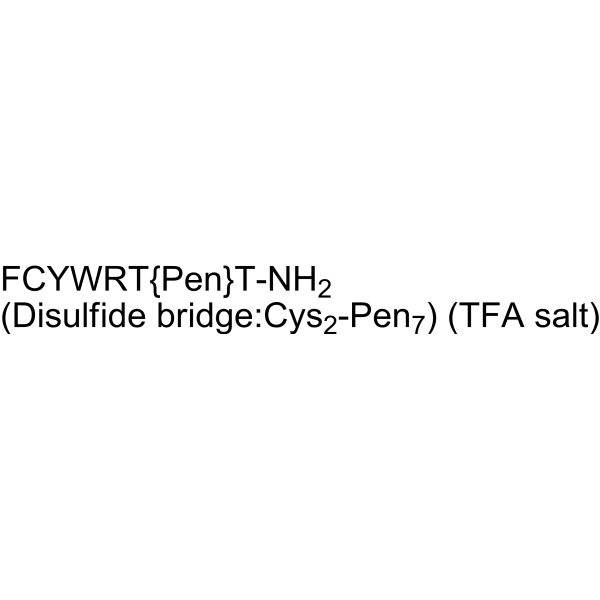
{d-Phe}-Cys-Tyr-{d-Trp}-Arg-Thr-{Pen}-Thr-NH2 (Disulfide bridge:Cys2-Pen7)
-
Sequence Shortening
{d-Phe}-CY-{d-Trp}-RT-{Pen}-T-NH2 (Disulfide bridge:Cys2-Pen7)
-
Envío
Room temperature in continental US; may vary elsewhere.
-
Almacenamiento
Sealed storage, away from moisture and light, under nitrogen
Powder -80°C 2 years -20°C 1 year * In solvent : -80°C, 6 months; -20°C, 1 month (sealed storage, away from moisture and light, under nitrogen)


Publications (2)
-
Journal Impact Factor
-
Most Recent
-
Nat Commun
Epigenetic regulation of beta-endorphin synthesis in hypothalamic arcuate nucleus neurons modulates neuropathic pain in a rodent pain model. [Abstract]2023 Nov 9;14(1):7234. PMID: 37945654 -
Pharmacol Biochem Behav
Dual activation of 5-HT1A and μ-opioid receptors mediates dezocine's antidepressant effects in mice with comorbid pain and depression. [Abstract]2026 Feb:259:174136. PMID: 41365431


Solvente y solubilidad
In Vitro:
H2O : 100 mg/mL (Need ultrasonic)


Pureza y Documentación
-
Ficha de datos (278 KB)
-
SDS (252 KB)
- English - EN (252 KB)
- Français - FR (252 KB)
- Deutsch - DE (252 KB)
- Norwegian - NO (252 KB)
- Español - ES (252 KB)
- Swedish - SV (252 KB)
- Italian - IT (252 KB)
- Korean - KR (252 KB)
- Portuguese - PT (252 KB)
-
Instrucciones de manejo (2659 KB)
Referencias
[1]. Mitchell J Bartlett, et al. Highly-selective µ-opioid Receptor Antagonism Does Not Block L-DOPA-induced Dyskinesia in a Rodent Model.BMC Res Notes [Content Brief]
[2]. Abbruscato TJ, et al. Blood-brain barrier permeability and bioavailability of a highly potent and mu-selective opioid receptor antagonist, CTAP: comparison with morphine. J Pharmacol Exp Ther. 1997 Jan;280(1):402-9. [Content Brief]

Calculators
Concentration (start) × Volume (start) = Concentration (final) × Volume (final)


CTAP TFA Related Classifications
HY-P1335A Related Classifications
 Powered by Bioz