



PRMT6-IN-3

Based on 1 Customer Validation
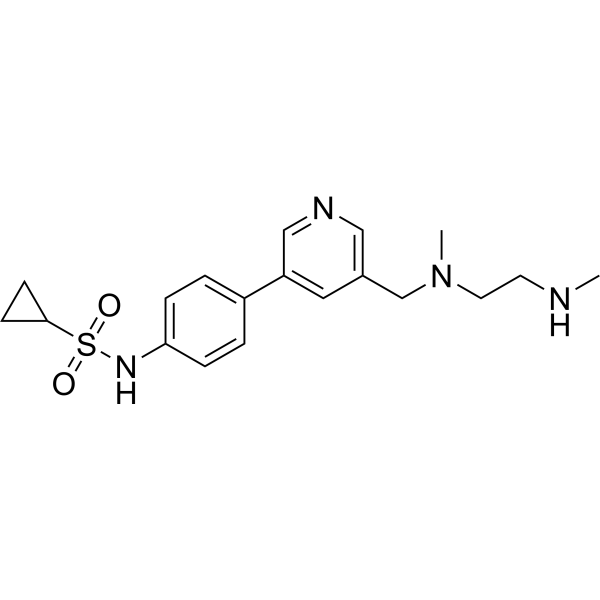
PRMT6-IN-3 (compound 25) is a selective PRMT6 inhibitor with an IC50 value of 192 nM. PRMT6-IN-3 can induce apoptosis in cancer cells and has anticancer activity.
Para uso exclusivo en investigación. No vendemos a pacientes.
- Pureza : 99.66%
- No. CAS: 2890765-10-1
- Fòrmula: C19H26N4O2S
- Peso molecular:374.50
-
Almacenamiento:Powder -20°C, 3 years , 4°C, 2 years ; In solvent -80°C, 6 months , -20°C, 1 month

To place orders, for customer services and technical support, please contact: MedChemExpress USA
Tel: 609-228-6898 E-mail: [email protected] [email protected]


-
 Actividad biológica
-
Chemical Information
-
Solvente y solubilidad
- Protocolo
- Pureza y Documentación
- Referencias
-
 Help & FAQs


Ver todos los productos específicos de isoformas Histone Methyltransferase
More

Actividad biológica
Descripciòn
Cellular Effect
|
Cell Line

|
Type | Value | Description | References |
|---|---|---|---|---|
| HCC827 | IC50 |
14.83 μM
Compound: a25
|
Antiproliferative activity against human HCC827 cells for 5 days by MTT assay
Antiproliferative activity against human HCC827 cells for 5 days by MTT assay
|
[PMID: 36566712] |
| HCC827 | IC50 |
17.91 μM
Compound: a25
|
Antiproliferative activity against human HCC827 cells for 3 days by MTT assay
Antiproliferative activity against human HCC827 cells for 3 days by MTT assay
|
[PMID: 36566712] |
| HCC827 | IC50 |
9.84 μM
Compound: a25
|
Antiproliferative activity against human HCC827 cells for 7 days by MTT assay
Antiproliferative activity against human HCC827 cells for 7 days by MTT assay
|
[PMID: 36566712] |
| MDA-MB-435 | IC50 |
12.03 μM
Compound: a25
|
Antiproliferative activity against human MDA-MB-435 cells for 5 days by MTT assay
Antiproliferative activity against human MDA-MB-435 cells for 5 days by MTT assay
|
[PMID: 36566712] |
| MDA-MB-435 | IC50 |
16.67 μM
Compound: a25
|
Antiproliferative activity against human MDA-MB-435 cells for 3 days by MTT assay
Antiproliferative activity against human MDA-MB-435 cells for 3 days by MTT assay
|
[PMID: 36566712] |
| MDA-MB-435 | IC50 |
3.98 μM
Compound: a25
|
Antiproliferative activity against human MDA-MB-435 cells for 7 days by MTT assay
Antiproliferative activity against human MDA-MB-435 cells for 7 days by MTT assay
|
[PMID: 36566712] |
In Vitro
PRMT6-IN-3(compound 25) (80 μM, 3-7 days) has anti-proliferative activity against HCC827 and MDA-MB-435 cells[1].
PRMT6-IN-3(compound 25) (0-40 μM, 72 h) significantly induces apoptosis of cancer cells in a dose-dependent manner. Among them, a concentration of 40 μM could induce apoptosis in 43.44% and 35.08% of HCC827 and MDA-MB-435 cells, respectively[1].
MedChemExpress (MCE) has not independently confirmed the accuracy of these methods. They are for reference only. Further protocols information, click here.
In Vivo
| Parameters | iv (2 mg/kg) | po (10 mg/kg) |
| Tmax (h) | 0.08 | 0.33 |
| T1/2 (h) | 1.46 | 1.63 |
| AUC(0-t)(ng*h/mL) | 661.50 | 123.53 |
| MRT(0-t) (h) | 1.24 | 1.86 |
| Cmax (ng/mL) | - | 88.32 |
| F (%) | - | 3.73 |
MedChemExpress (MCE) has not independently confirmed the accuracy of these methods. They are for reference only.


Chemical Information
-
No. CAS 2890765-10-1
-
Appearance Solid
-
Peso molecular 374.50
-
Fòrmula C19H26N4O2S
-
Color White to yellow
-
SMILES
O=S(C1CC1)(NC2=CC=C(C3=CC(CN(C)CCNC)=CN=C3)C=C2)=O
-
Envío
Room temperature in continental US; may vary elsewhere.
-
Almacenamiento
Powder -20°C 3 years 4°C 2 years In solvent -80°C 6 months -20°C 1 month


Solvente y solubilidad
In Vitro:
DMSO : 55 mg/mL (146.86 mM; Need ultrasonic and warming; Hygroscopic DMSO has a significant impact on the solubility of product, please use newly opened DMSO)
Please refer to the solubility information to select the appropriate solvent. Once prepared, please aliquot and store the solution to prevent product inactivation from repeated freeze-thaw cycles.
Storage method and period of stock solution: -80°C, 6 months; -20°C, 1 month. When stored at -80°C, please use it within 6 months. When stored at -20°C, please use it within 1 month.
Please refer to the solubility information to select the appropriate solvent. Once prepared, please aliquot and store the solution to prevent product inactivation from repeated freeze-thaw cycles.
Storage method and period of stock solution: -80°C, 6 months; -20°C, 1 month. When stored at -80°C, please use it within 6 months. When stored at -20°C, please use it within 1 month.
Concentration (start) × Volume (start) = Concentration (final) × Volume (final)

Protocolo
-
Apoptosis
Apoptosis, also called programmed cell death, is generally characterized by distinct morphological characteristics.
-
TUNEL staining for apoptotic DNA fragmentation
TUNEL staining detects DNA strand breaks by using terminal deoxynucleotidyl transferase to add labeled nucleotides to exposed 3′-OH DNA termini, generating either microscopic staining in fixed cells or tissue sections, or fluorescence/cytometric signal in cell suspensions. TUNEL positivity reflects DNA fragmentation but should not be interpreted alone as definitive apoptosis, because TUNEL can also label necrotic, autolytic, mechanically damaged, or DNA-repair-associated DNA breaks.
-
Cell Cytotoxicity Assay
Cytotoxicity assays are usually based on the assessment of cell membrane damage, which can also be indirectly detected by measuring cell viability. Detection methods include MTT assay, CKK-8 assay, LDH assay and ATP assay, etc.
-
Annexin V plus membrane-impermeant dye apoptosis staining
Annexin V-based apoptosis assays rely on the detection of phosphatidylserine (PS) externalization from the inner leaflet of the plasma membrane to the outer leaflet, an early biochemical hallmark of apoptosis. Fluorescently labeled Annexin V binds PS in a calcium-dependent manner, enabling identification of early apoptotic cells by flow cytometry or fluorescence microscopy. When combined with a membrane-impermeant DNA-binding dye (e. g. , propidium iodide), this approach allows discrimination between viable (Annexin V−/dye−), early apoptotic (Annexin V+/dye−), and late apoptotic or necrotic (Annexin V+/dye+) cell populations by assessing membrane integrity and PS exposure.
-
Apoptosis Solutions
Apoptosis is a regulated, generally non-lytic cell-death pathway that removes unwanted, damaged, infected, or abnormal cells through coordinated morphological changes, caspase activation, DNA fragmentation, and membrane remodeling. The intrinsic apoptosis pathway is controlled mainly by mitochondrial outer membrane permeabilization, BCL-2 family proteins, cytochrome c release, apoptosome formation, caspase-9 activation, and downstream executioner caspase-3/7 activation. The extrinsic apoptosis pathway is initiated by death receptors such as Fas, TNFR, and TRAIL receptors, which recruit adaptor proteins and activate caspase-8 before engaging executioner caspases or mitochondrial amplification through BID cleavage. Apoptosis is linked to many phenotypes, including cancer cell killing, tissue homeostasis, immune regulation, neurodegeneration, infection response, and treatment-induced cytotoxicity; unresolved questions include how apoptosis interacts with necroptosis, pyroptosis, ferroptos


Pureza y Documentación
-
Ficha de datos (269 KB)
-
SDS (393 KB)
- English - EN (393 KB)
- Français - FR (393 KB)
- Deutsch - DE (393 KB)
- Norwegian - NO (393 KB)
- Español - ES (393 KB)
- Swedish - SV (393 KB)
- Italian - IT (393 KB)
- Korean - KR (393 KB)
- Portuguese - PT (393 KB)
-
Instrucciones de manejo (2659 KB)
Referencias


Complete Stock Solution Preparation Table
Please refer to the solubility information to select the appropriate solvent. Once prepared, please aliquot and store the solution to prevent product inactivation from repeated freeze-thaw cycles.
Storage method and period of stock solution: -80°C, 6 months; -20°C, 1 month. When stored at -80°C, please use it within 6 months. When stored at -20°C, please use it within 1 month.
| Optional Solvent | Concentration Solvent Mass | 1 mg | 5 mg | 10 mg | 25 mg |
|---|---|---|---|---|---|
| DMSO | 1 mM | 2.6702 mL | 13.3511 mL | 26.7023 mL | 66.7557 mL |
| 5 mM | 0.5340 mL | 2.6702 mL | 5.3405 mL | 13.3511 mL | |
| 10 mM | 0.2670 mL | 1.3351 mL | 2.6702 mL | 6.6756 mL | |
| 15 mM | 0.1780 mL | 0.8901 mL | 1.7802 mL | 4.4504 mL | |
| 20 mM | 0.1335 mL | 0.6676 mL | 1.3351 mL | 3.3378 mL | |
| 25 mM | 0.1068 mL | 0.5340 mL | 1.0681 mL | 2.6702 mL | |
| 30 mM | 0.0890 mL | 0.4450 mL | 0.8901 mL | 2.2252 mL | |
| 40 mM | 0.0668 mL | 0.3338 mL | 0.6676 mL | 1.6689 mL | |
| 50 mM | 0.0534 mL | 0.2670 mL | 0.5340 mL | 1.3351 mL | |
| 60 mM | 0.0445 mL | 0.2225 mL | 0.4450 mL | 1.1126 mL | |
| 80 mM | 0.0334 mL | 0.1669 mL | 0.3338 mL | 0.8344 mL | |
| 100 mM | 0.0267 mL | 0.1335 mL | 0.2670 mL | 0.6676 mL |


PRMT6-IN-3 Related Classifications
HY-152236 Related Classifications
 Powered by Bioz