



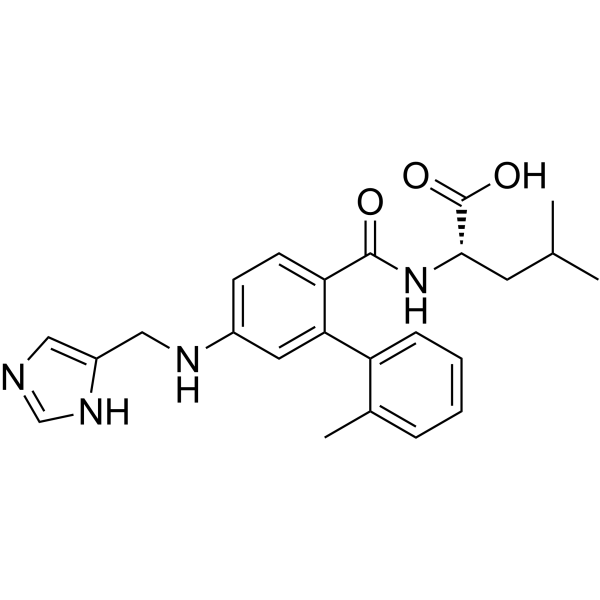
GGTI-2154
GGTI-2154 is a potent and selective inhibitor of geranylgeranyltransferase I (GGTase I), with an IC50 of 21 nM. GGTI-2154 shows more than 200-fold selectivity for GGTase I over FTase (IC50=5600 nM). GGTI-2154 can be used for the research of cancer.
Nur für Forschungszwecke. Wir verkaufen nicht an Patienten.
- CAS. Nr.: 251577-10-3
- Formel: C24H28N4O3
- Molecular Weight:420.50
-
Speicherung:
Please store the product under the recommended conditions in the Certificate of Analysis.

To place orders, for customer services and technical support, please contact: MedChemExpress USA
Tel: 609-228-6898 E-mail: [email protected] [email protected]


-
 Biologische Aktivität
-
Chemical Information
- Reinheit & Dokumentation
- Verweise
-
 Help & FAQs




Biologische Aktivität
Beschreibung
IC50 & Target
IC50: 21 nM (GGTase I)[1]
In Vitro
In Vivo
GGTI-2154 (50 mg/kg/day; i.p. for 50 day) inhibits A-549 tumor growth in nude mice by 60%[1].
MedChemExpress (MCE) has not independently confirmed the accuracy of these methods. They are for reference only.
-
Animal Model:MMTV-v-Ha-ras transgenic mice bearing mammary carcinoma[2]
-
Dosage:100 mg/kg/day
-
Administration:S.c. with osmotic mini-pumps for 14 days
-
Result:Halted the tumors aggressive growth.
Resulted in rapid tumor regression within 3 days of initiation of drug treatment.


Chemical Information
-
CAS. Nr. 251577-10-3
-
Molecular Weight 420.50
-
Formel C24H28N4O3
-
SMILES
CC(C)C[C@@H](C(O)=O)NC(C1=CC=C(NCC2=CN=CN2)C=C1C3=CC=CC=C3C)=O
-
Versand
Room temperature in continental US; may vary elsewhere.
-
Speicherung
Please store the product under the recommended conditions in the Certificate of Analysis.


Reinheit & Dokumentation
Verweise
[1]. Sun J, et, al. Antitumor efficacy of a novel class of non-thiol-containing peptidomimetic inhibitors of farnesyltransferase and geranylgeranyltransferase I: combination therapy with the cytotoxic agents cisplatin, Taxol, and gemcitabine. Cancer Res. 1999 Oct 1;59(19):4919-26. [Content Brief]
[2]. Sun J, et, al. Geranylgeranyltransferase I inhibitor GGTI-2154 induces breast carcinoma apoptosis and tumor regression in H-Ras transgenic mice. Cancer Res. 2003 Dec 15;63(24):8922-9. [Content Brief]

Calculators
Konzentration (Stammlösung) × Volumen (Stammlösung) = Konzentration (Ziellösung) × Volumen (Ziellösung)


GGTI-2154 Related Classifications
HY-16229 Related Classifications
 Powered by Bioz