



GIV3727
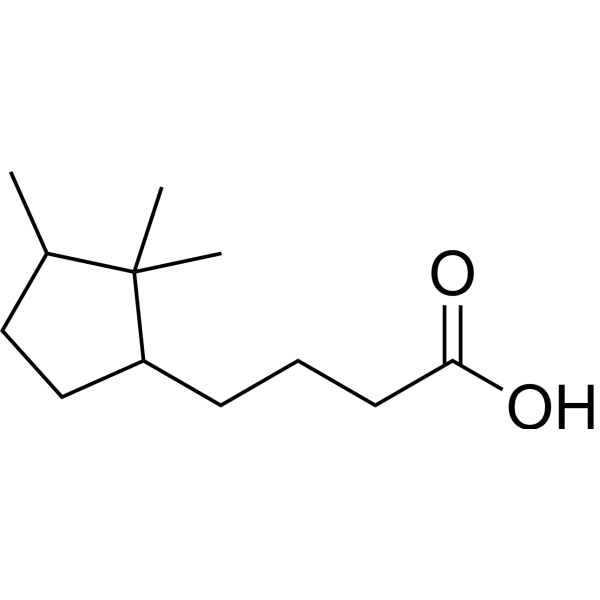
GIV3727 is an orally active bitter taste receptor antagonist targeting TAS2R4, TAS2R7, TAS2R20, TAS2R31, TAS2R40, and TAS2R43, with orthosteric, insurmountable antagonism at hTAS2R31. GIV3727 blocks TAS2R4 and prevents Gallic acid-induced upregulation of GDF15 mRNA expression. GIV3727 inhibits agonist-evoked receptor activation. GIV3727 reduces the perceived bitterness of acesulfame K and saccharin without affecting sweet taste perception. GIV3727 can be used for obesity research.
For research use only. We do not sell to patients.
- CAS No.: 957136-80-0
- Formula: C12H22O2
- Molecular Weight:198.30
-
Storage:
Solution, -20°C, 2 years

To place orders, for customer services and technical support, please contact: MedChemExpress USA
Tel: 609-228-6898 E-mail: [email protected] [email protected]


-
 Biological Activity
-
Chemical Information
- Protocols
- Purity & Documentation
- References
-
 Help & FAQs




Biological Activity
Description
IC50 & Target
[1]|
GDF15 |
Cellular Effect
|
Cell Line

|
Type | Value | Description | References |
|---|---|---|---|---|
| HEK293 | IC50 |
6.4 μM
|
Inhibition of acesulfame K-induced activation of hTAS2R31 in HEK293 cells expressing hTAS2R31 and G16gust44 measured by high-throughput calcium imaging.
Inhibition of acesulfame K-induced activation of hTAS2R31 in HEK293 cells expressing hTAS2R31 and G16gust44 measured by high-throughput calcium imaging.
|
20537538 |
| HEK293 | IC50 |
7.9 μM
|
Inhibition of saccharin-induced activation of hTAS2R31 in HEK293 cells expressing hTAS2R31 and G16gust44 measured by high-throughput calcium imaging.
Inhibition of saccharin-induced activation of hTAS2R31 in HEK293 cells expressing hTAS2R31 and G16gust44 measured by high-throughput calcium imaging.
|
20537538 |
In Vitro
The TAS2R antagonist GIV3727 (110 µM; 30 min) blocks gallic acid-induced GDF15 mRNA expression in primary jejunal crypts but does not affect GLP-1 mRNA expression or azithromycin-induced GDF15 mRNA expression[1].
GIV3727 (6.4 μM; acesulfame K) is a novel, reversible antagonist of hTAS2R31, inhibiting activation by acesulfame K and saccharin with IC50 values of 6.4 μM and 7.9 μM, respectively, and also inhibits hTAS2R43[2].
GIV3727 (6-25 μM) acts as an orthosteric, insurmountable antagonist of hTAS2R31, increasing agonist EC50 3- to 10-fold and decreasing maximal signal amplitude by 35-70% at 25 μM[2].
GIV3727 (6-25 μM) significantly reduces hTAS2R31 receptor activation across all concentrations of acesulfame K, saccharin, and aristolochic acid[2].
MedChemExpress (MCE) has not independently confirmed the accuracy of these methods. They are for reference only. Further protocols information, click here.


Chemical Information
-
CAS No. 957136-80-0
-
Appearance Liquid
-
Molecular Weight 198.30
-
Formula C12H22O2
-
Color Colorless to light yellow
-
SMILES
OC(CCCC1CCC(C1(C)C)C)=O
-
Shipping
Room temperature in continental US; may vary elsewhere.
-
Storage
Solution, -20°C, 2 years

Protocols
-
RT-PCR
Reverse transcription technology uses RNA as a template to synthesize DNA. RT-PCR is simple, specific and sensitive, and can be used to detect gene expression levels and expression differences in cells; detect RNA virus content; clone cDNA sequences of specific genes.
-
RNA extraction experimental
By lysing cells, releasing RNA, and removing impurities such as proteins and DNA, high-purity RNA products are finally obtained. The commonly used traditional method is the guanidine isothiocyanate/phenol/chloroform method (Trizol), which is suitable for a variety of animal materials including animal tissues, microorganisms, cultured cells, etc., and most plant materials.
-
Research Protocol for Metabolic Diseases
AMP-activated protein kinase, AMPK, is a conserved cellular energy sensor that responds to reduced cellular energy status and coordinates metabolism by increasing ATP-generating catabolic pathways while suppressing ATP-consuming anabolic processes. In metabolic disease research, the AMPK pathway is experimentally relevant because it regulates hepatic lipid synthesis, fatty acid oxidation, glucose production, skeletal-muscle glucose disposal, mTORC1-linked biosynthesis, autophagy, mitochondrial homeostasis, and whole-body energy balance. The central pathway logic is that energy stress, metformin, exercise-like stimulation, or direct AMPK activators increase AMPKα Thr172 phosphorylation and downstream substrate phosphorylation, including ACC and RAPTOR. Phosphorylation of ACC suppresses lipogenesis and supports fatty acid oxidation, whereas phosphorylation of RAPTOR suppresses mTORC1 signaling and links cellular energy status to growth and protein synthesis control. The pathway is linked
-
Real Time qPCR (Q-PCR)
Real-time quantitative PCR (qPCR) quantifies an amplifiable nucleic-acid target by monitoring fluorescence during PCR cycling rather than measuring product only after amplification. The increase in fluorescence tracks accumulation of PCR product, and the quantification cycle (Cq; historically also Ct/CP) is related to the initial amount of target: samples containing more starting target generally reach the defined fluorescence threshold in fewer cycles.


Purity & Documentation
-
Data Sheet (277 KB)
-
SDS (393 KB)
- English - EN (393 KB)
- Français - FR (393 KB)
- Deutsch - DE (393 KB)
- Norwegian - NO (393 KB)
- Español - ES (393 KB)
- Swedish - SV (393 KB)
- Italian - IT (393 KB)
- Korean - KR (393 KB)
- Portuguese - PT (393 KB)
-
Handling Instructions (2659 KB)
References

Calculators
Concentration (start) × Volume (start) = Concentration (final) × Volume (final)


GIV3727 Related Classifications
HY-124956 Related Classifications
 Powered by Bioz