



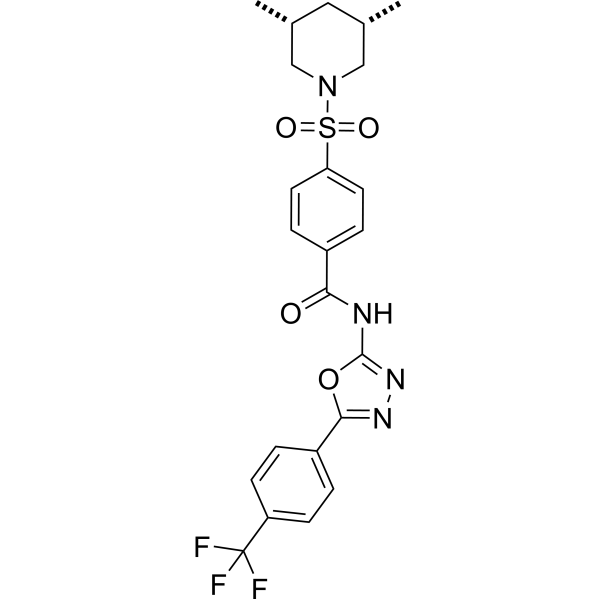
HSGN-94

Based on 1 Customer Validation
HSGN-94 is a potent antimicrobial agent with lipoteichoic acid (LTA) biosynthesis inhibition. HSGN-94 inhibits drug-resistant Gram-positive bacteria with MIC values of 0.25-2 μg/mL. HSGN-94 inhibits biofilm formation of MRSA and Vancomycin-resistant Enterococci. HSGN-94 also inhibits pro-inflammatory cytokines, exhibits in vivo efficacy in an MRSA murine wound infection model.
Nos produits utilisent uniquement pour la recherche. Nous ne vendons pas aux patients.
- Pureté : 98.80%
- CAS No.: 2570797-85-0
- Formule: C23H23F3N4O4S
- Masse moléculaire:508.51
-
Stockage:Powder -20°C, 3 years , 4°C, 2 years ; In solvent -80°C, 6 months , -20°C, 1 month

To place orders, for customer services and technical support, please contact: MedChemExpress USA
Tel: 609-228-6898 E-mail: [email protected] [email protected]


-
 Activité biologique
-
Chemical Information
-
Solvant et solubilité
- Protocole
- Pureté et documentation
- Références
-
 Help & FAQs




Activité biologique
Description
In Vitro
HSGN-94 (50 μM; 30 min) directly binds to CDP-diacylglycerol-glycerol-3-phosphate 3-phosphatidyltransferase (PgsA)[1].
HSGN-94 (0.25 μg/mL; 2 h) downregulates the expression level of PgsA, an essential protein for phospholipid synthesis in the bacteria S. aureus[1].
HSGN-94 (16, 32, 64, and 128 μg/mL; 2 h) is not toxic to HaCat cells at concentrations up to 64 μg/mL[1].
MedChemExpress (MCE) has not independently confirmed the accuracy of these methods. They are for reference only. Further protocols information, click here.
In Vivo
MedChemExpress (MCE) has not independently confirmed the accuracy of these methods. They are for reference only.
-
Animal Model:MRSA murine wound infection model[1]
-
Dosage:2%
-
Administration:External use; twice daily for 5 days
-
Result:Reduced the levels of the pro-inflammatory cytokines, monocyte chemo attractant protein-1 (MCP-1), tumor necrosis factor-α (TNF-α), and interleukin-1 beta (IL-1β) in MRSA USA300 skin lesions.


Chemical Information
-
CAS No. 2570797-85-0
-
Appearance Solid
-
Masse moléculaire 508.51
-
Formule C23H23F3N4O4S
-
Color White to off-white
-
SMILES
O=S(C1=CC=C(C=C1)C(NC2=NN=C(O2)C3=CC=C(C=C3)C(F)(F)F)=O)(N4C[C@@H](C[C@@H](C4)C)C)=O
-
Livraison
Room temperature in continental US; may vary elsewhere.
-
Stockage
Powder -20°C 3 years 4°C 2 years In solvent -80°C 6 months -20°C 1 month


Solvant et solubilité
In Vitro:
DMSO : 100 mg/mL (196.65 mM; Need ultrasonic; Hygroscopic DMSO has a significant impact on the solubility of product, please use newly opened DMSO)
Please refer to the solubility information to select the appropriate solvent. Once prepared, please aliquot and store the solution to prevent product inactivation from repeated freeze-thaw cycles.
Storage method and period of stock solution: -80°C, 6 months; -20°C, 1 month. When stored at -80°C, please use it within 6 months. When stored at -20°C, please use it within 1 month.
Please refer to the solubility information to select the appropriate solvent. Once prepared, please aliquot and store the solution to prevent product inactivation from repeated freeze-thaw cycles.
Storage method and period of stock solution: -80°C, 6 months; -20°C, 1 month. When stored at -80°C, please use it within 6 months. When stored at -20°C, please use it within 1 month.
Concentration (start) × Volume (start) = Concentration (final) × Volume (final)

Protocole
-
Research Protocol for Infectious Diseases
Infectious-disease experiments test how pathogens interact with host barriers, innate immune receptors, inflammatory signaling, pathogen replication, and tissue injury; pattern-recognition receptors such as TLRs, RIG-I-like receptors, NOD-like receptors, and inflammasomes detect microbial molecules and activate NF-κB, interferon, and cytokine responses. The central hypothesis is that infection severity reflects the balance between pathogen burden and host response: protective inflammation restricts pathogen growth, whereas excessive or mislocalized inflammation contributes to tissue damage and disease phenotype. Unresolved questions include which host pathways are protective versus pathogenic, why some infection models fail to translate to human disease, and which combined readouts best predict clinically relevant infection outcomes.
-
LPS-Induced Endotoxemia/Systemic Inflammation
Lipopolysaccharide (LPS)-induced endotoxemia is a widely used in vivo model of acute systemic inflammation in which LPS, a Gram-negative bacterial endotoxin, activates innate immune signaling primarily through TLR4, leading to rapid and transient induction of pro-inflammatory cytokines such as TNF-α, IL-6, and IL-1β in circulation and tissues. This cytokine surge is commonly used as a measurable readout of systemic inflammatory activation and immune dysregulation, and is typically assessed within hours after intraperitoneal LPS administration in mouse models of endotoxemia. The model captures key features of systemic inflammatory response syndrome, including cytokine release, immune cell activation, and downstream tissue responses, and has been used to evaluate anti-inflammatory interventions such as cytokine modulation, lipid mediators, and immune cell-targeting therapies.
-
Gram Staining of Tissue Sections
Gram staining of tissue sections is a histochemical technique used to differentiate Gram-positive and Gram-negative bacteria within histological specimens based on differences in bacterial cell wall structure and dye retention, adapted from classical bacteriological Gram staining into tissue-compatible “histological Gram stain” variants. In tissue applications, modifications of the Brown-Hopps and Brown-Brenn methods are commonly used to improve differentiation of microorganisms embedded within host connective tissue and to reduce overstaining or loss of Gram-negative signal, which are known limitations of earlier approaches. The principle relies on crystal violet-iodine complex retention in Gram-positive organisms and subsequent decolorization and counterstaining steps that allow contrast visualization of Gram-negative organisms against tissue background.
-
Research Protocol for Inflammation-related Diseases
The NLRP3 inflammasome is a cytosolic innate immune signaling platform that integrates priming signals and danger-signal activation to promote caspase-1 activation, maturation of IL-1β and IL-18, and gasdermin D-mediated pyroptotic cell death. The core experimental logic is to determine whether inflammatory disease phenotypes are driven by increased NLRP3 expression, ASC-containing inflammasome assembly, caspase-1 cleavage, GSDMD cleavage, and extracellular release of IL-1β/IL-18 rather than by nonspecific cell injury alone. The pathway is strongly linked to inflammation-related disease phenotypes because monosodium urate crystals activate NALP3/NLRP3 inflammasome signaling in gout-like crystal inflammation, cholesterol crystals activate NLRP3 inflammasomes in atherogenesis models, and DSS-induced intestinal inflammation has been reported to involve NLRP3 inflammasome activity. However, experimental colitis studies also show context-dependent protective effects of NLRP3 inflammasome co
-
Fungal Biofilm Culture
Fungal biofilm culture is an in vitro method for growing surface-attached fungal communities, most commonly Candida albicans, on abiotic substrates such as polystyrene wells, silicone elastomer, or polymethylmethacrylate; the assay models adhesion, proliferation, filamentation, extracellular-matrix-associated maturation, and dispersion. Biofilm output can be read by optical density at 600 nm for adherent biomass, XTT reduction for metabolic activity, CFU recovery for viable attached or dispersed cells, and microscopy for architecture.


Pureté et documentation
-
Fiche technique (273 KB)
-
SDS (251 KB)
- English - EN (251 KB)
- Français - FR (251 KB)
- Deutsch - DE (251 KB)
- Norwegian - NO (251 KB)
- Español - ES (251 KB)
- Swedish - SV (251 KB)
- Italian - IT (251 KB)
- Korean - KR (251 KB)
- Portuguese - PT (251 KB)
-
Instruction de manipulation (2659 KB)
Références


Complete Stock Solution Preparation Table
Please refer to the solubility information to select the appropriate solvent. Once prepared, please aliquot and store the solution to prevent product inactivation from repeated freeze-thaw cycles.
Storage method and period of stock solution: -80°C, 6 months; -20°C, 1 month. When stored at -80°C, please use it within 6 months. When stored at -20°C, please use it within 1 month.
| Optional Solvent | Concentration Solvent Mass | 1 mg | 5 mg | 10 mg | 25 mg |
|---|---|---|---|---|---|
| DMSO | 1 mM | 1.9665 mL | 9.8326 mL | 19.6653 mL | 49.1632 mL |
| 5 mM | 0.3933 mL | 1.9665 mL | 3.9331 mL | 9.8326 mL | |
| 10 mM | 0.1967 mL | 0.9833 mL | 1.9665 mL | 4.9163 mL | |
| 15 mM | 0.1311 mL | 0.6555 mL | 1.3110 mL | 3.2775 mL | |
| 20 mM | 0.0983 mL | 0.4916 mL | 0.9833 mL | 2.4582 mL | |
| 25 mM | 0.0787 mL | 0.3933 mL | 0.7866 mL | 1.9665 mL | |
| 30 mM | 0.0656 mL | 0.3278 mL | 0.6555 mL | 1.6388 mL | |
| 40 mM | 0.0492 mL | 0.2458 mL | 0.4916 mL | 1.2291 mL | |
| 50 mM | 0.0393 mL | 0.1967 mL | 0.3933 mL | 0.9833 mL | |
| 60 mM | 0.0328 mL | 0.1639 mL | 0.3278 mL | 0.8194 mL | |
| 80 mM | 0.0246 mL | 0.1229 mL | 0.2458 mL | 0.6145 mL | |
| 100 mM | 0.0197 mL | 0.0983 mL | 0.1967 mL | 0.4916 mL |


HSGN-94 Related Classifications
HY-146811 Related Classifications
 Powered by Bioz