



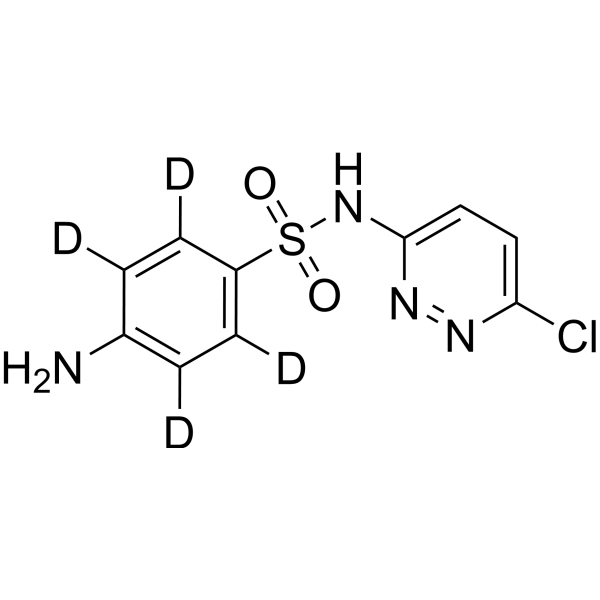
Sulfachloropyridazine-d4

Based on 1 Customer Validation
Sulfachloropyridazine-d4 is the deuterium labeled Sulfachloropyridazine. Sulfachloropyridazine is a broad spectrum sulfonamide used against both Gram-positive and Gram-negative aerobic bacteria.
For research use only. We do not sell to patients.
- Purity : 99.0%
- CAS No.: 1795037-54-5
- Formula: C10H5D4ClN4O2S
- Molecular Weight:288.75
-
Storage:Powder -20°C, 3 years , 4°C, 2 years ; In solvent -80°C, 6 months , -20°C, 1 month

To place orders, for customer services and technical support, please contact: MedChemExpress USA
Tel: 609-228-6898 E-mail: [email protected] [email protected]


-
 Biological Activity
-
Chemical Information
-
Solvent & Solubility
- Protocols
- Purity & Documentation
- References
-
 Help & FAQs


All Antibiotic Isoforms
More

Biological Activity
Description
In Vitro
Stable heavy isotopes of hydrogen, carbon, and other elements have been incorporated into drug molecules, largely as tracers for quantitation during the drug development process. Deuteration has gained attention because of its potential to affect the pharmacokinetic and metabolic profiles of drugs[2].
MedChemExpress (MCE) has not independently confirmed the accuracy of these methods. They are for reference only. Further protocols information, click here.
Application
1. This compound can be used as a tracer
2. This compound can be used as an internal standard for quantitative analysis by NMR, GC-MS, or LC-MS.


Chemical Information
-
CAS No. 1795037-54-5
-
Unlabeled CAS 80-32-0
-
Appearance Solid
-
Molecular Weight 288.75
-
Formula C10H5D4ClN4O2S
-
Color Light yellow to yellow
-
SMILES
NC1=C([2H])C([2H])=C(S(NC2=CC=C(Cl)N=N2)(=O)=O)C([2H])=C1[2H]
-
Synonyms
Sulfachlorpyridazine-d4
-
Shipping
Room temperature in continental US; may vary elsewhere.
-
Storage
Powder -20°C 3 years 4°C 2 years In solvent -80°C 6 months -20°C 1 month


Solvent & Solubility
In Vitro:
DMSO : 200 mg/mL (692.64 mM; Need ultrasonic; Hygroscopic DMSO has a significant impact on the solubility of product, please use newly opened DMSO)
Please refer to the solubility information to select the appropriate solvent. Once prepared, please aliquot and store the solution to prevent product inactivation from repeated freeze-thaw cycles.
Storage method and period of stock solution: -80°C, 6 months; -20°C, 1 month. When stored at -80°C, please use it within 6 months. When stored at -20°C, please use it within 1 month.
Please refer to the solubility information to select the appropriate solvent. Once prepared, please aliquot and store the solution to prevent product inactivation from repeated freeze-thaw cycles.
Storage method and period of stock solution: -80°C, 6 months; -20°C, 1 month. When stored at -80°C, please use it within 6 months. When stored at -20°C, please use it within 1 month.
Concentration (start) × Volume (start) = Concentration (final) × Volume (final)

Protocols
-
Aerobic Bacterial Batch Culture on Broth/Agar
Aerobic bacterial batch culture grows a closed inoculated population in broth or on agar without continuous medium replacement; growth readouts include turbidity/OD for total suspended biomass and colony-forming units for viable cells able to form colonies on agar. OD-based growth curves reflect light scattering by cells, but OD is instrument-, pathlength-, species-, cell-size-, and density-dependent, so OD should be calibrated or interpreted alongside viable counts when quantitative cell density is required.
-
Gram Staining of Tissue Sections
Gram staining of tissue sections is a histochemical technique used to differentiate Gram-positive and Gram-negative bacteria within histological specimens based on differences in bacterial cell wall structure and dye retention, adapted from classical bacteriological Gram staining into tissue-compatible “histological Gram stain” variants. In tissue applications, modifications of the Brown-Hopps and Brown-Brenn methods are commonly used to improve differentiation of microorganisms embedded within host connective tissue and to reduce overstaining or loss of Gram-negative signal, which are known limitations of earlier approaches. The principle relies on crystal violet-iodine complex retention in Gram-positive organisms and subsequent decolorization and counterstaining steps that allow contrast visualization of Gram-negative organisms against tissue background.


Purity & Documentation
-
Data Sheet (273 KB)
-
SDS (252 KB)
- English - EN (252 KB)
- Français - FR (252 KB)
- Deutsch - DE (252 KB)
- Norwegian - NO (252 KB)
- Español - ES (252 KB)
- Swedish - SV (252 KB)
- Italian - IT (252 KB)
- Korean - KR (252 KB)
- Portuguese - PT (252 KB)
-
Handling Instructions (2659 KB)
References
[1]. Dirany A, et al. Electrochemical treatment of the antibiotic sulfachloropyridazine: kinetics, reaction pathways, and toxicity evolution. Environ Sci Technol. 2012 Apr 3;46(7):4074-82 [Content Brief]
[2]. Russak EM, et al. Impact of Deuterium Substitution on the Pharmacokinetics of Pharmaceuticals. Ann Pharmacother. 2019;53(2):211-216. [Content Brief]


Complete Stock Solution Preparation Table
Please refer to the solubility information to select the appropriate solvent. Once prepared, please aliquot and store the solution to prevent product inactivation from repeated freeze-thaw cycles.
Storage method and period of stock solution: -80°C, 6 months; -20°C, 1 month. When stored at -80°C, please use it within 6 months. When stored at -20°C, please use it within 1 month.
| Optional Solvent | Concentration Solvent Mass | 1 mg | 5 mg | 10 mg | 25 mg |
|---|---|---|---|---|---|
| DMSO | 1 mM | 3.4632 mL | 17.3160 mL | 34.6320 mL | 86.5801 mL |
| 5 mM | 0.6926 mL | 3.4632 mL | 6.9264 mL | 17.3160 mL | |
| 10 mM | 0.3463 mL | 1.7316 mL | 3.4632 mL | 8.6580 mL | |
| 15 mM | 0.2309 mL | 1.1544 mL | 2.3088 mL | 5.7720 mL | |
| 20 mM | 0.1732 mL | 0.8658 mL | 1.7316 mL | 4.3290 mL | |
| 25 mM | 0.1385 mL | 0.6926 mL | 1.3853 mL | 3.4632 mL | |
| 30 mM | 0.1154 mL | 0.5772 mL | 1.1544 mL | 2.8860 mL | |
| 40 mM | 0.0866 mL | 0.4329 mL | 0.8658 mL | 2.1645 mL | |
| 50 mM | 0.0693 mL | 0.3463 mL | 0.6926 mL | 1.7316 mL | |
| 60 mM | 0.0577 mL | 0.2886 mL | 0.5772 mL | 1.4430 mL | |
| 80 mM | 0.0433 mL | 0.2165 mL | 0.4329 mL | 1.0823 mL | |
| 100 mM | 0.0346 mL | 0.1732 mL | 0.3463 mL | 0.8658 mL |


Sulfachloropyridazine-d4 Related Classifications
HY-136382S Related Classifications
 Powered by Bioz